
DoseRAD2026 is important because it turns AI dose calculation into a measurable benchmark: given a CT or MRI volume and beam parameters, an algorithm must output a beam-specific 3D dose distribution.
The key point is that the reference is not a subjective planning preference. The dataset provides Monte Carlo reference doses, allowing methods to be evaluated for both speed and error across photon and proton tasks.
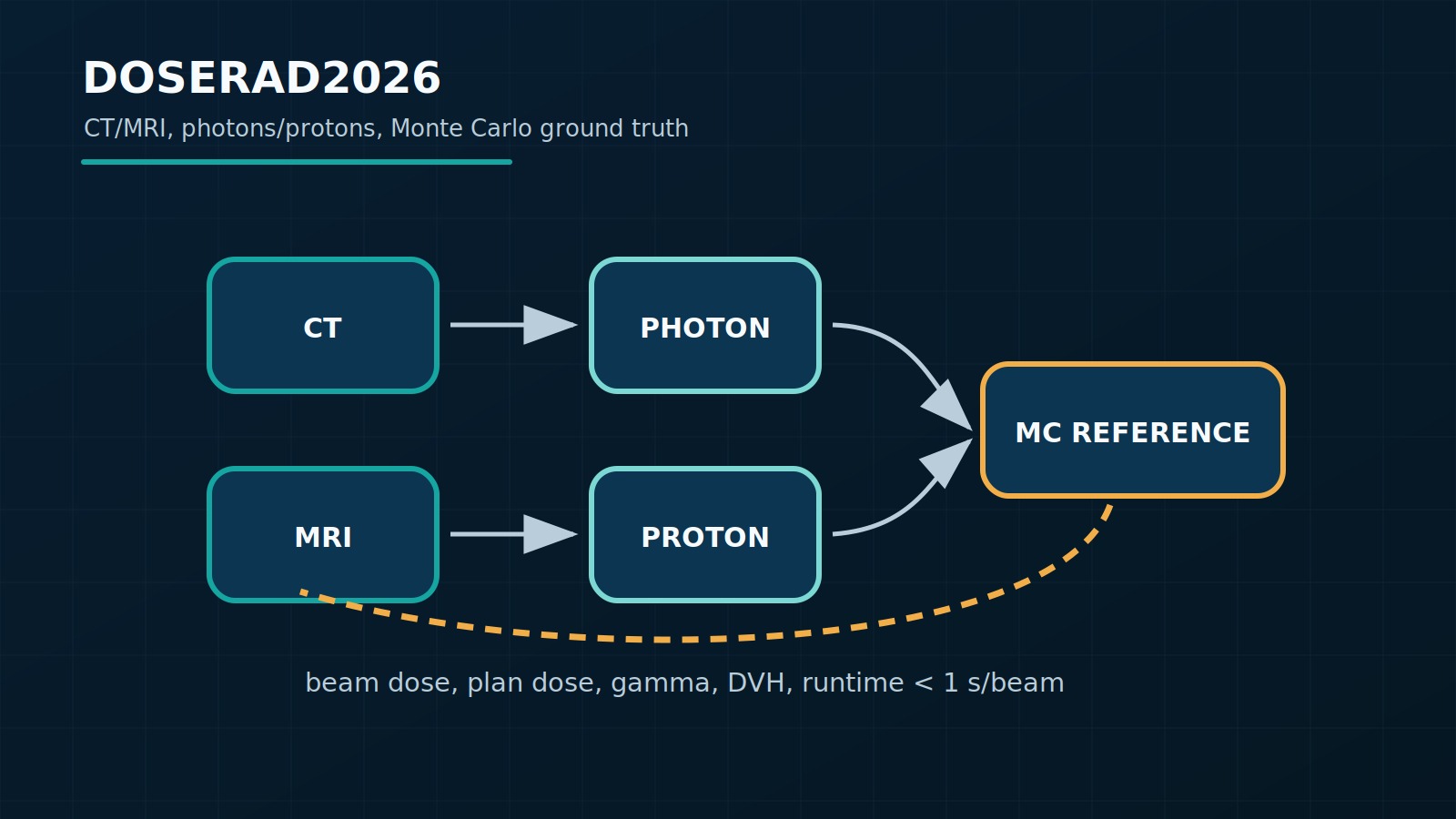
What the challenge asks for
- Photon dose on CT, relevant to VMAT and conventional planning.
- Photon dose on MRI, relevant to MR-Linac and online adaptive radiotherapy.
- Proton dose on CT, where range error can change clinical interpretation.
- Proton dose on MRI, connecting MRI-only workflows and MRI-guided proton research.
Each task receives a 3D image and beam specification. Photon beams are VMAT-like control-point segments with MLC, gantry and isocenter information. Proton beams are pencil beam spots with position, energy and geometry.
Why Monte Carlo is the ground truth
The Monte Carlo radiotherapy article explains the physics: MC models particle transport with high fidelity, but computational cost still limits workflows that need near-real-time response. DoseRAD2026 uses MC as the reference to test whether fast methods can approximate that physics with acceptable error.
That does not mean that every model trained against MC is clinically approved. It means the evaluation target is stronger than only comparing against human-approved plans or a specific analytical TPS engine.
Dataset and scale
| Dimension | Description |
|---|---|
| Patients | 122 thoracic and abdominal cases with spatially aligned CT and MRI |
| Training | 75 patients released in April 2026 |
| Testing | 40 private patients until March 2030 and 7 private external patients |
| Photons | 40,500 training beam segments |
| Protons | 81,000 training beamlets |
| Reference | Beam-level Geant4 Monte Carlo dose, reported as dose-to-medium in Gy |
| License | CC BY-NC 4.0 for research and education, non-commercial |
Metrics that matter
The metrics page separates beam-level and plan-level evaluation. Beam-level metrics include masked mean absolute error in the high-dose region and integrated depth-dose curve distance. Plan-level metrics include stratified MAE, 3D local 1%/1 mm gamma, and a DVH-based clinical score.
The clinically interesting constraint is runtime. The challenge imposes an average limit below 1 second per beam, including loading and initialization, on an AWS g5 instance. That forces submissions to balance accuracy and speed.
What this changes clinically
- It separates fast-dose research from commercial AI-assisted planning tools.
- It connects directly to adaptive dose recalculation on CBCT and synthetic CT, where time and uncertainty matter.
- It exposes the difference between beamlet/segment dose prediction and a clinically approvable treatment plan.
- It reinforces that validation and QA must evaluate anatomy, beam geometry, material mapping, runtime, and DVH impact.
Interpretation risk
DoseRAD2026 is a benchmark, not a clinical authorization. It includes simplified linac and proton models, private test data, and challenge-specific submission rules. A winning method may be scientifically promising and still require engineering, regulation, cybersecurity, DICOM integration, and local validation before patient use.
FAQ
Does DoseRAD2026 use Monte Carlo data for training?
Yes. For each beam or beamlet, the dataset provides a Monte Carlo reference dose distribution, along with CT, MRI, and beam configuration files.
Does the challenge evaluate full plans?
Participants output individual beam dose maps; the evaluation also reconstructs complete plans using clinical weights to compute MAE, gamma, and DVH metrics.
Why are there MRI tasks?
MRI does not directly provide electron density. That creates a dose-calculation problem for MRI-only, MR-Linac, and adaptive workflows that must infer or bypass material information.
References
- DoseRAD2026 Grand Challenge. https://doserad2026.grand-challenge.org/
- DoseRAD2026 dataset. https://doserad2026.grand-challenge.org/data/
- DoseRAD2026 metrics and ranking. https://doserad2026.grand-challenge.org/metrics-and-ranking/
- DoseRAD2026 rules. https://doserad2026.grand-challenge.org/timeline-and-rules/
- DoseRAD2026 Hugging Face dataset. https://huggingface.co/datasets/LMUK-RADONC-PHYS-RES/DoseRAD2026
- DoseRAD2026 Zenodo DOI. https://doi.org/10.5281/zenodo.19347848
- DoseRAD2026 dataset paper. https://doi.org/10.48550/arXiv.2604.12778