
There is a contemporary temptation to treat Pencil Beam as if it were just an old algorithm waiting to be replaced by something better. This reading is lazy. Pencil Beam was not just a preliminary stage in the TPS story. It was an extremely intelligent solution to a real clinical problem: how to calculate doses quickly enough for planning to become practicable.
If today it makes sense to point out his limits, this is only possible because he brilliantly solved the previous generation of the problem. The mistake is in forgetting one half or another of the story. Exalting Pencil Beam too much erases its limits in heterogeneity. Dismissing it as “outdated” erases the conceptual importance it had for the entire subsequent evolution of trading algorithms.
This article starts from this double obligation: to recognize why the method was revolutionary and to explain precisely where its hypotheses begin to fail in modern clinical practice.
In this Article
- 1. What Pencil Beam tries to do
- 2. Why it was revolutionary
- 3. Why he was so convincing for so long
- 4. Where elegance lives and where limitation lives
- 5. Longitudinal heterogeneity versus lateral heterogeneity
- 6. Why lung is such a bad scenario for this family
- 7. The relationship with the algorithms that came after
- 8. Small fields: where simplification starts to take a toll
- 9. The problem of false security in “almost homogeneous” cases
- 10. The problem is not just the beam, it is the algorithmic family
- 11. Where Pencil Beam is still useful as a reference
- 12. The most common reading error today
- 13. A fair way to summarize its position today
- 14. Conclusion
- 15. The conceptual legacy that was left behind
- 16. Frequently asked questions
- 17. References
- 18. Continue reading
What Pencil Beam tries to do
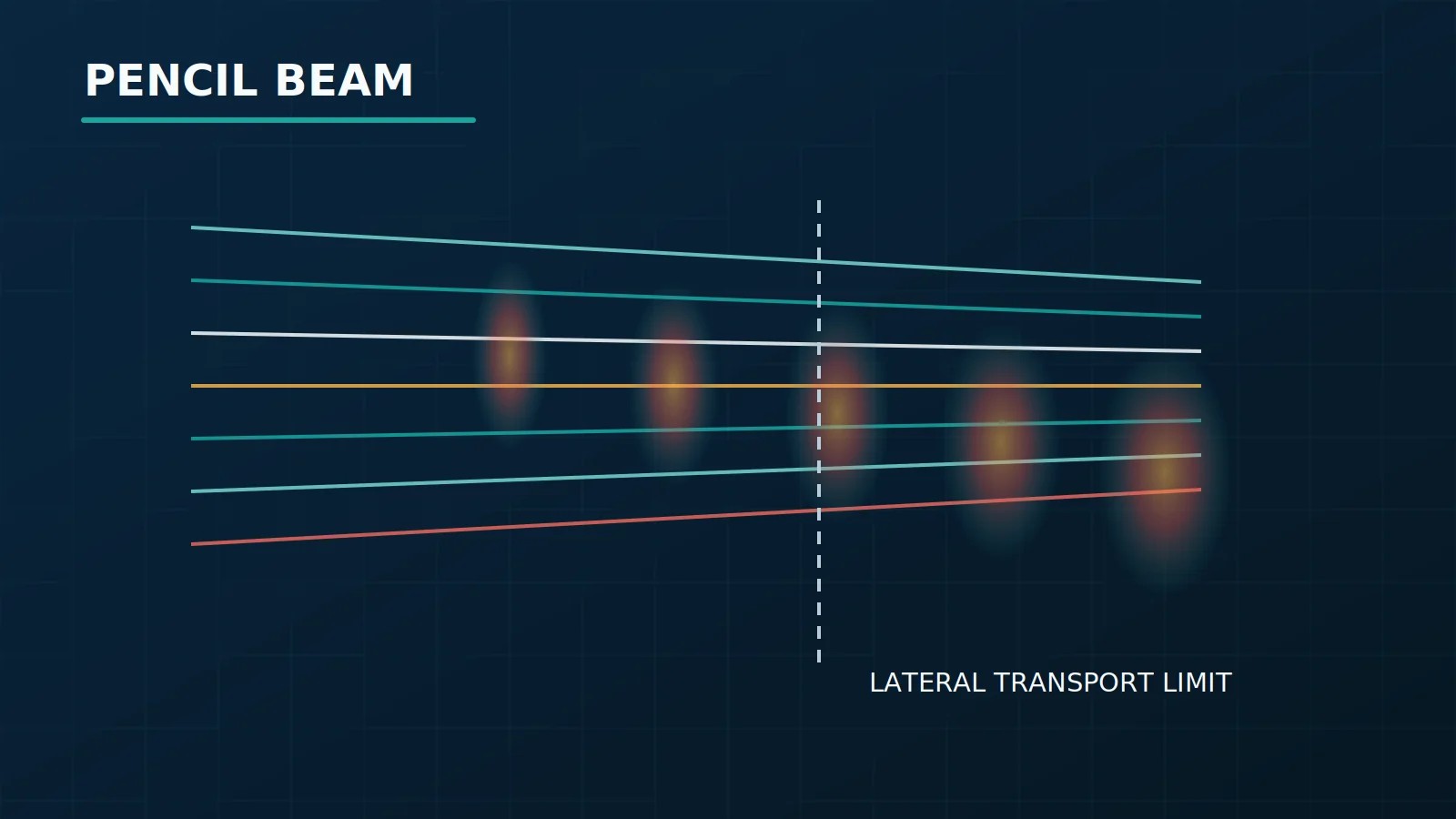
The fundamental idea is simple and elegant. Instead of treating the entire radiation field as a single object, the algorithm decomposes the wide beam into many narrow beams, or pencil beams. The total dose at a point is then obtained by summing the contributions of all these small elements.
This logic can be read as a simplified form of superposition. In editorial terms, the idea is close to something like:
Or, in a continuous formulation closer to the superposition language:
In the practice of Pencil Beam, this three-dimensional integral is simplified by hypotheses that allow us to better separate the problem along the beam axis and in the lateral plane.
This decomposition was the secret of his success. It made the problem numerically manageable long before clinical routine could absorb much heavier engines.
Why it was revolutionary
Pencil Beam was revolutionary for at least four reasons.
1. Speed
It brought calculation times compatible with the clinical flow at a time when computational cost was a much more severe bottleneck than today.
2. Modularity
By decomposing the field into smaller units, the algorithm allowed the beam description to be organized in a more controllable way.
3. Integration with measured data
Much of the strength of the method came from the ability to adapt kernels and profiles to machine commissioning data.
4. Enabling modern planning practice
Without methods from this family, the transition from more empirical planning to quantitative and iterative planning would have been much slower.
This is why treating Pencil Beam just as an “old algorithm” is missing the historical dimension of the problem. He created conditions for the clinic to depend on large-scale dose calculation.
Why he was so convincing for so long
Part of the historical strength of Pencil Beam It didn’t just come from speed. It also came from the feeling of clinical stability. In relatively homogeneous geometries, with non-extreme fields and without aggressive lateral heterogeneities, the algorithm delivered predictable responses, integrated well with commissioning data and allowed a very efficient planning flow.
This helps explain why many services have relied on it for years without immediately feeling the need to migrate. The algorithm did not fail in every situation; it worked well enough over a wide range of the routine at the time.
This nuance matters because it avoids a simplistic reading of the story. Pencil Beam did not survive due to inertia. He survived because, within the territory in which his hypothesis was appropriate, he was operationally very strong.
Where elegance lives and where limitation lives
The same structure that gave strength to Pencil Beam defines its limitation. The method is especially efficient when the main beam challenge can be addressed along the depth, with a relatively controlled lateral description. This works very well under reasonably homogeneous conditions.
The problem appears when the dominant phenomenon stops being just “how the beam weakens along the axis” and becomes “how the dose reorganizes laterally after crossing a heterogeneity”.
This is where elegance becomes fragility.
Longitudinal heterogeneity versus lateral heterogeneity
This distinction is probably the most important for understanding Pencil Beam.
What it does relatively well
It tends to deal well with corrections linked to radiological depth. If the medium changes along the beam axis, it is still possible, to some extent, to rewrite the path in terms of water equivalent.
What it does badly or does badly early
It suffers when heterogeneity changes the lateral transport of secondary particles. These include:
- lung;
- air cavities;
- soft tissue reentry;
- bone-tissue interfaces;
- small fields.
In simple terms: Pencil Beam tends to see the problem better in depth than in the three-dimensional space around the beam.
Why lung is such a bad scenario for this family
Pulmão é o grande exemplo porque junta baixa densidade com forte impacto lateral no transporte eletrônico. Em baixa densidade:
- a penumbra se alarga;
- o equilíbrio eletrônico muda;
- a distribuição lateral deixa de se comportar como no tecido aproximadamente água-equivalente.
O handbook utilizado neste cluster é bastante claro ao dizer que algoritmos de pencil beam não conseguem tratar corretamente o transporte de elétrons secundários em meios heterogêneos e, por isso, não accountam adequadamente certos efeitos em pulmão.
É exatamente essa limitação que motivou o avanço para métodos de convolução/superposição e depois para collapsed cone, AAA, Acuros XB and Monte Carlo.
The relationship with the algorithms that came after
It is tempting to imagine a straight line in which Pencil Beam was simply replaced by better algorithms. The real story is more interesting.
AAA
AAA continues to use the logic of beamlets, which shows how the Pencil Beam idea remained alive. The difference is that it enriches this logic with:
- multi-component modeling of the source;
- kernels derived from Monte Carlo;
- anisotropic treatment of heterogeneity;
- better description of lateral scattering.
Collapsed cone
CCC starts from a stronger convolution/superposition logic and tries to preserve the relevant three-dimensional transport at a viable cost. It is, in many ways, a direct response to Pencil Beam ‘s limitations on heterogeneities.
Acuros and Monte Carlo
These methods go even further, because they shift the problem formulation to explicit transport, either by deterministic solution of the LBTE, or by stochastic simulation.
The important point here is that evolution does not negate Pencil Beam. It explains where its central hypothesis fails to suffice.
Small fields: where simplification starts to take a toll
Even apart from dramatic heterogeneities, small fields already put significant pressure on the Pencil Beam.
family When the field becomes small:
- penumbra occupies a larger fraction of the field;
- electronic balance becomes more delicate;
- any lateral simplification becomes more visible;
- collimation modeling starts to weigh more.
This helps explain why Pencil Beam can look acceptable in conventional geometries and quickly lose strength when the context changes to:
- SRS;
- SBRT;
- small targets in lung;
- irregular and strongly modulated fields.
The problem of false security in “almost homogeneous” cases
One of the risks of Pencil Beam is precisely that it works sufficiently convincingly in many intermediate cases. This can create false security in situations that seem only mildly heterogeneous, but where lateral physics has already started to matter more than the user realizes.
Classic examples include:
- thoracic lesions not very small but surrounded by lung;
- regions close to air cavities;
- oblique fields in fabric-mixed geometries;
- arrangements where DVH appears stable but local distribution is not.
This is an important reason to study the algorithmic family, not just the local usage history. Just because a service has used the method without apparent problems for a long time does not mean it was equally robust in all scenarios.
The problem is not just the beam, it is the algorithmic family
Many historical comparisons show that the difference between Pencil Beam and more modern methods do not appear uniformly in all cases. This sometimes leads to the simplistic conclusion that “it still works well in many patients, so the criticisms are exaggerated.”
This conclusion misses the point. The problem is not that Pencil Beam fails in all cases. The problem is that your algorithmic family carries a predictable structural limitation:
when the lateral transport of secondary particles matters a lot, the approximation ceases to be robust.
This predictability is precisely why modern clinics have come to value convolution/superposition algorithms and then explicit transport.
Where Pencil Beam is still useful as a reference
Even though it is no longer the primary choice for many modern contexts, Pencil Beam remains useful in at least three ways.
1. Historical and conceptual reference
Without understanding its logic, it is more difficult to understand why AAA and other methods based on beamlets were so influential.
2. Pedagogical comparison
It helps to show the resident or physicist in training what exactly improves when moving to more physical algorithms.
3. Critical reading of literature and clinical legacy
Many historical data, old systems and even certain legacy service decisions still bear the mark of Pencil Beam. Knowing him helps to interpret this legacy more honestly.
The most common reading error today
The most common error today is twofold:
- or the method is treated as if it were still sufficient for any modern scenario;
- or is treated as if he has nothing left to teach.
Both readings are wrong.
If the case involves strong heterogeneity, difficult interfaces, small fields and important lateral physics, Pencil Beam is clearly no longer competitive against more modern algorithms.
But if the discussion is about the genealogy of commercial algorithms and what made planning clinically possible, Pencil Beam remains the centerpiece of the story.
A fair way to summarize its position today
A technically fair way to summarize the place of Pencil Beam in contemporary radiotherapy is this:
it was revolutionary because it made dose calculation clinically viable on a large scale; it has become insufficient in several modern scenarios because the clinic has started to demand better treatment of lateral transport and heterogeneities.
This phrase avoids both nostalgia and technical contempt.
Conclusion
Pencil Beam was a brilliant solution for its time and remains a fundamental idea for understanding the evolution of trading algorithms. Its merit lies in having transformed dose calculation into a viable clinical tool. His limit lies in having been born into a world in which the lateral physics of heterogeneity could still, to a certain extent, be simplified.
Today, radiotherapy requires more than this in many scenarios. Lung, air-tissue interfaces, bone, small fields and highly modulated techniques expose precisely the part of the problem that Pencil Beam tends to see worse.
This is why the later history of TPS did not abandon its basic logic of decomposition into smaller units, but began to enrich it or replace it with more physical families. Understand the Pencil Beam correctly, therefore, it is not an exercise in archeology. It’s the best way to understand why algorithms like AAA, collapsed cone, Acuros XB and Monte Carlo needed to exist.
The conceptual legacy that was left behind
Perhaps the best way to do justice to Pencil Beam is to recognize that almost all the algorithms that came after it dialogue with it, even when they surpass it. The idea of decomposing the beam, organizing local contributions and reconstructing the dose by superposition has not disappeared. She was being enriched.
AAA, for example, still works with beamlets, but inserts anisotropic kernels and much richer source modeling. In other words: Pencil Beam ‘s intuition survived, but its physics was expanded.
This legacy is the best proof that the method was more than a provisional stepping stone. He was a foundation.
Frequently asked questions
Is Pencil Beam still suitable for modern planning?
It depends on the scenario and implementation. It can be useful in nearly homogeneous geometry, but lung, air cavities, interfaces, and small fields usually favor algorithms with more complete lateral transport.
Why does it fail more often in lung?
Low density increases the lateral range of secondary electrons and promotes loss of electronic equilibrium. Mainly longitudinal corrections cannot fully represent that redistribution.
Are Pencil Beam and AAA the same algorithm?
No. Both may decompose the beam into narrow elements, but AAA uses richer source modeling and anisotropic kernels. AAA therefore remains a separate canonical article.
Does field size change the error?
Yes. Smaller fields increase the relevance of lateral disequilibrium and dependence on the source model, detector, and commissioning.
Does the method still have educational value?
Yes. It exposes the approximations that later algorithms were designed to address and helps interpret legacy systems and literature.