
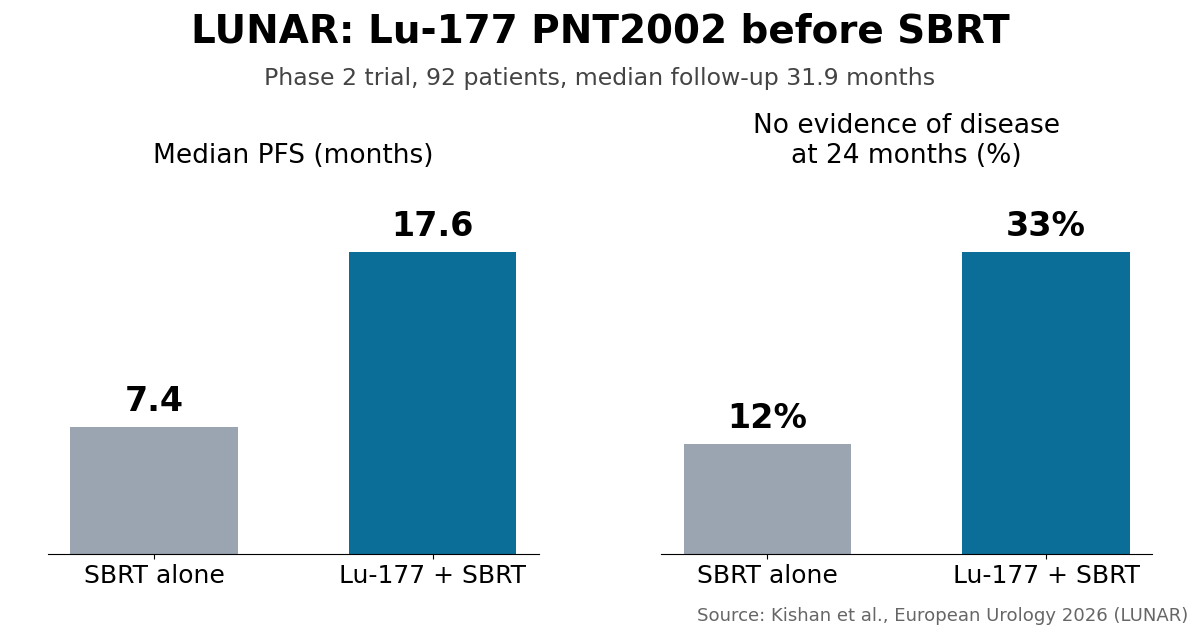
Giving lutetium-177 PNT2002 before SBRT more than doubled the time to disease progression in men with oligorecurrent hormone-sensitive prostate cancer, and the benefit held with almost three years of follow-up. The updated phase 2 LUNAR trial from the University of California, Los Angeles (UCLA), published October 12 in European Urology, reports a median progression-free survival (PFS) of 17.6 months with the combination versus 7.4 months with stereotactic body radiotherapy alone. At 24 months, 33% of patients in the combination arm had no evidence of disease, compared with 12% in the SBRT arm.
What LUNAR tested and what the update adds
LUNAR (NCT05496959) is a single-center, open-label randomized trial led by radiation oncologist Amar Kishan and nuclear medicine physician Jeremie Calais. Between September 2022 and November 2023, 92 men with PSMA PET/CT-detected oligorecurrent disease and one to five lesions amenable to SBRT were randomized 1:1. One group (47 patients) received SBRT to all lesions alone; the other (45) first received two cycles of 177Lu-PNT2002 at 6.8 GBq each, two weeks apart, followed by the same SBRT. Randomization was stratified by stage (N1/M1a vs. M1b) and lesion count.
The primary endpoint, PFS, counted new lesions on PSMA PET/CT, initiation of salvage hormonal therapy, or death as events. PET was repeated at PSA progression and/or 12 months after SBRT. The first analysis, published in the Journal of Clinical Oncology in late 2025 at a median follow-up of 22 months, had already shown the benefit (hazard ratio 0.37) without added toxicity: the only grade 3 events were lymphopenia, in two patients in the SBRT arm and three in the combination arm.
The new analysis extends median follow-up to 31.9 months and turns to secondary and exploratory endpoints closer to what matters clinically. According to the paper’s abstract:
- PFS: median 17.6 vs. 7.4 months (HR 0.38; 95% CI 0.23-0.61; p<0.001);
- hormonal therapy-free survival: HR 0.57 (95% CI 0.34-0.95; p=0.03);
- polymetastatic PFS (exploratory): HR 0.28 (95% CI 0.08-1.03; p=0.04);
- castration-resistant disease-free survival (exploratory): HR 0.13 (95% CI 0.02-1.10; p=0.03);
- conventional imaging PFS (exploratory): HR 0.46 (95% CI 0.19-1.09; p=0.07).
No new safety signals emerged. The authors write that the combination kept showing a PFS and hormone therapy-free survival benefit, and describe the gains in exploratory endpoints as hypothesis-generating evidence that the radioligand may alter the course of disease rather than merely postpone the next PET-visible lesion.
Technical context: oligorecurrence, PSMA PET and PNT2002
Oligorecurrence means disease returning at a few sites (up to five in LUNAR) after treatment of the primary tumor, in a patient who is still castration-sensitive. Treating only those lesions, so-called metastasis-directed therapy, gained traction from two phase 2 trials. In the Belgian STOMP trial, metastasis-directed therapy (surgery or SBRT) delayed androgen deprivation compared with surveillance (median 21 vs. 13 months). In the US ORIOLE trial, SBRT cut progression at six months from 61% to 19% versus observation. We reviewed that body of evidence in SBRT in oligometastatic and oligoprogressive cancer.
The catch is that most of these patients progress again, usually with new lesions outside the treated fields, a sign of microscopic disease no scan picked up. That is where the radioligand comes in. PNT2002 is 177Lu-PSMA-I&T, a different molecule from 177Lu-PSMA-617 (vipivotide tetraxetan, Novartis’ Pluvicto), although both target the same antigen and carry the same beta emitter. It was developed by POINT Biopharma, acquired by Eli Lilly in 2023, and licensed to Lantheus for commercialization. Its registration trial, SPLASH, is in castration-resistant disease; in the LUNAR setting, use is investigational. The rationale is straightforward: SBRT delivers ablative dose to visible lesions, while systemic lutetium reaches subclinical PSMA-expressing deposits. For those following the lutetium market, the radionuclide already has generic versions in other indications, as we covered when the FDA approved Bravnetsa.
Why PSMA PET-driven PFS is a debated endpoint
The UCLA group itself acknowledges that the initial result was driven by new lesions on PSMA PET. That endpoint is sensitive but contestable: PET picks up small foci that might never change treatment or survival, and scan timing influences when progression is recorded. That is why the protocol prespecified harder endpoints, such as time to hormonal therapy, polymetastatic progression and castration resistance. That these signals point the same way adds consistency. Still, in the two exploratory endpoints with p below 0.05 the hazard ratio confidence interval crosses 1, reflecting the small number of events. These are data to design the next trial, not to change practice.
Implications for radiation oncology and medical physics
For a radiotherapy department, the combination adds steps to the workflow. SBRT is planned after two cycles of lutetium, by which time lesions may have shrunk or lost uptake; whether the target volume comes from the baseline PET or a restaging scan is a decision the protocol must make explicit. Fusing PSMA PET/CT with the planning CT, with margins consistent with registration uncertainty in bone and lymph nodes, remains central. Then there is the question of combined dose: radioligand absorbed dose in lesions and organs at risk such as salivary glands, kidneys and marrow can be estimated with post-therapy SPECT/CT, but summing it with SBRT dose is not trivial, since dose rates and radiobiology differ. For medical physicists, post-therapy dosimetry and systematic recording of those data are the way to understand the interaction, although the LUNAR abstract does not report such an analysis.
In Brazil and across Latin America, adoption runs into logistics. PSMA PET is concentrated in private and academic centers, lutetium-PSMA therapy depends on licensed nuclear medicine services and reimbursement, and PNT2002 itself is not approved for this use. Coordination between radiation oncology and nuclear medicine, however, can be built now. The topic connects with the debate on SBRT in localized prostate cancer, as in PACE-A, and with the growing diagnostic role of PSMA PET, which we discussed in our story on PSMA PET/CT-guided biopsy.
Limitations and next steps
LUNAR is small, single-center and open-label, and PET reads may have been influenced by knowledge of treatment arm. Overall survival cannot yet be assessed: the trial plans follow-up of up to 60 months, with primary completion estimated for September 2032. The authors also stress that not every oligorecurrent patient is likely to need systemic intensification on top of SBRT, and that PSMA PET should help select those who benefit. As they put it, further studies will show whether these outcomes can be replicated or improved upon, which in practice means a multicenter phase 3 trial.
Source: AuntMinnie and Kishan et al., European Urology 2026