
The FDA has granted final approval to Lantheus’ Bravnetsa (lutetium Lu 177 dotatate) for adults with somatostatin receptor-positive gastroenteropancreatic neuroendocrine tumors (GEP-NETs), including foregut, midgut and hindgut tumors. What makes the decision matter for all of nuclear medicine is the regulatory route: the product was cleared through an ANDA (Abbreviated New Drug Application), the generic pathway, after the agency judged it bioequivalent and therapeutically equivalent to Lutathera. Lantheus says it is the first radioligand therapy approved this way in the United States.
What was approved, and when
Bravnetsa, known in development as PNT2003, received tentative approval from the FDA in March 2026. A tentative approval means the product met the technical requirements but was still blocked by intellectual property protecting the reference drug. According to Lantheus, full approval depended on the end of a 30-month stay triggered by Hatch-Waxman patent litigation, which expired in June 2026. Final approval was announced on September 22.
The label mirrors Lutathera’s adult labeling with one exception: the pediatric indication approved for the reference product is excluded, because Advanced Accelerator Applications (Novartis) still holds marketing exclusivity for it. The recommended cumulative dose is 29.6 GBq, and the company lists class warnings that nuclear medicine teams already know: myelosuppression, secondary myelodysplastic syndrome and leukemia (2.3% in NETTER-1), renal toxicity, embryo-fetal toxicity, and temporary or permanent infertility from the absorbed dose to the gonads.
Lantheus puts the US GEP-NET population at roughly 200,000 patients and notes that up to half are initially misdiagnosed, with an average of 4.3 years from symptom onset to diagnosis. Launch timing and price were not disclosed; chief executive Mary Anne Heino described a “thoughtful” launch centered on reliable supply.
The clinical foundation: NETTER-1 and NETTER-2
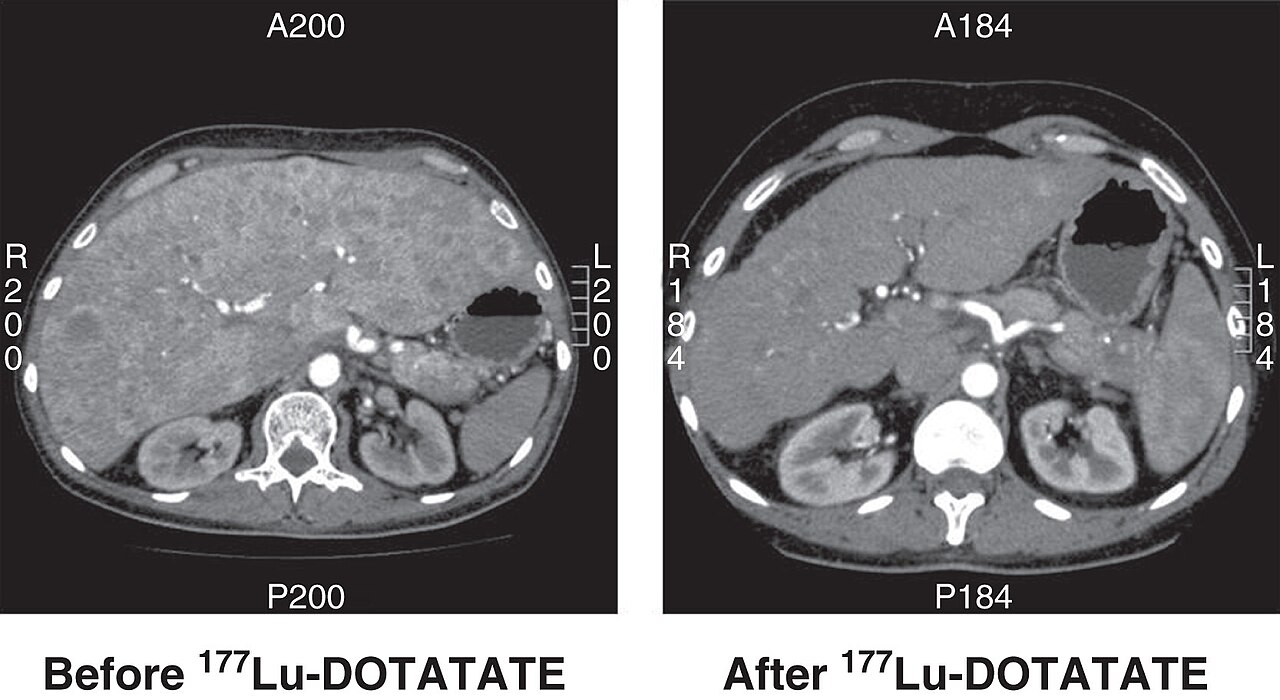
As an ANDA product, Bravnetsa did not need its own efficacy trial; it relies on the evidence behind Lutathera. That evidence comes mainly from NETTER-1, which randomized 229 patients with progressive, receptor-positive midgut NETs to 177Lu-DOTATATE plus octreotide LAR or to high-dose octreotide LAR. The risk of progression or death fell by about 79% (progression-free survival HR 0.21), and objective response was 18% versus 3%. In the final analysis, median overall survival was 48.0 versus 36.3 months (HR 0.84), a difference that did not reach statistical significance, partly because many control patients later crossed over to PRRT.
NETTER-2, published in The Lancet in 2024, moved treatment to the first line for grade 2 and 3 GEP-NETs with higher Ki-67 and showed median progression-free survival of 22.8 months versus 8.5 months with high-dose octreotide. Bravnetsa prescribing rests on this body of data, not on a new study.
How PRRT works in practice
The standard peptide receptor radionuclide therapy (PRRT) schedule is 7.4 GBq (200 mCi) every 8 weeks for four cycles, with octreotide LAR 30 mg between treatments. Each infusion is paired with an amino acid solution (lysine and arginine) to limit tubular reabsorption of the peptide and protect the kidneys, which, along with bone marrow, are the dose-limiting organs.
Patient selection is image-driven. Somatostatin receptor PET with 68Ga-DOTATATE, 68Ga-DOTATOC or 64Cu-DOTATATE confirms that lesions express the receptor, with uptake at least comparable to liver. It is the most established example of theranostics: one molecular target guides both diagnosis and therapy. Tumors with low receptor expression, or with dominant FDG-avid, receptor-negative disease, tend to respond poorly.
Lutetium-177 has a physical half-life of 6.65 days, emits beta particles with a mean tissue range below 1 mm, and gamma photons at 113 and 208 keV. The gamma emission allows SPECT/CT after each cycle, which makes individualized dosimetry possible, with absorbed doses to kidneys and lesions calculated instead of giving everyone the same fixed activity. Most centers still use fixed activity, but post-therapy dosimetry is one of the busiest areas of medical physics in radiopharmaceuticals. On the radiation safety side, excretion is predominantly urinary in the first hours, which shapes decisions on admission or release, toilet hygiene and close-contact precautions over the following days.
What a radiopharmaceutical “generic” means
Under an ANDA, the manufacturer must show the same active ingredient, route, dosage form, strength and labeling as the reference product, plus bioequivalence. For a radiopharmaceutical that means characterizing the labeled molecule, radiochemical purity, specific activity and impurity profile. The therapeutic equivalence determination is what lets the product be treated as a substitute for the original.
One technical point that matters to nuclear medicine departments is how the lutetium-177 is produced, since some routes leave a 177mLu impurity with a half-life of about 160 days, which affects waste management. The Lantheus announcement does not say which route Bravnetsa uses; that is worth checking in the label and with the supplier.
The market is being reshaped too. On September 14, the FDA approved Curium’s Bexlutry, another lutetium Lu 177 dotatate for the same population, through the 505(b)(2) pathway. And Curium is in the process of acquiring Lantheus itself, a deal we have covered here that still needs a shareholder vote and regulatory clearance. For Novartis, whose Lutathera booked $225 million in the second quarter of 2026 alone, that is two direct competitors within weeks.
Implications and open questions
For US patients, competition should mean more supply and possibly pressure on price and on the logistics of a short-lived product made to order and shipped as a patient dose. For the field, the precedent matters more than the product: a tested generic pathway opens the door for other radioligands as their patents expire, and the theranostics agenda that dominated SNMMI 2026 now includes price and access, not just efficacy. Lantheus has also been broadening its portfolio on several fronts, as its recent tau PET approval showed.
Outside the US, the FDA decision has no direct effect. In Brazil, for example, any product needs its own Anvisa registration, although PRRT with 177Lu-DOTATATE is already delivered at Brazilian nuclear medicine centers and a 2022 constitutional amendment relaxed the state monopoly on medical radioisotopes, widening room for private production and distribution. Because the therapy requires tight coordination among nuclear medicine, oncology, medical physics and radiation protection, it also feeds the debate on the role of radiation oncology in radiopharmaceutical therapy.
It remains to be seen whether Bravnetsa actually lowers costs or simply redistributes market share, and how a combined Curium-Lantheus will handle two equivalent products in one portfolio. None of this changes clinical practice: the indication, selection by somatostatin receptor PET, the four-cycle schedule and dose precautions all stay the same.
Source: Diagnostic Imaging