
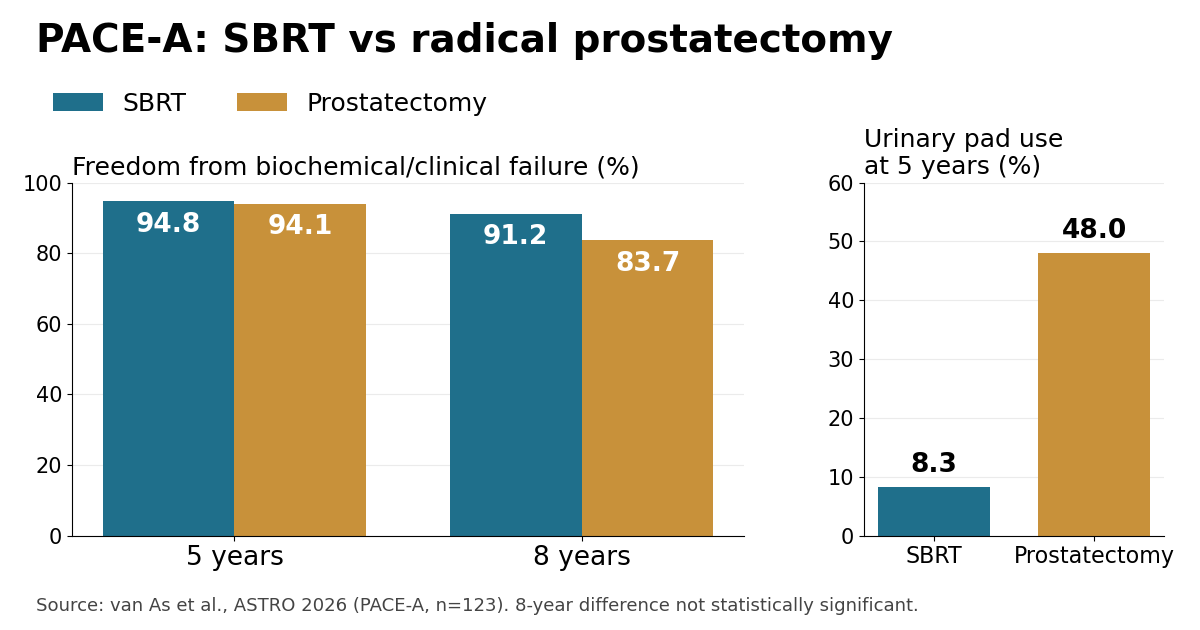
SBRT for localized prostate cancer delivered biochemical control equivalent to radical prostatectomy for up to eight years while causing far less urinary incontinence, according to long-term results of the phase 3 PACE-A trial presented in a plenary session at the ASTRO Annual Meeting in Boston (September 26-30, 2026). At five years, 94.8% of patients treated with stereotactic body radiotherapy were free from biochemical or clinical failure versus 94.1% in the surgical group, and only 8.3% of irradiated men used urinary pads compared with 48% after surgery.
What PACE-A showed at ASTRO 2026
PACE-A is the surgical arm of the PACE program (Prostate Advances in Comparative Evidence), led by the Royal Marsden Hospital and the Institute of Cancer Research in London. The trial randomized 123 men with low- or intermediate-risk disease to SBRT (63) or radical prostatectomy (60) across eight centers. Median age was 65.5 years and median PSA was 7.9 ng/mL; androgen deprivation therapy was not allowed, which isolates the effect of the local modality. The results were presented by Nicholas van As, medical director of the Royal Marsden.
Beyond the 94.8% versus 94.1% five-year figures, freedom from biochemical or clinical failure at eight years was 91.2% with SBRT and 83.7% with surgery, a difference that did not reach statistical significance. The incontinence finding stands out: an absolute gap of almost 40 percentage points in the use of at least one pad per day at five years. Grade 0-1 gastrointestinal toxicity was comparable, with a single grade 2 or higher event in the SBRT arm; on the genitourinary side there was one grade 2+ case after surgery and two after SBRT.
Speaking at an ASTRO press briefing, van As said both strategies achieved excellent biochemical control and argued that every patient considering prostatectomy should be given information about SBRT before deciding. The message is aimed at referral pathways: in many health systems, the first specialist a patient sees is the urologist.
Two-year quality-of-life results had already appeared in European Urology in 2024: 50% of surgical patients and 6.5% of SBRT patients used one or more pads daily; sexual function was better after SBRT, while bowel scores were slightly better after surgery. The 2026 presentation adds the long-term oncologic outcome that the comparison was missing.
The PACE family: PACE-B and PACE-C
PACE-A sits alongside two much larger trials. PACE-B, published in the New England Journal of Medicine in 2024, randomized 874 patients at 38 centers to SBRT at 36.25 Gy in five fractions or to conventional (78 Gy in 39 fractions) or moderately hypofractionated (62 Gy in 20 fractions) radiotherapy. At a median follow-up of 74 months, five-year freedom from failure was 95.8% with SBRT and 94.6% with control treatment, confirming noninferiority. The trade-off was a higher incidence of late grade 2 or higher genitourinary toxicity (26.9% vs 18.3%), with no gastrointestinal difference.
PACE-C, published in Lancet Oncology in 2025, moved to intermediate- and high-risk patients receiving six months of hormone therapy, comparing 60 Gy in 20 fractions with 36.25 Gy in five fractions plus a mandatory 40 Gy CTV target. Among 1,208 randomized men, acute RTOG grade 2+ toxicity was similar (genitourinary 27% vs 28%; gastrointestinal 11% vs 13%). PACE-C efficacy data are not yet mature.
Technical context: dose, margins and organs at risk
The 36.25 Gy in five fractions schedule, with internal escalation to about 40 Gy in the prostate, delivers a high biologically effective dose to a tumor with a low α/β ratio of around 1.5 Gy. The flip side is that the urethra, bladder neck and anterior rectal wall receive high doses per fraction, and small geometric errors matter more than over 39 fractions. PACE-derived protocols therefore combine 3-5 mm margins, strict rectal and bladder constraints and, in experienced centers, urethra-sparing techniques. For planning teams, our guide to prostate CTV delineation and IMRT is a useful refresher.
Image guidance is the critical piece. In PACE, treatment on a conventional linac required intraprostatic fiducial markers, while CyberKnife used real-time tracking. MR-guided radiotherapy now offers another route: in the randomized MIRAGE trial (JAMA Oncology, 2023), MR-guided SBRT with 2 mm margins cut acute grade 2+ genitourinary toxicity from 43.4% to 24.4% and gastrointestinal toxicity from 10.5% to zero compared with CT guidance. Hydrogel rectal spacers are part of the same conversation, as shown by the Olympus acquisition of BioProtect, and multiparametric MRI has gained weight in staging and target definition.
What it means for radiotherapy services, including Latin America
The logistical argument is strong: five sessions instead of 20 to 39 free up machine time, reduce travel for patients from remote areas and shorten waiting lists, which matters in Brazil and across Latin America. Yet the technique requires a linac with volumetric IGRT, a fiducial insertion workflow or MR simulation, small-field quality assurance and standardized protocols. A survey published in Cureus in 2026 of 37 radiation oncologists and physicists from 28 institutions in ten Latin American countries found that 59.5% used prostate SBRT, but mean concordance with PACE-B prescription parameters was only 36.2%, even on a homogeneous technology platform. In other words, the machine alone is not enough; protocols and QA must be harmonized.
PACE-A also reinforces the need for shared decision-making between urology and radiation oncology. Teams already treating metastases with extreme hypofractionation can build on their experience with SBRT in oligometastatic disease, but prostate planning has its own motion and bladder/rectal filling issues that require a dedicated routine. At the same meeting, ASTRO also released its first guideline on bladder preservation, another sign of momentum for radiotherapy in pelvic tumors.
Limitations and next steps
PACE-A is small: 123 patients, slow accrual between 2012 and 2022, and not everyone received the allocated treatment. It was designed with quality-of-life coprimary endpoints rather than tumor control, which limits the statistical power of the biochemical failure comparison; the numerical SBRT advantage at eight years should be read as no difference, not superiority. Biochemical failure is also defined differently after surgery and after radiotherapy. The ASTRO data are still conference results awaiting peer-reviewed publication. Even so, together with PACE-B and PACE-C, they form the strongest randomized evidence base yet available for prostate SBRT.
Source: Diagnostic Imaging