
The American Society for Radiation Oncology (ASTRO) released an updated guideline on hypofractionated radiation therapy for localized prostate cancer on October 27, 2026, replacing its 2018 recommendations. Two changes carry the message: moderate hypofractionation is now recommended over conventional fractionation in every risk group, and five-fraction stereotactic body radiation therapy (SBRT) moves from a hedged alternative to a standard option for low- and intermediate-risk disease.
The guideline appears in Practical Radiation Oncology and applies to men who choose definitive external beam radiation therapy. Its task force included radiation, medical and urologic oncologists, a medical physicist and a patient representative, working with ASCO, AUA, ESTRO and SUO.
What the new guideline recommends
The recommendations rest on a systematic review conducted by the U.S. Agency for Healthcare Research and Quality and organized around five key questions. According to ASTRO’s news release and the published abstract:
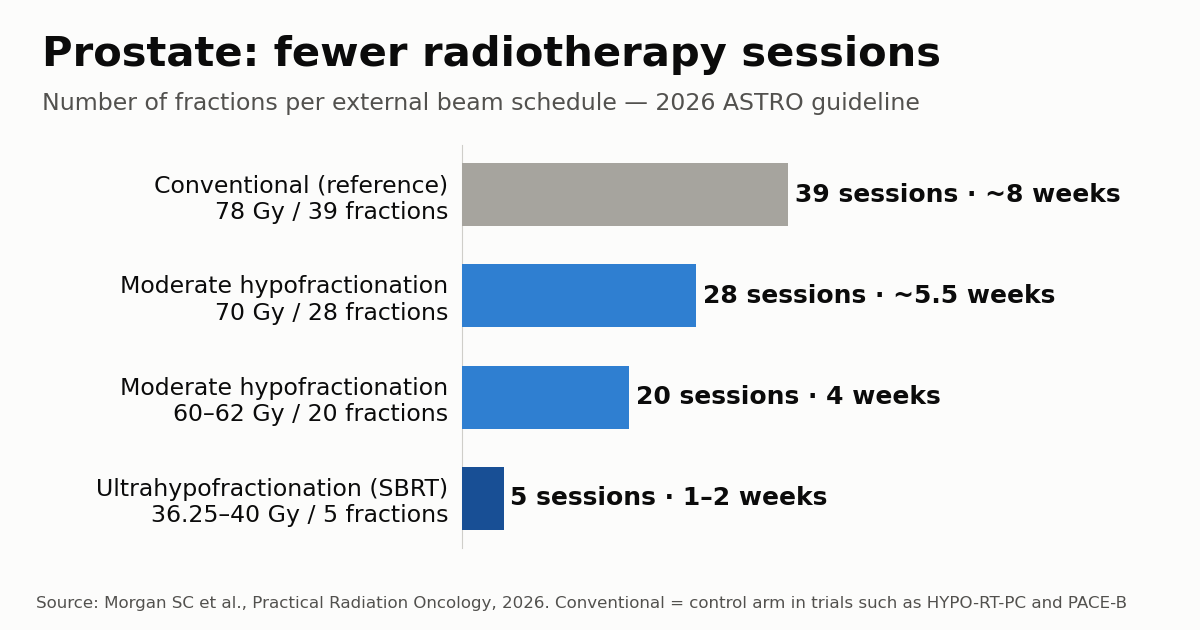
- Moderate hypofractionation for everyone. For treatment of the prostate with or without the seminal vesicles, moderate hypofractionation is recommended over conventional fractionation in all risk groups, regardless of age, comorbidity, anatomy or baseline urinary function. The task force cites randomized trials with more than 7,000 patients showing comparable cancer control, side effects and quality of life.
- Dose schedules. 60 to 62 Gy in 20 fractions or 70 Gy in 28 fractions for moderate hypofractionation; 36.25 to 40 Gy in five fractions for SBRT, as a conditional recommendation. Fewer than five fractions only on a clinical trial.
- SBRT by risk group. Recommended as an option for low-risk patients who decline active surveillance and for intermediate-risk patients treated to the prostate and seminal vesicles. For high-risk and very high-risk disease the recommendation is conditional, for selected patients and preferably within trials.
- Urinary symptoms. With significant baseline urinary symptoms, moderate hypofractionation is conditionally preferred over SBRT.
- Pelvic nodes. With elective nodal irradiation, moderate hypofractionation to the prostate plus concurrent conventional or near-conventional dosing to the pelvis in a single-phase plan. Elective nodal SBRT only on a trial.
- Hormone therapy. Androgen deprivation decisions are independent of the fractionation choice.
On target volumes, low-risk patients should have the prostate alone treated, with at least part of the seminal vesicles added as risk rises; a focal boost to an MRI-visible dominant lesion may be considered in selected cases. The document stresses IMRT, MRI-informed planning when appropriate, daily motion management and, for SBRT, intrafraction tracking (a conditional recommendation). Rectal spacers are framed as part of shared decision making.
“SBRT has moved from a promising alternative to a standard treatment option for many patients with localized prostate cancer,” said task force chair Scott C. Morgan, MD, of The Ottawa Hospital.
How it differs from the 2018 guideline
The 2018 ASTRO/ASCO/AUA guideline already offered moderate hypofractionation across risk groups. The shift is in SBRT: in 2018 it “may be offered” for low- and intermediate-risk disease as a conditional recommendation, with intermediate-risk patients ideally treated on a trial or registry. For high-risk disease, the panel conditionally recommended against routine use.
| Topic | 2018 guideline | 2026 guideline |
|---|---|---|
| Moderate hypofractionation | Offered across risk groups | Recommended over conventional fractionation across all risk groups |
| SBRT, low risk | May be offered (conditional) | Standard option |
| SBRT, intermediate risk | May be offered (conditional), ideally on a trial or registry | Standard option, treating prostate and seminal vesicles |
| SBRT, high risk | Conditional recommendation against routine use | Conditionally recommended in selected patients |
The trials behind the update
Moderate hypofractionation rests on large, mature trials. In the UK’s CHHiP trial of 3,216 men, 60 Gy in 20 fractions was noninferior to 74 Gy in 37 fractions (90.6% and 88.3% free of biochemical or clinical failure at five years). Canada’s PROFIT trial, with 1,206 intermediate-risk patients, reported 85% five-year failure-free survival with both 60 Gy in 20 fractions and 78 Gy in 39. RTOG 0415 established 70 Gy in 28 fractions in 1,115 low-risk men, with some increase in late toxicity.
For SBRT, the pivotal evidence came from PACE-B (New England Journal of Medicine, 2024): in 874 low- and intermediate-risk patients treated without hormone therapy, 36.25 Gy in five fractions was noninferior to control radiotherapy, with 95.8% and 94.6% failure-free at five years. The cost was urinary, with late grade 2 or higher genitourinary toxicity of 26.9% versus 18.3%, which helps explain the preference for moderate schedules in men who already have urinary symptoms. Against surgery, the PACE-A comparison of SBRT and prostatectomy added further support for five fractions.
NRG-GU005, published in JAMA in September 2026, adds nuance. In 698 intermediate-risk patients, SBRT reduced clinically meaningful bowel decline compared with moderately hypofractionated IMRT (34.9% vs 43.8%) but was not superior for three-year disease-free survival (88.6% vs 92.1%). The investigators call the SBRT prescription used modest; longer follow-up will matter.
Fewer fractions demand tighter technique
The rationale is radiobiological. Prostate cancer is unusually sensitive to fraction size (α/β estimates are low, commonly 1.5 to 2 Gy), so dose can be concentrated into fewer sessions without losing tumor control, provided the rectum and bladder are protected. With five fractions instead of 39, each session carries a far larger share of the dose, and a setup error that would wash out over a long course matters much more in a short one.
In practice, daily motion management usually means daily volumetric imaging, fiducial markers or transponders, bladder and rectal preparation and, at some centers, MR-guided radiotherapy; the release does not say which method the guideline prefers. Careful prostate and seminal vesicle CTV delineation matters more now that seminal vesicle coverage depends on risk, and prostate MRI helps define a dominant lesion for a possible boost. Rectal spacers are an option to discuss, not a requirement.
What it means for services in Brazil and Latin America
Prostate cancer is the most common tumor among Brazilian men outside non-melanoma skin cancer, according to the National Cancer Institute (INCA). For services with waiting lists, including Brazil’s public system, where Law 12,732/2012 sets a 60-day limit to start first treatment after diagnosis, the math is simple: moving from 39 sessions to 20 frees 19 linac slots per patient, and moving to five frees 34. Patients also travel less, which the guideline treats as an equity issue.
The gain is not linear, though. SBRT sessions tend to be longer, need stricter image verification and patient-specific quality assurance, and depend on well-defined protocols shared by medical physics, dosimetry and radiation oncology. Where a machine lacks adequate daily imaging or a way to monitor motion during delivery, moderate hypofractionation in 20 or 28 fractions is the natural step, and it is already the recommended standard for every risk group.
Limitations and what to watch
This article is based on ASTRO’s news release and the abstract indexed in PubMed; the full guideline, with dose constraints, margins and the evidence grade for each recommendation, was not openly accessible at the time of writing. The task force acknowledges that the role of SBRT in high-risk disease still depends on ongoing studies, as does the integration of advanced imaging and adaptive techniques. The document covers only definitive external beam treatment of localized disease; the release does not address post-prostatectomy or salvage radiotherapy.
The equity data come from the United States, with no specific analysis for Latin America. The update joins other recent ASTRO guidelines, such as those on bladder preservation and pancreatic cancer, and like them it supports shared decision making rather than replacing case-by-case clinical judgment.
Source: ASTRO — ASTRO updates guideline on shorter-course radiation therapy for localized prostate cancer; guideline: Morgan SC et al. Hypofractionated Radiation Therapy for Localized Prostate Cancer: An ASTRO Clinical Practice Guideline. Practical Radiation Oncology, 2026