
ASTRO has published an update to its clinical practice guideline on radiation therapy for pancreatic cancer in adults, replacing the 2019 document. It appeared August 13 in Practical Radiation Oncology and captures what genuinely changed over the past half-decade: radiation therapy now carries formal recommendations across resectable, borderline resectable, locally advanced, recurrent and oligometastatic settings, with explicit guidance on dose escalation, MR guidance and online adaptation.
Who wrote it, and on what evidence base
The task force was multidisciplinary by design: radiation, medical and surgical oncologists, plus a radiation oncology resident, a medical physicist and a patient representative. It was chaired by Daniel Chang, MD, FASTRO, professor and chair of radiation oncology at the University of Michigan, with Michael D. Chuong, MD, vice chair and medical director of radiation oncology at Baptist Health Herbert Wertheim Cancer Institute, serving as vice chair.
Recommendations came from a systematic review of literature published between 2010 and June 2026, and the document was developed in collaboration with ASCO, ESTRO and the Society of Surgical Oncology — a relevant detail, because a radiation indication in pancreatic cancer is rarely the radiation oncologist’s decision alone.
“Indications for the use of radiation therapy in treating pancreatic cancer have changed notably in the last several years,” Chang said. Chuong adds the practical point: “This guideline gives clinicians clearer direction about when radiation therapy is appropriate and how to integrate it safely with other treatments.”
What is recommended in each setting
The stratification is worth walking through, because recommendation strength varies considerably. In resectable disease, preoperative chemoradiation is conditionally recommended; postoperative chemoradiation is also conditionally recommended, limited to pN0 patients who did not receive preoperative therapy. In borderline resectable disease, preoperative radiation or chemoradiation is recommended to improve local control and the likelihood of a margin-negative resection — the language here is firmer.
For locally advanced disease, chemoradiation or radiation after chemotherapy is recommended as definitive treatment. The same holds for medically inoperable patients or those declining surgery. For isolated locoregional recurrence, definitive-intent radiation or chemoradiation is recommended; reirradiation enters as a conditional recommendation, always with careful dosimetric assessment — meaning reconstructed cumulative dose to duodenum, stomach and bowel, not an estimate from memory.
In the oligometastatic or oligoprogressive setting, the guideline conditionally recommends definitive-intent chemoradiation or radiation directed at metastatic lesions and the untreated primary tumor. That formally incorporates a practice that had been growing without guideline backing, a topic we detailed in reviewing what the evidence says about SBRT in oligometastatic disease. Finally, in palliative care, radiation is recommended for bleeding, pain and obstruction, and dose escalation is considered reasonable in selected cases for pain relief.
Technique: what the guideline demands in the room
This is the part that changes planning and commissioning. IMRT with daily image guidance is the standard delivery recommendation. Patient-specific respiratory motion assessment is a requirement, not a suggestion — which in practice means 4DCT, target excursion assessment, and a deliberate choice among abdominal compression, gating or breath-hold. Pancreas is among the worst abdominal targets in this respect: the tumor moves with respiration and the organs at risk move independently between fractions.
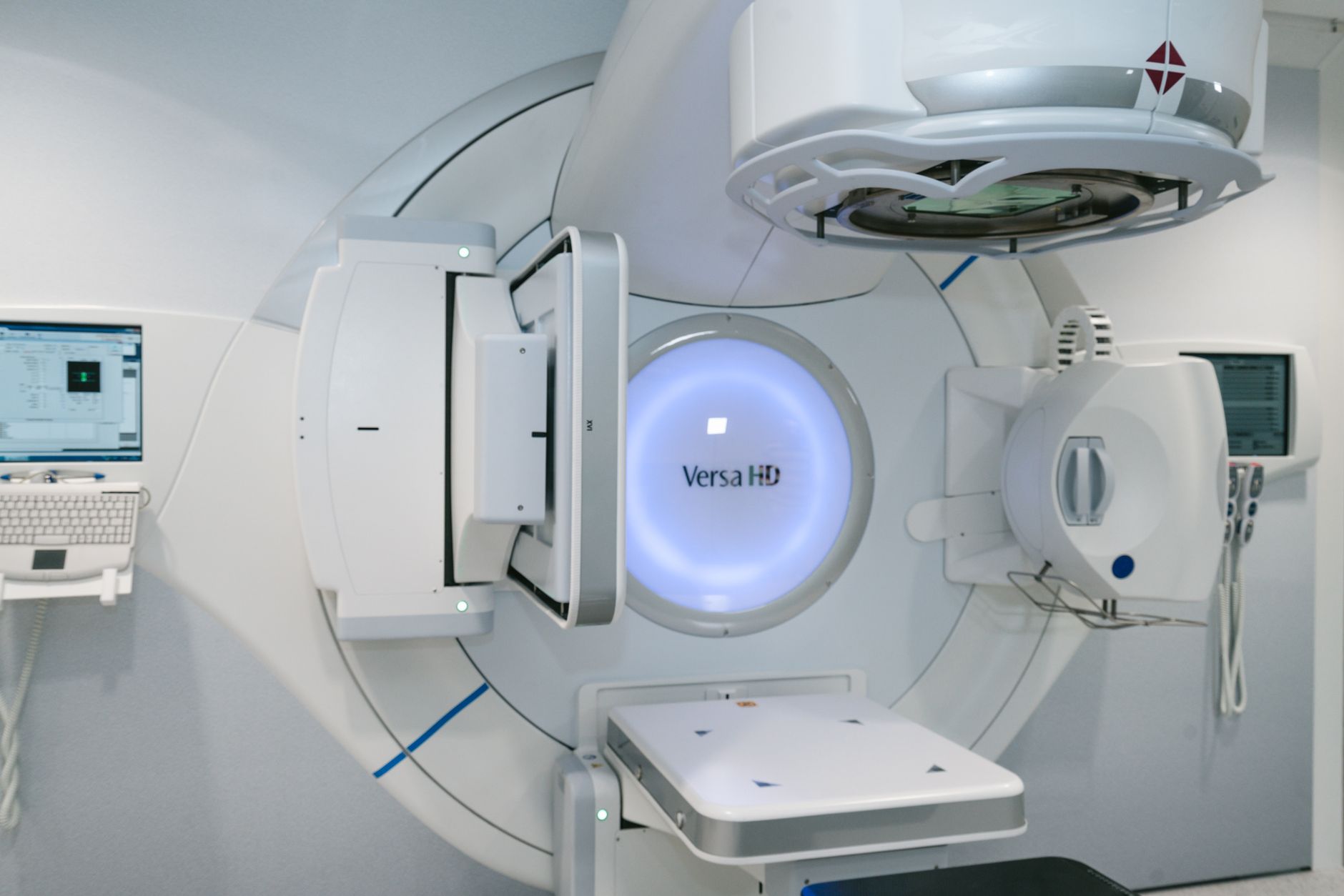
SBRT is considered appropriate where shorter courses are indicated. For locally advanced disease, dose escalation is recommended, conditioned on volumetric image guidance and motion management. And one recommendation deserves highlighting because it implies capital investment: adaptive radiation therapy is recommended for dose-escalated SBRT. In other words, a department intending to deliver ablative dose to the pancreas needs adaptive capability — replanning on the anatomy of the day, whether through adaptive CBCT or an MR-guided platform.
Among the themes the task force emphasized are integration with systemic therapy and surgery, elective coverage of the so-called “triangle” — the region bounded by the celiac axis and superior mesenteric artery, the portal/superior mesenteric vein and the aorta, where perineural invasion and local recurrence concentrate — and celiac plexus radiosurgery for pain control.
Why this update was needed
Historical context explains the document’s weight. For years, chemoradiation in pancreatic cancer lived under the shadow of trials that failed to show an overall survival gain from adding radiation after induction chemotherapy in locally advanced disease. The practical result was a narrowing indication at many centers: if it does not extend life, why irradiate?
What changed since has three components. First, more effective chemotherapy regimens began selecting better for patients with genuinely localized disease. Second, delivery evolved from conformal fields at 50.4 Gy in 28 fractions to hypofractionated ablative-intent regimens that are biologically far more aggressive. Third, and decisive, online adaptation made it tolerable to escalate dose with the duodenum millimeters from the target.
The epidemiologic urgency also weighs in. ASTRO estimates 67,500 new pancreatic cancer diagnoses and 52,700 deaths in the United States in 2026, with five-year survival of just 13% across all stages. Projections have the disease becoming the second leading cause of cancer death by 2030.
Implications for departments
An honest reading cuts two ways. Much of the delivery guidance is already feasible on installed equipment: IMRT/VMAT with daily CBCT-based IGRT and 4DCT for motion assessment are available at most mid-sized centers. That covers conventional chemoradiation, palliation, and much of SBRT without aggressive escalation.
The adaptation recommendation for dose-escalated SBRT is another conversation. Online adaptive platforms — MR-guided or CBCT-based adaptive workflows — remain scarce in many markets, and the requirement is not only hardware: it involves medical physics present at the fraction, same-day organ-at-risk contouring, and substantially more machine time per session. A department without that arrangement should, for safety, hold at non-ablative dose rather than escalate without adaptation. It is also worth revisiting contour alignment against the new elective triangle coverage — our material on target delineation and RT planning in pancreatic cancer is a good starting point for comparing volumes.
Capacity and center sustainability matter too, and we have covered how ablative approaches are reshaping practice in ablative radiotherapy for pancreatic cancer. A guideline that demands more sophisticated technology and more machine time per patient carries cost — and in a system with a waiting list, cost translates into access.
Limitations and what is still missing
It is worth noting how many recommendations arrive flagged as conditional. That is not a weakness of the document but a faithful portrait of the evidence base: in pancreatic cancer, much of the data comes from institutional series and phase 2 studies rather than randomized phase 3 trials. Dose escalation with adaptation, elective triangle coverage and celiac plexus radiosurgery are active areas where the next update will likely shift tone — in either direction.
For the radiation oncologist treating these patients, the operational message is direct: the question is no longer “radiate or not” but “with what intent, at what dose, and with what technical capability to deliver it safely.” Departments that answer the third part honestly will treat better.