
Ablative dose is changing the prognosis in locally advanced pancreatic cancer
Radiotherapy stopped being a palliative gesture in locally advanced pancreatic cancer once it started delivering genuinely ablative dose. The gap between “irradiating the pancreas” and “ablating the tumor” is numerical and brutal: conventional SBRT schedules top out around 60 to 72 Gy of biologically effective dose, below the threshold the literature ties to durable local control. Push toward 100 Gy and survival shifts to another level — and that is where the data behind the current optimism sit.
The arithmetic that defines “ablative”
Biologically effective dose lets you compare different fractionation schemes. For tumor, $\alpha/\beta = 10$ Gy is used:
$$\mathrm{BED} = n \cdot d \left(1 + \frac{d}{\alpha/\beta}\right)$$
where $n$ is the number of fractions and $d$ the dose per fraction. The arithmetic states the problem plainly. A 35 Gy in 5 fractions schedule delivers $\mathrm{BED}_{10} = 59.5$ Gy; 40 Gy in 5 fractions reaches 72 Gy. Both fall short of the 70-to-100 Gy range the literature associates with a true ablative effect in pancreatic adenocarcinoma. Meanwhile 50 Gy in 5 fractions — the SMART regimen — delivers exactly $\mathrm{BED}_{10} = 100$ Gy. That is a difference of intent, not of nuance.
Survival data with ablative regimens
The most-cited reference is the work of Marsha Reyngold and colleagues in JAMA Oncology. The series included 119 patients with localized unresectable or medically inoperable disease treated with ablative radiotherapy at $\mathrm{BED} \geq 98$ Gy on standard equipment — notably, without an MR-Linac. Two schedules were used depending on tumor-to-bowel distance: 75 Gy in 25 fractions ($\mathrm{BED}_{10} = 97.5$ Gy) for tumors within 1 cm of stomach or intestine, and 67.5 Gy in 15 fractions ($\mathrm{BED}_{10} \approx 97.9$ Gy) for tumors at 1 cm or more.
Nearly all patients (97.5%) received induction chemotherapy before radiotherapy. The results: median overall survival of 26.6 months from diagnosis and 18.4 months from radiotherapy, with 74% survival at 12 months and 38% at 24 months. Cumulative local progression was 17.6% at 12 months and 32.8% at 24 months. For a population historically sitting below 15 months of median survival, that is a meaningful displacement of the curve.
Daily adaptation: how to escape the toxicity
The obstacle was never calculating the dose but delivering it without perforating the duodenum. CT-guided ablative SBRT series recorded grade 3 or higher gastrointestinal toxicity rates above 20% when target coverage was prioritized over organ-at-risk sparing. That is unacceptable in a non-surgical, definitive-intent treatment.
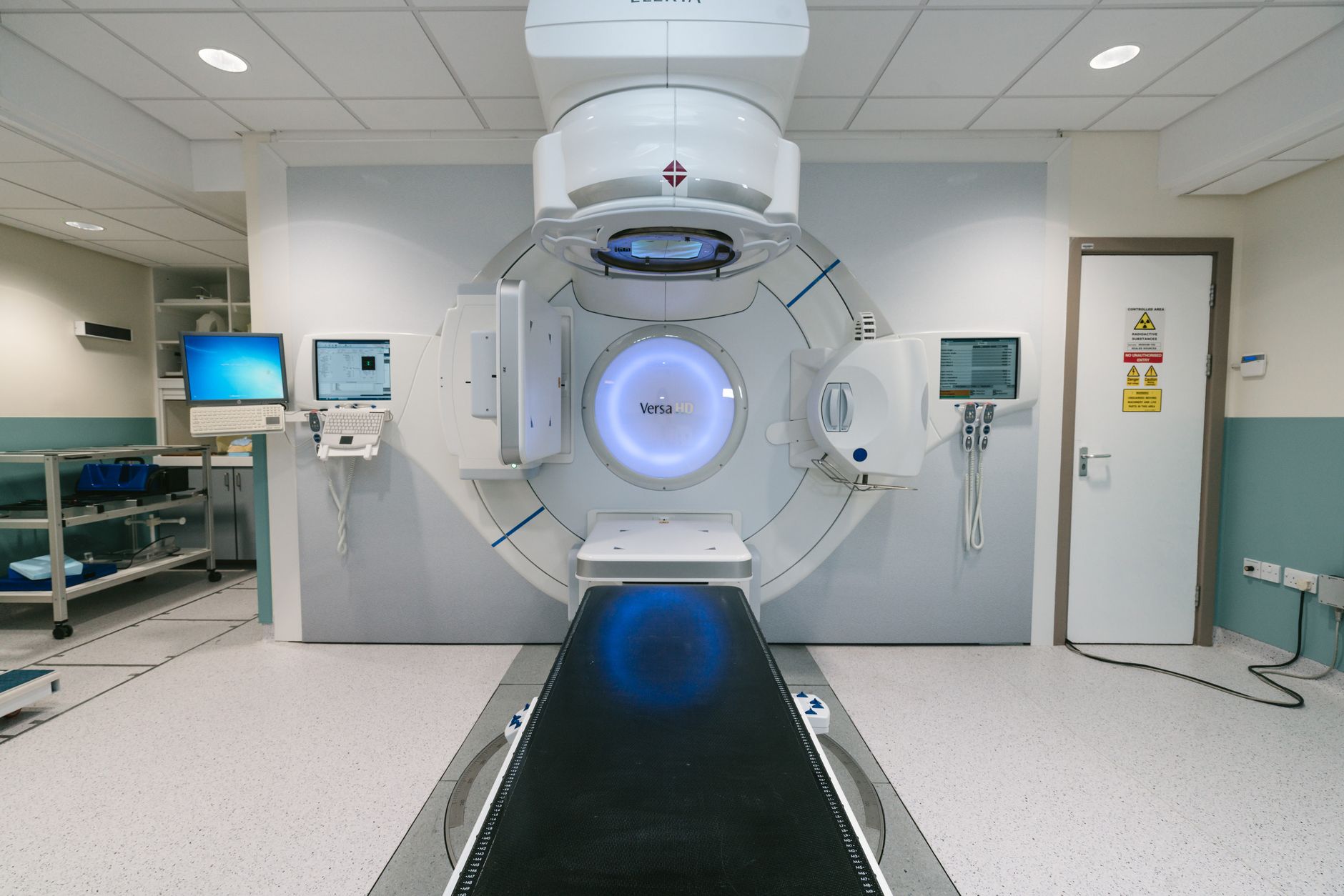
The technical answer was on-table adaptation. In the SMART study, a multicenter open-label phase 2 trial in borderline resectable and locally advanced disease, treatment was delivered on a 0.35 T MR-guided system at 50 Gy in 5 fractions with daily replanning to absorb interfraction anatomical change — a full or empty stomach, bowel gas, respiratory tumor motion. At a median follow-up of 8.8 months the primary endpoint was met: 0% acute grade ≥3 gastrointestinal toxicity definitely related to treatment.
The Montpellier prospective registry, using the same approach, reported median overall survival of 20.9 months from completion of radiotherapy, with 86.7% survival at 6 months (95% CI: 75-93%) and 68.6% at 12 months (95% CI: 53-80%), and no severe acute related toxicity. An earlier single-institution experience reported limited late toxicity: 2 cases (4.6%) of grade 3 gastrointestinal ulcers and 3 cases (6.8%) of grade 2.
What about departments without an MR-Linac?
That is the question that matters for most services, and two answers coexist. The first is Reyngold’s: ablative dose with longer fractionation (15 to 25 fractions) on conventional equipment, accepting a less elegant schedule in exchange for biological margin in normal-tissue repair. The second is CT-guided on-table adaptation — the route the ARTIA-Pancreas trial is testing, a prospective single-arm multicenter study of CT-guided stereotactic adaptive radiotherapy designed specifically to deliver ablative dose while cutting the acute grade ≥3 gastrointestinal toxicity rate.
Practical implications for a radiotherapy department
Three operational consequences follow directly. First, selection: the documented benefit is in localized, non-metastatic disease after induction chemotherapy, in patients with response or stability — not in systemic progression. Second, workflow: on-table adaptation turns a 15-minute fraction into a 45-to-60-minute session with a physicist and a physician present. That reorders machine scheduling and staffing, and it belongs in the calculation before anyone commits to the protocol.
Third, contouring. Delineating target and organs at risk in the pancreas to millimeter precision, fraction after fraction, is the real bottleneck of daily adaptation. That is where pancreatic target delineation stops being an anatomy exercise and becomes a room-time problem — the same pressure driving interest in automated contouring across the discipline.
Context and honest limitations
None of these data come from a randomized phase 3 trial comparing ablative dose against chemotherapy alone. They are prospective series and registries with probable selection bias: patients who reach radiotherapy after months of induction are, by definition, those who did not progress. Part of the observed survival gain reflects that selection rather than the dose alone. Median follow-up in the daily-adaptation studies remains short — 8.8 and 10.8 months — which limits conclusions about late toxicity, precisely the concern in small bowel.
Access is the other issue. An MR-Linac is referral-center equipment, and an adaptive session consumes staff time most departments do not have spare. Reyngold’s route — ablative dose with conventional fractionation, standard equipment and rigorous immobilization — is the more transportable option, and probably the more relevant one for anyone reading this ahead of the next tumor board.
Outlook
What comes next combines three fronts. Faster adaptation, with automated contouring and replanning in minutes, making the 5-fraction schedule viable outside centers of excellence. Earlier diagnosis, where AI for early pancreatic cancer detection has shown promising performance — and ablative dose to a smaller tumor is always an easier conversation. And tighter integration with systemic therapy, including ablative radiotherapy as a bridge to resection in initially unresectable cases. The question for the next decade is not whether ablative dose works, but in whom it works best.
Source: AuntMinnie. Evidence cited: Reyngold M, et al. JAMA Oncology 2021; Parikh PJ, et al. (SMART multicenter phase 2 study) Radiotherapy and Oncology 2023; Montpellier prospective registry, 2023.