
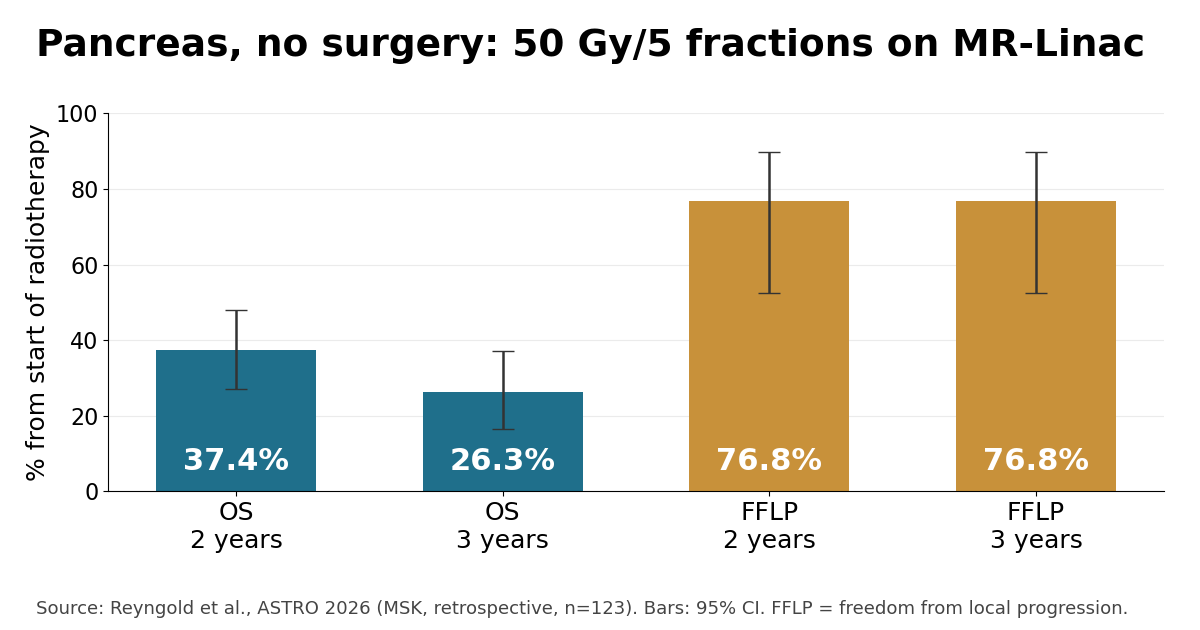
MR-guided adaptive radiotherapy for localized pancreatic cancer treated without surgery produced overall survival of 37.4% at two years and 26.3% at three years, with 76.8% of patients free from local progression at both time points, in a retrospective series of 123 patients from Memorial Sloan Kettering Cancer Center (MSK) in New York. The data were presented at the ASTRO 2026 Annual Meeting in Boston, and treatment consisted of 50 Gy in 5 fractions on the 1.5 T Elekta Unity MR-Linac with daily on-table replanning.
What the MSK study presented at ASTRO 2026
The work, led by radiation oncologist Marsha Reyngold with Christopher Crane and MSK medical physicists including Neelam Tyagi and James Mechalakos, was shown in a quick-pitch session on ablative radiotherapy for pancreaticobiliary tumors and is published as an abstract in the meeting supplement of the International Journal of Radiation Oncology, Biology, Physics (Reyngold et al., Int J Radiat Oncol Biol Phys 2026;126(1):S250-S251). It reached a wider audience through a press release from Elekta, the system’s manufacturer, which was republished by ITN.
This is a retrospective, single-institution analysis of consecutive patients treated between May 2020 and December 2024, without surgery and with at least 12 months of follow-up. Of the 123 patients, 106 had primary disease and 17 had locoregional recurrence. Median age was 68 years (range 41 to 94), 73.9% had ECOG 0 or 1, median tumor size was 3.4 cm, and 54.5% of tumors were in the pancreatic head. Median CA 19-9 was 171 U/mL. Among primary cases, 88.7% were locally advanced or borderline resectable, three were resectable and nine had metastatic disease. Most patients (85.4%) received induction chemotherapy, mainly mFOLFIRINOX (82 patients) or gemcitabine with nab-paclitaxel (18).
At a median follow-up of 24.2 months, overall survival measured from radiotherapy was 37.4% (95% CI 27.0-47.9) at two years and 26.3% (95% CI 16.5-37.2) at three years. Freedom from local progression was 76.8% (95% CI 52.4-89.8) at both two and three years. On univariate analysis, only GTV coverage measured as D80 was associated with local control; no clinical or dosimetric factor was associated with survival. The authors conclude that the data support prioritizing 50 Gy in 5 fractions in prospective trials where online adaptive technology is available. The abstract does not report toxicity.
How treatment was planned and delivered
The technical detail is what makes the result worth a closer look for physicists and dosimetrists. The prescription was 50 Gy to the high-dose PTV and 25 to 33 Gy to the microscopic-disease PTV, in 5 fractions over two weeks. With an α/β of 10 Gy, 50 Gy in 5 fractions corresponds to a BED of 100 Gy, the threshold the literature links to an ablative effect in pancreatic adenocarcinoma, as discussed in our analysis of ablative radiotherapy in pancreatic cancer.
Organ-at-risk limits were strict: for stomach and small bowel, D0.035 cm³ below 33 Gy and D5 cm³ below 27 Gy; for large bowel, D0.035 cm³ of 35 to 38 Gy and D5 cm³ below 30 Gy. In practice, target coverage gives way whenever bowel moves close. Median high-dose PTV D95 was 41.5 Gy (33.1 to 51.2 Gy) and median GTV V100% was 80%. In other words, the nominal dose is ablative, but the dose actually delivered to part of the volume is lower, and the abstract itself suggests that better tumor coverage by at least 40 Gy translates into better local control.
Only patients with no or minimal contact between tumor and the gastrointestinal lumen were candidates. The adaptive workflow was adapt-to-shape, with daily recontouring in MIM software on T1, T2 and balanced sequences. An abdominal compression belt kept respiratory motion below 5 mm, and the target was monitored with cine MRI during delivery. For teams working with this equipment, the magnetic field also changes dose deposition at air interfaces, a topic covered in our article on MR-Linac dose calculation.
How it compares with the earlier conventional-linac series
The same group previously published in JAMA Oncology a series of 119 patients treated with ablative doses on a conventional linear accelerator in 15 or 25 fractions, with 38% two-year survival from radiotherapy and a cumulative local progression of 32.8% at two years. Two-year survival is therefore nearly identical across the two series; what changes is the shorter five-fraction course, a numerically higher local control rate, and the first three-year estimate. Cross-series comparisons cannot establish superiority, however: selection criteria differ, and the MR-Linac cohort required tumors set away from the bowel.
Practical implications and the role of technology
The updated ASTRO pancreatic cancer radiation guideline already recognizes SBRT for locally advanced disease after induction chemotherapy. The MSK data reinforce that ablative doses in few fractions are feasible with high-quality daily imaging and on-table replanning, but they do not replace prospective trials. For centers in Brazil and Latin America, where MR-Linac availability is still limited, the message cuts two ways: the result depends on a workflow that requires a team trained in online recontouring, and the conventional-linac series shows that longer ablative schedules may be an alternative where on-table MRI is not available. Careful target and organ-at-risk delineation remains the critical step in either setting.
In its release, Elekta tied the study to Unity Pro, a new version of the platform that, according to the company, adds AI-assisted contouring, GPU-accelerated planning and remote collaboration to shorten the adaptive session. These features were not part of the study, which was carried out on Unity between 2020 and 2024.
Limitations and next steps
The numbers themselves call for caution. The study is retrospective and single-center, and it was presented at a meeting without a peer-reviewed full paper. Confidence intervals are wide, especially for local control (52.4% to 89.8%), and the cohort includes recurrences and a few metastatic patients, which makes extrapolation harder. There is also significant anatomical selection, and the abstract reports no toxicity data. Even so, about a quarter of patients alive at three years without surgery is a signal worth testing in a prospective trial, as the authors propose. The manufacturer’s release is available via Elekta/MFN, and the abstract can be found on the ASTRO session page.
Source: ITN (Imaging Technology News)