
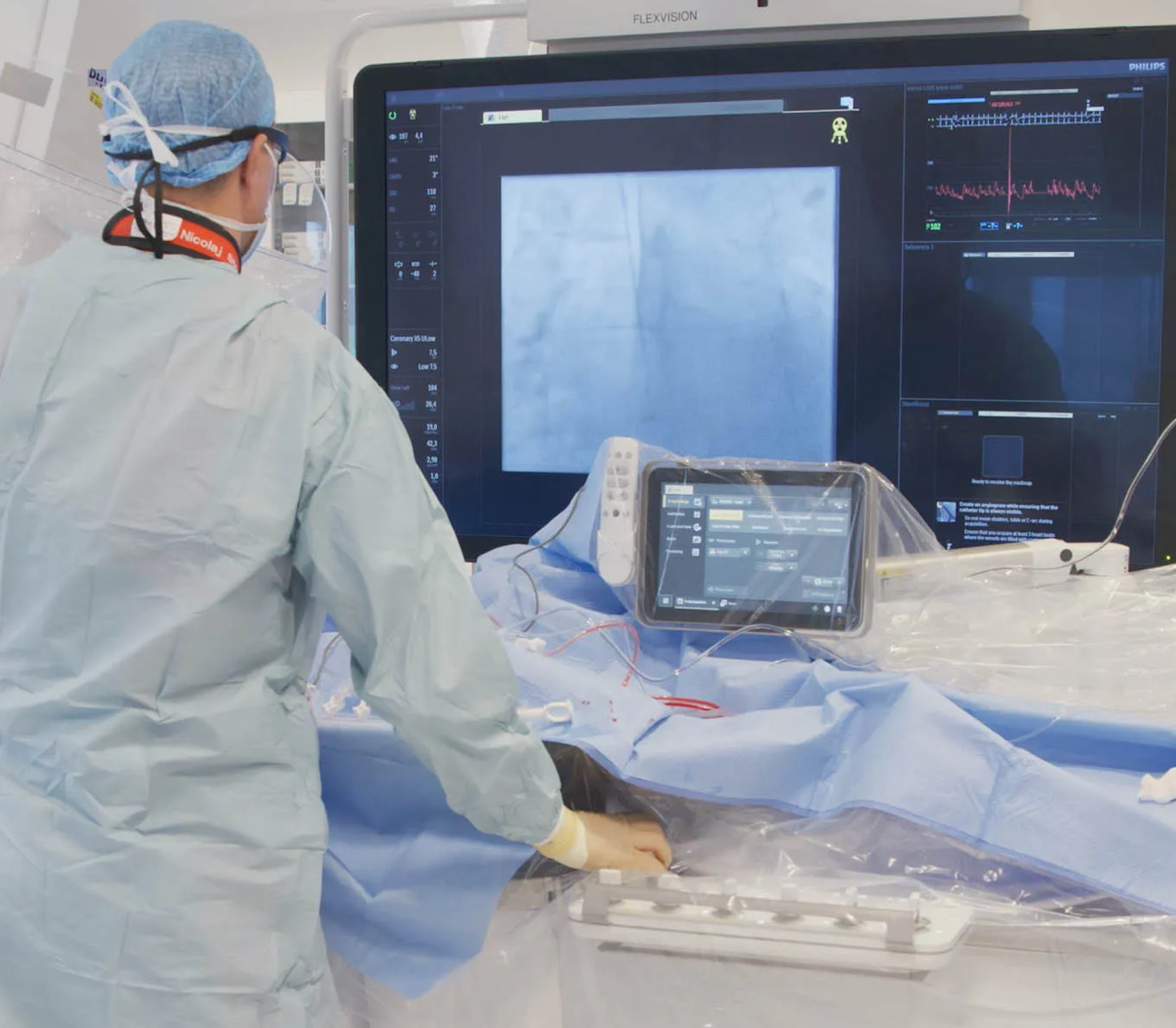
Royal Philips has introduced SmartIQ, a coronary imaging technology designed for its Azurion image-guided therapy platform. The stated goal is to improve image quality while reducing radiation exposure during cardiac procedures. The launch, reported by DOTmed on May 21, will be officially demonstrated at EuroPCR 2026 in Paris, with participation from clinical teams already using the system in routine practice.
What SmartIQ promises
SmartIQ includes an ultralow-dose protocol for coronary procedures that, according to the company, uses more than 50% less radiation compared with the lowest dose setting available on Philips ClarityIQ. ClarityIQ was already a reference for low-dose angiography, with documented reductions of 23% to 83% versus prior systems depending on the procedure type. The additional 50% step on top of that baseline matters for the interventional cardiologist who runs multiple long procedures per day.
The SmartIQ pitch goes beyond pure dose reduction. According to Philips, the protocol allows coronary cine imaging at dose levels approaching those of fluoroscopy, depending on the clinical setting and imaging system. In other words, operators can capture cine sequences — used to document and quantify the procedure — at dose regimes that until now were reserved for continuous fluoroscopic visualization.
Why this matters for interventional cardiology
Radiation in the cath lab is a sensitive topic for two reasons. First, coronary patients who undergo five or six procedures over a decade can accumulate meaningful doses. Second, and most importantly, occupational exposure to the interventional cardiologist, technologist, and nursing staff in the room sums up across thousands of procedures. Epidemiologic studies link this exposure to lens opacities, skin changes, and brain tumor risk among high-volume operators.
Cutting the cine component — historically the largest source of dose per procedure — without sacrificing diagnostic quality is exactly the kind of improvement that translates directly into radiation safety policy. Under the ALARA principle, any real dose reduction backed by clinical evidence should be implemented when feasible.
What early users are saying
In a statement, cardiologist Dr. Mark Winkens of Elisabeth-TweeSteden Hospital in Tilburg, the Netherlands, described SmartIQ as a win-win: very low doses and even better image quality. Another early user, Dr. Nicolaj Brejnholt Stottrup of Aarhus University Hospital in Denmark, emphasized that image quality is the foundation of every decision made in the cath lab. These statements come from centers that participated in the first wave of European deployment.
A recent pilot study published in the Journal of the Society for Cardiovascular Angiography & Interventions (JSCAI) evaluated SmartIQ in a blinded design. According to Philips, the technology received higher image-quality scores and was preferred in most image comparisons while maintaining or lowering radiation dose and contrast volume.
The RADIQAL trial and the path to stronger evidence
Philips is also running the RADIQAL trial, which compares dose reductions between SmartIQ and ClarityIQ while assessing procedural performance. According to the company, enrollment has completed at European sites and the trial has reached about 60% of its overall target. Full results are not yet public, but the trial design promises to give the community a body of evidence less dependent on anecdotal reports.
This kind of formal study is crucial to overcome the criticism that imaging improvements seen in demos do not always translate into verifiable gains in daily practice. Cardiologists evaluating an upgrade of the technology fleet need, beyond marketing materials, evidence that can support purchasing decisions in front of procurement committees.
The Philips imaging ecosystem
The release fits a broader Philips strategy to evolve Azurion as the reference platform for image-guided therapy. The move parallels the portfolio renewal of competitors, as we covered in our analysis of Siemens Healthineers refreshing its imaging leadership for 2026, and the wave of launches across other modalities, as we discussed in coverage of the Aplio i800 EUS from Olympus and Canon. In all of these cases, the competitive vector is the same: more imaging with less dose, more embedded intelligence, and a better experience for the team in the room.
Implications for hospital decision-makers
For cath lab leaders, SmartIQ entering the market opens two doors. First, renegotiation of existing Philips contracts, including software upgrades for already installed Azurion systems. Second, the new technology becomes a comparative benchmark in tenders for new units, especially in regions where coronary volume justifies investment in state-of-the-art equipment. The reduced exposure also enters as an argument in radiation safety committees and occupational health programs.
Those gains, however, depend on calibration for the local patient mix. Patients with higher BMI may not benefit as much from ultralow-dose protocols without fine-tuning, and the learning curve of the team during the transition also influences the actual performance delivered by the system in routine use. Service line leaders should also plan dosimetry audits before and after the protocol switch, so that the reported reductions can be confirmed in their own data and shared with hospital safety committees on a recurring basis.
Source: DOTmed News