
Lung screening has moved from trial evidence to delivery problem
Nobody in Seoul spent much time arguing about whether low-dose CT (LDCT) works for lung cancer screening. The sessions at the IASLC World Conference on Lung Cancer, held 12–15 September 2026 at the COEX centre in Seoul, were about something harder: reaching the eligible people who are not being scanned, and doing it without swamping radiology departments with indeterminate nodules. Australia, Taiwan, China and France each brought results from programmes that are already running, and together they sketch a fairly practical playbook.
Two threads ran through the week. One is eligibility — the NLST-derived criteria that most guidelines still use look only at age and pack-years, and several national datasets now show who that leaves out. The other is what happens after the scan: report standardisation, follow-up circuits, and the growing use of algorithms that estimate a person’s future risk rather than simply describing today’s nodule.
What the national programmes reported
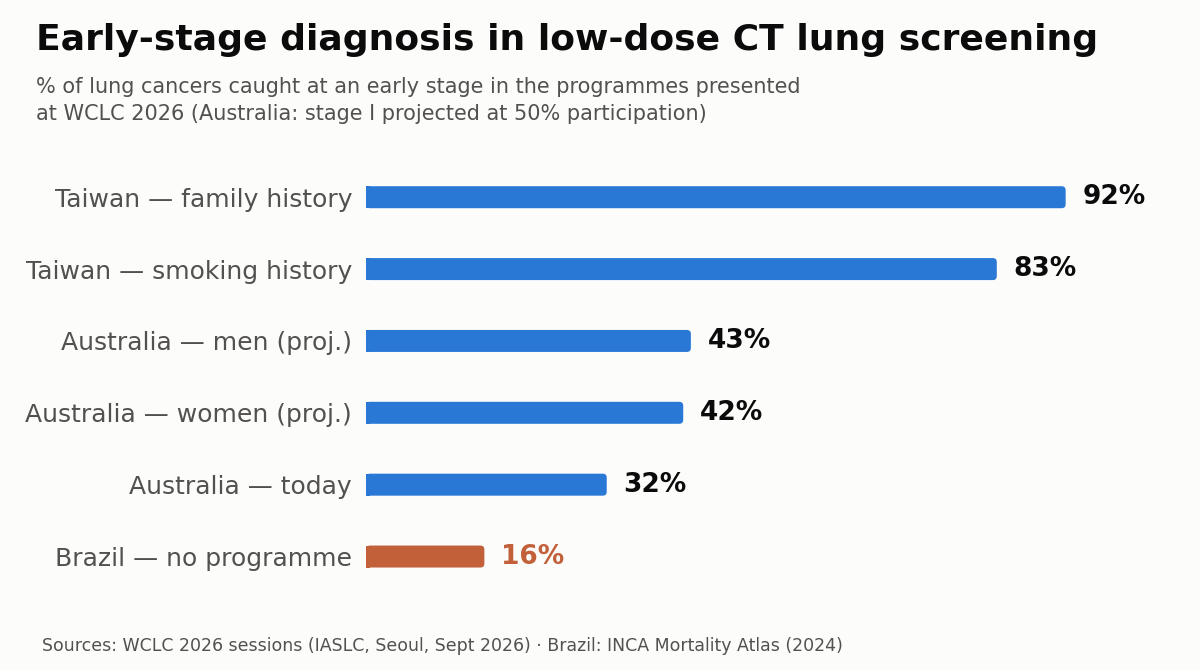
Australia’s programme is the newest of the lot, having launched in 2025, and it drew the most attention because its modelling implies a population-level stage shift. If participation reaches 50% of the eligible population, the share of diagnoses made at stage I is projected to climb from 32% today to 42% in women and 43% in men. The Ready to Screen (R2S) trial surveyed 1,700 eligible candidates and found the demand plausible: 85% said they “definitely” intended to be screened, and 26% reported having already had an LDCT scan.
Taiwan’s data cut closest to current eligibility rules. Across 2,800 cancers found by the national programme, detection was 74% higher among people enrolled on family history than among those enrolled on smoking history — 18 versus 10 cancers per 1,000 screened. Stage distribution moved too: 92% of the family-history cancers were early stage, against 83% in the smoking-history group. In East Asia, where lung cancer in never-smokers carries far more epidemiological weight than in Western cohorts, family history looks like a defensible invitation criterion in its own right.
China reported a programme that screened 6,700 people using risk factors beyond tobacco and recorded a 56% reduction in lung cancer mortality. France went after adherence and prevention at the same time, bolting smoking-cessation therapy onto its LDCT pathway: 88% of invitees attended their scan, and participants were 44% less likely to keep smoking. That last result is the cheapest win presented all week — the same appointment that detects the tumour also chips away at what caused it.
From describing the nodule to predicting the cancer
LDCT is a non-contrast chest acquisition at a fraction of a diagnostic CT’s dose, built to find pulmonary nodules in people with no symptoms. Reports typically follow Lung-RADS, which grades a finding by size and attenuation and sets the return interval. It is a descriptive system: it answers how suspicious this nodule looks now, not how likely this person is to have cancer in twelve months.
That gap is what makes MIT’s Sybil algorithm interesting. Applied to two large screening datasets, NLST and P-IELCAP, Sybil beat Lung-RADS on AUC for predicting one-year cancer risk from suspicious nodules. Researchers also ran it over coronary artery calcium scans and got usable lung cancer risk estimates for both smokers and never-smokers across 15 years of follow-up — oncological signal sitting unread inside a scan ordered for cardiac reasons. A separate group deployed Softek’s Illuminate AI to surface incidental pulmonary nodules in routine imaging alongside a formal screening programme, and turned up more cancers than screening alone. We have covered adjacent ground before, both on incidental findings on lung CT as a cancer risk signal and on how AI and patient navigation lift screening rates.
What this asks of radiology departments
Scaling screening puts three unglamorous demands on a department: an audited acquisition protocol, a structured report, and a follow-up loop that actually closes. Standardisation is not a footnote here — a recent study we reviewed showed how widely radiologists vary when reading lung CT, and a population programme multiplies every bit of that spread. Uptake is the other half of the equation, and real-world numbers have been humbler than trial numbers, as we noted when screening uptake rose but mortality benefit came out mixed.
Brazil sits at an earlier point on this curve, and the contrast is instructive. LDCT is not part of the national screening portfolio — unlike mammography and cervical cytology, which have established recommendations and pathways inside the public system (SUS). The most concrete move so far came in April 2026, when INCA, Rio de Janeiro’s municipal health department and AstraZeneca opened a feasibility study at Hospital Municipal Souza Aguiar under epidemiologist Arn Migowski. It enrols at least 397 people aged 50 to 80 who currently smoke or quit within the past 15 years, recruited through the city’s tobacco-cessation programme, with two years of follow-up. The stated goal is local evidence for a future national guideline.
The burden explains the urgency. INCA’s mortality atlas recorded 32,465 deaths from bronchial and lung cancer in Brazil in 2024 — more than prostate (17,826) and breast (20,849) combined. Roughly 84% of cases are diagnosed at an advanced stage and five-year survival sits near 5.2%. That ratio is precisely what the programmes presented in Seoul are designed to invert.
Caveats and what comes next
The Seoul numbers deserve to be read with their limits attached. Australia’s stage shift is a projection resting on 50% participation, a level no national lung screening programme has yet reached. A 6,700-person Chinese cohort is thin ground for a standalone mortality estimate. Taiwan’s family-history finding reflects East Asian epidemiology that does not transfer automatically to Latin America or Europe. And Sybil was validated on well-curated screening datasets; running it across the mixed scanners and protocols of routine hospital practice is a different engineering problem.
The direction of travel is nonetheless unambiguous. Lung screening is following the path mammography took: out of the trial, into public policy, and judged from then on by participation, scanner capacity and reporting quality. For most health systems the open question is no longer whether LDCT works, but whom to invite, with what imaging capacity, and through which follow-up pathway.
Source: The Imaging Wire