
The FDA has refreshed its list of marketing authorizations for AI-enabled medical devices, and the picture is unchanged: radiology still dominates. Counting everything the agency has cleared since it began tracking the category, 1,614 AI-enabled devices had been authorized through the end of June 2026 — up 5.9% from the first-quarter figure. Of those, 1,230 are radiology devices, or 76% of the total. No other specialty comes close.
The second-quarter numbers
The FDA publishes this tally quarterly, and the latest cut covers decisions through June 30, 2026. In the quarter alone, the agency authorized 89 AI-enabled devices, slightly fewer than the 92 it cleared in the first quarter. Of those 89, 66 (74%) were radiology devices — essentially the same share as the previous quarter, when imaging products accounted for 75% of clearances.
It helps to know what the count includes. The list is not limited to standalone software: it also captures hardware with AI on board, such as scanners shipping with accelerated reconstruction, automated positioning or factory-installed algorithmic post-processing. That explains part of the large equipment vendors’ advantage in the ranking, and it is a good reason not to read raw authorization counts as a proxy for clinical maturity.
The vendor ranking barely moved
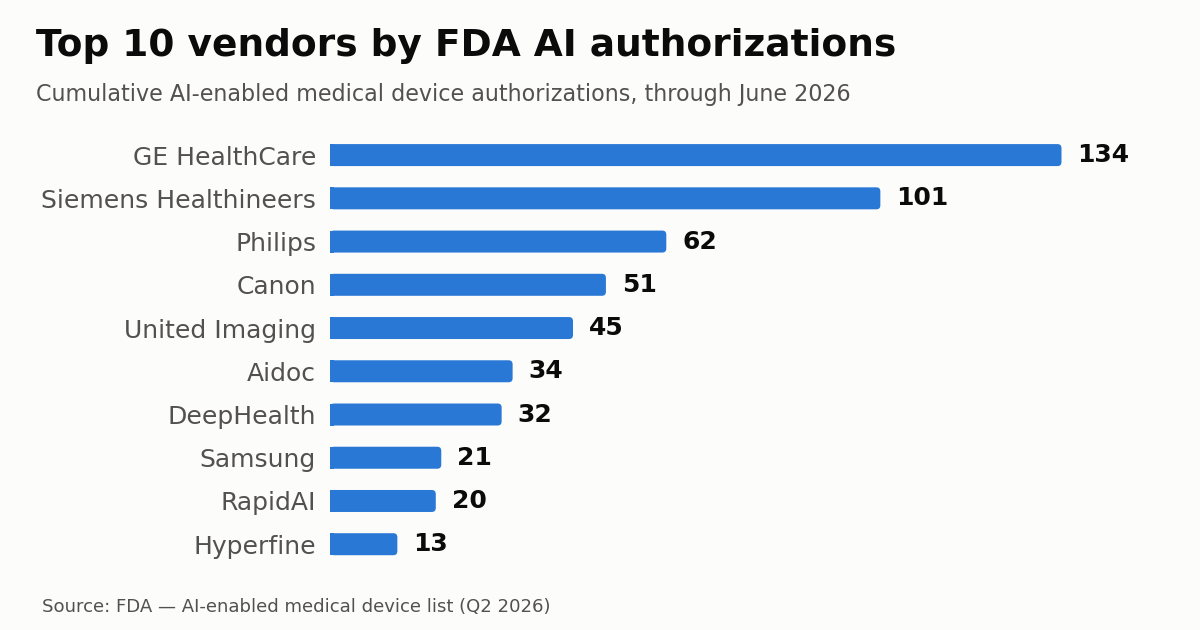
GE HealthCare keeps the lead with 134 authorizations, a figure that includes products brought in by companies it has acquired over the years. Next come Siemens Healthineers (101), Philips (62), Canon (51) and United Imaging (45). Among firms born inside the AI wave itself, Aidoc shows 34 and DeepHealth 32. Samsung (21), RapidAI (20) and Hyperfine (13) round out the top 10.
The acquisition caveat matters more than it looks. When a manufacturer buys an algorithm developer, the target’s regulatory history lands on the buyer’s scoreboard. Much of the gap between the top five and everyone else therefore reflects M&A strategy as much as submission capacity — the same consolidation logic playing out on the services side, as in Radiology Partners’ acquisition of Everlight.
Why radiology dominates the list
The concentration is no accident. Medical imaging is, by construction, a problem of dense, labeled data digitized in an open standard — DICOM — which makes assembling training sets far more tractable than in specialties that depend on free text, physiologic signal or physical examination. Add to that the fact that many imaging algorithms have an objectively measurable endpoint: presence or absence of a finding, a volume, a score.
There is a regulatory factor too. Most of these products come through the 510(k) pathway, which requires demonstrating substantial equivalence to a marketed device rather than a de novo clinical efficacy trial. With hundreds of predicates already authorized in radiology, each new submission finds a shorter road — a compounding effect that feeds itself. That design is precisely what prompted Radiology Partners to ask the FDA for clearer rules on how models may be updated after initial clearance.
What it changes in clinical practice
For people working in a department, the 1,230 figure says less about what works and more about what is available to buy. FDA authorization is not a synonym for proven clinical benefit in your population: it attests to safety and equivalence, not superiority. Recent literature has already shown the distance between the commercial promise and real-world performance — that is what surfaced when radiologists assessed what mammography AI actually delivered against what had been expected of it.
The useful question when evaluating a product, then, is not “is it cleared?” but: in which population was the pivotal study run, what was disease prevalence in that sample, how does performance hold across subgroups, and how does the vendor document model updates. Outside the US, the practical equivalent is checking the local regulator — in Brazil, ANVISA has its own rule for software as a medical device, and not every US-cleared product has completed a pathway there. Payment is starting to move as well, with Medicare now creating an add-on payment for CT triage AI.
Generative AI is the next frontier
The most interesting part of this update is not in the numbers but in what follows them. The FDA is currently soliciting feedback on how to regulate generative AI algorithms used directly in clinical care — the category that includes foundation models capable of drafting reports. These systems fit the 510(k) mold poorly: they have no obvious predicate, they emit natural-language output, and their behavior can shift with every new model version.
The agency’s decision will determine whether the pace of 89 authorizations per quarter holds, accelerates or stalls. It is also worth reading against the first-quarter 2026 tally: the stability between the two cuts suggests the market has reached a plateau of submissions through the traditional pathway, and that the next jump depends less on volume than on the regulatory framework the FDA draws for generative models. For a department leader, the practical takeaway is simple — the supply of cleared AI will keep growing, and internal governance for validating, monitoring and retiring algorithms has to grow with it.
Source: The Imaging Wire