In radiology, what decides AI adoption is less the algorithm and more the reimbursement behind it. That is the core argument of a new MedScout report highlighted by The Imaging Wire, which looks at the economics of imaging AI and previews part of the agenda for RSNA 2026, opening this week in Chicago.
The starting point is familiar: demand for imaging keeps rising while the workforce stays short, and developers pitched AI as the fix for that gap. Radiology, in fact, holds the most FDA AI authorizations of any specialty. Yet when you look at what actually reaches routine use, the test changes: it is payment predictability, not clinical promise alone, that separates the tools clinicians adopt from those that stall as pilots.
Predictable payment is what moves adoption
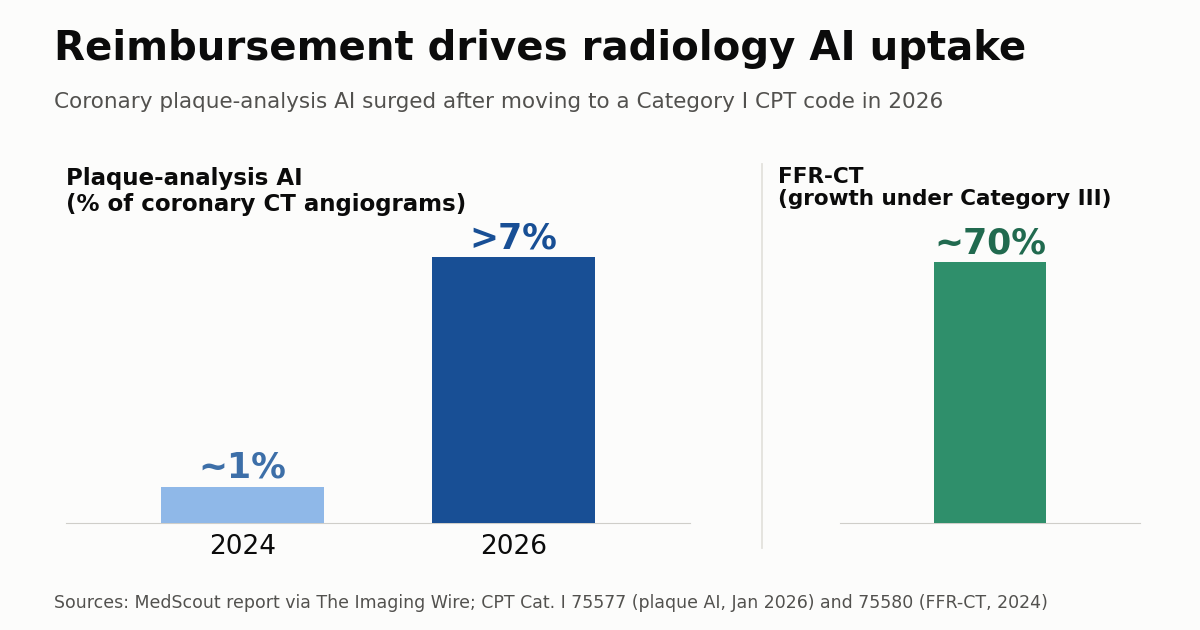
The report uses cardiac CT as its showcase. A coronary CT angiogram, or CCTA, is a contrast-enhanced scan that maps the coronary arteries; plaque-analysis AI then reads that same dataset to quantify and characterize the atherosclerotic plaque lining the vessel walls. Use of that software climbed once payment became more predictable, with the move to CPT Category I status in January 2026. By MedScout’s figures, the technique jumped from roughly 1% of all coronary CT angiograms in 2024 to more than 7% — a steep rise over a short window, and one the report ties to the coding change rather than to any single new algorithm.
The contrast with FFR-CT sharpens the point. That tool non-invasively estimates fractional flow reserve — a measure of how flow-limiting a coronary narrowing is — from the same CCTA dataset. It posted about 70% growth while still in Category III, likely because it already had a reliable, standardized hospital payment, a benefit usually reserved for Category I (which FFR-CT has now earned as well). The takeaway is blunt: most imaging-AI algorithms have no CPT code at all, which makes them less attractive economically.
What CPT Category I means — and why it matters
CPT is the procedure code set used for billing in the United States. Category I codes are permanent: they cover established services, carry assigned relative value and have set payment under Medicare and private plans. Category III codes are temporary, created to track emerging technology; they usually lack a fixed amount and leave payment to each payer’s discretion. In practice a Category I code acts as a financial green light, which is why the report frames reaching it as a possible key adoption benchmark for AI. The permanent plaque-AI code, 75577, took effect on January 1, 2026 and replaced the older Category III codes; FFR-CT uses 75580, a Category I code since 2024.
That code map is not fixed: the CPT set changes every year — for 2027, for instance, it brings 299 new codes touching radiology. And when a dedicated code is missing, alternative mechanisms help carry the cost, such as the Medicare add-on payment for inpatient triage AI, built precisely for newer tools without settled reimbursement.
From replacing to extending capacity
A second shift in narrative is under way. For years radiology was cast as one of the specialties most exposed to AI replacement — a fear that has not materialized. The talks slated for RSNA 2026 point the other way: they show AI extending the radiologist’s capacity rather than displacing it. Several studies cover AI used to triage patients for overloaded clinicians, including AI-predicted risk scores to guide supplemental scans. But the workflow bottleneck remains human, and the money is back at the center. It is the same reading the Neiman Health Policy Institute has used in rebutting the claim that AI replaces radiologists, and that also marked the point where imaging AI shifted into the implementation phase.
The Brazil and Latin America angle
In Brazil the reimbursement machinery is different, but the economic logic repeats. In the public system, billing follows the SUS SIGTAP table; in private coverage, insurers use the TUSS terminology and the ANS list of procedures to define mandatory coverage. None of those instruments currently offers a dedicated, specific payment path for imaging-AI software. Without a code that pays for per-exam use, local adoption tends to lean on institutional investment and efficiency gains — shorter reporting times, prioritizing urgent cases — rather than a direct fee per study analyzed. Allowing for differences in scale and regulation, it mirrors the U.S. report’s diagnosis: without predictable reimbursement, the technology advances slowly, however mature it is.
The limits of an economic read
It is worth separating data from interpretation. The adoption percentages for plaque analysis and FFR-CT come from MedScout’s proprietary report, relayed by The Imaging Wire, not from an auditable public registry — useful as a trend, not as an exact measure. A share of CCTA and a growth rate are also different metrics, so the two figures describe the pace of uptake, not a like-for-like comparison. Reimbursement is likewise not the only factor: solid clinical evidence, workflow integration and staff trust still weigh on the decision to buy and use a tool. RSNA 2026, running November 29 to December 3 in Chicago, should give attendees a clearer sense of where the specialty stands and where it heads in 2027 — with economics, not just the algorithm, as the thread.
Source: The Imaging Wire — The Economics Running Radiology’s AI Adoption