
The rebuttal: a decade of data against a soundbite
An editorial in the Journal of the American College of Radiology challenges the claim
that artificial intelligence has already made it unnecessary to hire more radiologists in the United
States. The team is led by Elizabeth Rula, executive director of the Harvey L. Neiman Health Policy
Institute (HPI) in Reston, Virginia, and responds to comments published in 2026 in JAMA Health
Forum by Harvard economist David Cutler and Lev Klarnet.
Cutler and Klarnet argued that the decrease in medical imaging had “allowed the U.S. to meet the
need for imaging without an increase in radiologists.” The HPI answer is blunt: “The assertion, we
think, is counter to recent collective experience of the radiology community and ignores a decade of
evidence.”
Where the reading of the data goes wrong
The central problem Rula and colleagues identify is the empirical base. The key study the
economists cite examined per capita imaging use through 2016 and attributed part of the apparent
decline to Medicare code bundling — a billing change, not a change in exam volume. When a payer
merges two codes into one, the count of “procedures” falls in the administrative record without a
single exam going undone.
The second problem is the metric. Counting exams ignores actual radiologist workload, which
depends on volume and complexity together. A whole-body CT with multiplanar reconstructions and
comparison against three priors is not equivalent to a chest radiograph, yet both register as “one
exam.”
The numbers HPI put on the table
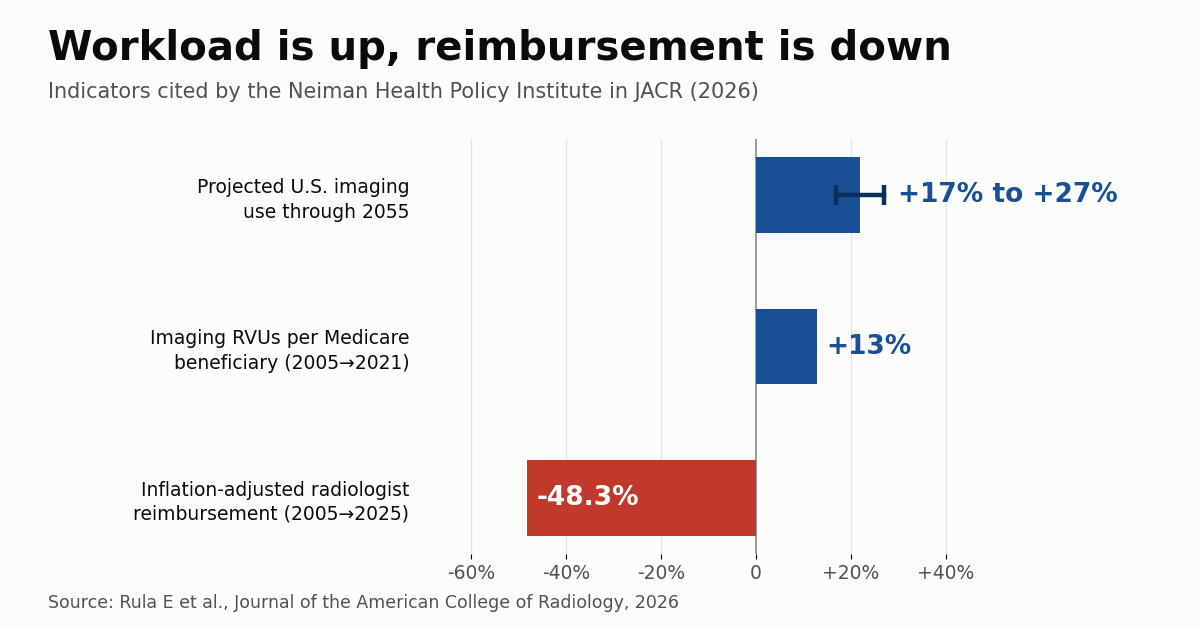
The rebuttal rests on peer-reviewed work from the institute itself. In 2025, the group projected
17% to 27% growth in U.S. medical imaging use through 2055, driven by population growth and ageing.
Medicare data compiled in the Neiman Almanac shows meaningful Part B volume increases in CT and MRI
between 2016 and 2024 — precisely the period after the series the economists relied on ends.
Another HPI study measured workload in relative value units (RVUs), which weight the time, effort
and risk of each procedure. Imaging RVUs per beneficiary reached their highest level in 2021, up 13%
from 2005. Over the same span, Medicare’s budget neutrality mandate cut inflation-adjusted
radiologist reimbursement by 48.3% between 2005 and 2025. More work, less payment per unit of
work.
The electronic record argument does not hold either
Cutler and Klarnet also argued that electronic health records have reduced repeat imaging. HPI
counters with a recent analysis finding that 12.5% of Medicare office-based imaging studies were
repeated between 2013 and 2022. That is not a marginal detail: duplicate imaging is a leading
source of waste and of avoidable radiation exposure, and it persists even where interoperability is
formally available — a process failure that echoes what we have written about
technology governance in radiology.
The ghost of 2016 is still in the room
The editorial spends time on historical context, and rightly so. In 2016, Nobel laureate Geoffrey
Hinton said deep learning would outperform radiologists at image analysis and that training more of
them made no sense. The prediction did not hold, and Hinton himself has walked it back: in a
New York Times interview in September 2026, he said a combination of AI and radiologists
will make radiologists more efficient while improving accuracy.
Rula and colleagues note that the concern “remains newsworthy and radiologists remain defensive,
indicating the longstanding ripple effect of Hinton’s prediction.” The practical argument is that
broad declarations from publicly authoritative figures have real consequences for specialty choice,
residency sizing and investment decisions — and take years for evidence to correct.
What it means outside the United States
The dispute concerns U.S. data, but the methodological lesson travels. Any discussion of whether
“AI will solve the radiologist shortage” has to separate three things that routinely get conflated:
exam volume, complexity per exam and available reading capacity. In health systems where specialist
distribution is heavily concentrated in large cities and teleradiology absorbs part of the demand
from smaller regions, the risk of reading an aggregate indicator as proof of sufficiency is higher
still — exactly the point we raised when we asked
whether the radiologist shortage is regional.
There is also the effect on people already in the profession. Turnover research consistently
shows perceived workload predicting exits, and public narratives of obsolescence help neither
retention nor recruitment — a theme we covered in
why radiologists quit.
How to read this without picking a side by reflex
Scepticism is warranted in both directions. HPI is an institute affiliated with the American
College of Radiology, and defending the economic relevance of the specialty sits inside its
institutional remit; that does not invalidate the data it cites, but it does ask for attention to
which metrics were selected. On the other side, the criticised comments were published as opinion,
not as original research. What the rebuttal demonstrates solidly is narrower and more useful than
the polarised debate suggests: the data series used to argue that demand fell ends in 2016, is
confounded by a coding change, and does not measure complexity.
The picture the evidence supports is neither replacement nor automatic shortage. It is a system
where demand grows, complexity per exam grows faster, payment per unit falls, and AI arrives as a
productivity tool whose gains are still being measured case by case — as the
FDA radiology AI authorisation figures
illustrate.
Source: AuntMinnie — HPI: Evidence contradicts broad claims about AI, radiology workforce