
Lung cancer screening with low-dose CT (LDCT) in the U.S. has an access problem, not an evidence problem: most eligible people never get an order for the scan. Three studies published on October 22, 2026, in the Journal of the American College of Radiology (JACR) take on that bottleneck. A primary care program in New York City multiplied the odds that an eligible patient’s LDCT was ordered; a culturally adapted intervention for Hispanic patients in California raised ordering from 13.3% to 50%; and a crosswalk of the American College of Radiology (ACR) registry found it can support about 69% of the international quality indicators for screening programs.
The baseline is sobering. An American Cancer Society analysis published in JAMA in November 2025, based on the 2024 National Health Interview Survey, found that only 18.7% of the 12.76 million screening-eligible Americans were up to date with lung cancer screening. For comparison, the same survey showed that 76% of women aged 50 to 74 had a mammogram in the preceding two years in 2021, according to the CDC. The three JACR papers are attempts to narrow that gap.
LungCheck: targeting primary care clinicians
The first study, led by Lauren Groner (Weill Cornell Medicine, now at the University of Miami), tested LungCheck, a behavior change strategy grounded in the Behavior Change Wheel framework. It combines educational meetings and materials for clinicians, including a website with a pack-year calculator; an implementation blueprint; a patient navigator at each site for scheduling and insurance preauthorization; and electronic health record (EHR) changes that flag eligible patients.
The 16-month pilot (2024–2025) was compared with a pre-pilot period (2022–2023) at two primary care practices: a federally qualified health center (FQHC) in Queens, a federally funded community clinic serving low-income and uninsured patients, and an academic faculty practice in Brooklyn. The analysis covered 5,918 patient-period observations. Among patients with documented eligibility, the odds of an LDCT order rose significantly at both sites: odds ratio (OR) 2.67 (95% CI, 1.47–4.85) at the academic practice and 4.53 (95% CI, 2.29–8.94) at the FQHC. A combined model adjusted for site, age, sex and race confirmed the effect (OR 1.95), and staff rated the strategy as acceptable and feasible (scores above 4.4 of 5).
The weaker result comes after the order. Among patients who received one, completion fell from 71.4% (10 of 14) to 35.7% (15 of 42) at the academic practice and held roughly steady at the FQHC (42.9% vs. 39.3%). More scans were done in absolute terms at both sites, but the completion rate did not improve. “Persistent barriers downstream of LDCT ordering are consistent with previous implementation studies identifying patient awareness, transportation, insurance, scheduling, and care coordination as major determinants of screening completion,” the authors write. One correction to trade coverage that described 5.9k people getting screened: the records are patient-period observations, not unique people, and the outcome was ordering, not completed screening.
Empower LCS: a culturally adapted approach for Hispanic patients
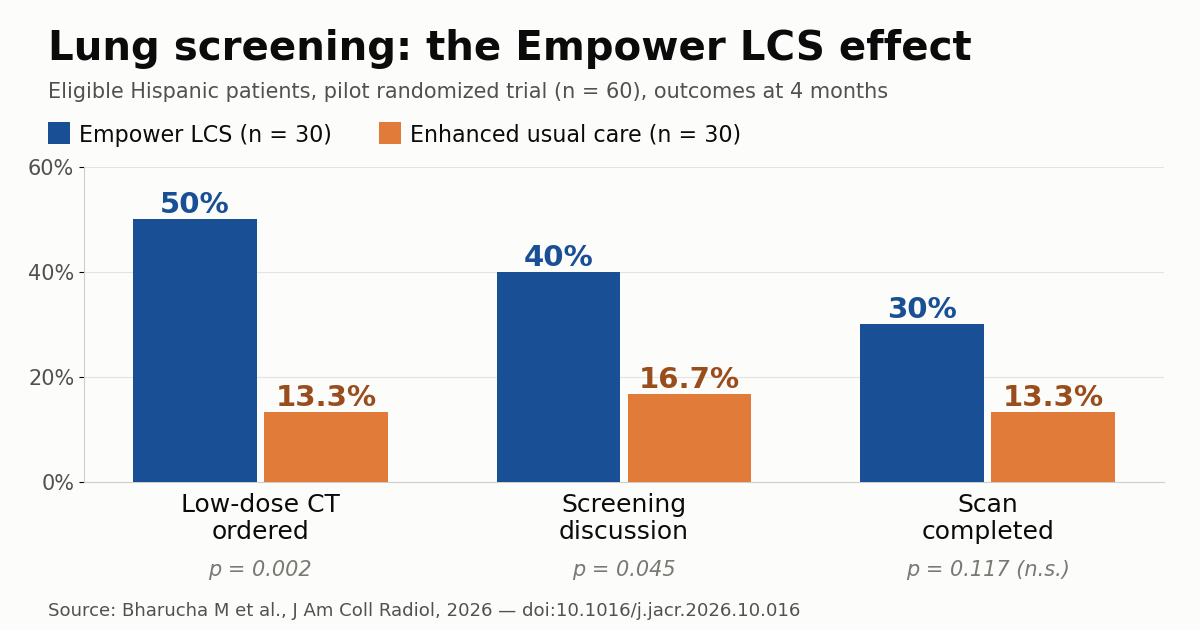
The second paper, from the University of California, Irvine (first author Mahnur Bharucha, senior author Gelareh Sadigh), is a pilot randomized controlled trial in 60 Hispanic patients aged 50 to 80 who met the 2021 U.S. Preventive Services Task Force (USPSTF) criteria: at least 20 pack-years and current smoking or quitting within the past 15 years. Of these, 35% were Spanish-speaking. Controls received enhanced usual care, meaning usual care plus a one-page handout. The Empower LCS arm received a culturally adapted decision aid, provider notification of eligibility, text-message reminders and support for health-related social needs.
At four months, LDCT ordering reached 50% with Empower LCS vs. 13.3% with enhanced usual care (p = 0.002), and screening discussions rose from 16.7% to 40% (p = 0.045). Completion was higher (30% vs. 13.3%) but not statistically significant (p = 0.117), which the authors attribute to the small sample. Qualitative interviews pointed to trust in the clinician as the driver of engagement and logistics as the barrier to completion. “These findings support culturally tailored, low-cost, scalable interventions to reduce disparities in LCS participation,” the investigators conclude. The approach echoes culturally tailored videos that improved breast screening.
How the ACR registry measures up to IASLC quality indicators
The third study asks whether programs can measure their own quality. The International Association for the Study of Lung Cancer (IASLC) has defined 26 consensus quality indicators for lung cancer screening, 20 rated essential and 6 desirable. The authors, with Groner as senior author and Ella Kazerooni among the coauthors, mapped each one to the data dictionary of the ACR Lung Cancer Screening Registry, the largest such registry in the U.S., and to its 46 clinical performance measures.
Eight indicators (30.8%) were directly measurable, 10 (38.5%) were derivable and 8 (30.8%) could not be calculated from registry data alone. The gaps cover screening uptake, clinical investigation, procedure complications, curative-intent treatment, diagnostic and treatment equity and some wait-time measures, and closing them would take new fields or external data links. Read editorially, the pattern is telling: a registry fed by radiology sees the CT suite clearly, but little of what comes before (who should have been invited) or after (biopsy, surgery), which is exactly where the other two studies found the friction.
Why primary care is the choke point
In the U.S., an LDCT requires an order, almost always from a primary care clinician. That clinician needs an accurate pack-year history, which EHRs often record poorly, and Medicare requires a counseling and shared decision-making visit before the first scan. Both intervention studies show that working on this step generates orders, and both show that an order alone does not guarantee a scan. The same pattern appeared when AI and patient navigation lifted screening rates and in our look at rising CT screening uptake and its real-world mortality effect.
What programs outside the U.S. can take from this
Countries building programs from scratch face the same three questions: who identifies eligible people, who gets them from order to scan, and what the quality system actually counts. Brazil is a useful example. It has no organized national LDCT program, and LDCT is not part of its national screening guidelines. Its most concrete step is a feasibility study launched by the National Cancer Institute (INCA) on April 1, 2026, with Rio de Janeiro’s municipal health department: at least 397 current and former smokers aged 50 to 80, recruited through the city’s smoking cessation program, followed for two years and funded by AstraZeneca, according to Agência Brasil. National programs discussed at the WCLC 2026 sessions on scaling LDCT screening face versions of the same issues.
Our editorial reading is that the drop between order and scan argues for building navigation and scheduling into any program from day one, the same lesson that applies to lung nodule follow-up programs. And the registry crosswalk shows that a quality system fed only by imaging data cannot track uptake or treatment.
Limitations and what to watch
None of these studies is definitive. LungCheck is a before-and-after comparison at two New York sites with no control group, so secular trends cannot be ruled out. Empower LCS enrolled 60 patients in one health system, partly relied on self-report, and its adjusted effect on ordering has a wide confidence interval (OR 7.32; 95% CI, 1.97–34.16). The IASLC crosswalk shows what the registry could measure, not how programs perform. Next up: a cluster randomized trial of an expanded LungCheck and Empower LCS/Call+, a pilot now recruiting at UC Irvine and Emory that adds telephone navigation for patients not screened by four months.
Source: The Imaging Wire — Better Lung Screening Strategies. Studies: Groner LK et al., LungCheck, JACR 2026; Bharucha M et al., Empower LCS, JACR 2026; Stoel G et al., ACR registry and IASLC indicators, JACR 2026.