
Keeping the bladder is now a first-line option
ASTRO released its first clinical guideline devoted entirely to radiation therapy in bladder cancer on September 16, and the headline conclusion is unambiguous: in carefully selected patients with muscle-invasive disease, keeping the bladder is a curative strategy that belongs on the table next to radical cystectomy, rather than a consolation prize for people too frail for surgery.
Task force chair Jason A. Efstathiou, of Mass General Brigham Cancer Institute and Harvard Medical School, framed it as a matter of how the choice is offered: bladder preservation, he said, should be presented as a curative option alongside radical cystectomy for appropriately selected patients with muscle-invasive disease. Vice chair Leslie K. Ballas, of Cedars-Sinai and first author of the document, added that radiation’s role in this disease reaches well past organ preservation. ASTRO expects roughly 85,000 new US bladder cancer diagnoses and 18,000 deaths in 2026.
Four key questions, one systematic review
The guideline appears in Practical Radiation Oncology (DOI 10.1016/j.prro.2026.09.001) and rests on a systematic review spanning 2009 through 2024, with 197 cited references. Its four key questions map the whole disease course: indications for curative-intent bladder preservation in non-metastatic disease; technique and dose-fractionation for the intact, localized or node-positive bladder; indications and technique for postoperative radiation; and when to irradiate the bladder or metastatic sites in the explicitly non-curative setting. The panel was assembled with the American Society of Clinical Oncology, the European Association of Urology and ESTRO, and it included urologists, medical oncologists, a medical physicist and a patient representative alongside radiation oncologists.
Trimodal therapy — maximal transurethral resection followed by radiation with concurrent radiosensitizing systemic therapy — is recommended as an alternative to radical cystectomy in selected cT2-4aN0M0 cases. ASTRO’s announcement spells out the favourable profile: a solitary tumour under 7 cm, predominantly urothelial histology, no extensive carcinoma in situ and no hydronephrosis. Neoadjuvant or induction systemic therapy is recommended for patients at higher risk of distant progression.
Two target architectures are endorsed: full dose to the whole bladder, or a reduced dose to the uninvolved bladder with a partial boost aimed at the tumour. Elective nodal irradiation is only conditionally recommended and depends on tumour characteristics, which puts renewed weight on target delineation and field setup in the bladder. After cystectomy, adjuvant radiation is conditionally recommended for urothelial carcinoma with (y)pT3-4 disease, involved nodes or positive margins. In high-burden metastatic disease with local symptoms such as bleeding or pain, bladder-directed radiation is recommended; in asymptomatic patients with high metastatic burden, it is not.
The trials underneath the recommendations
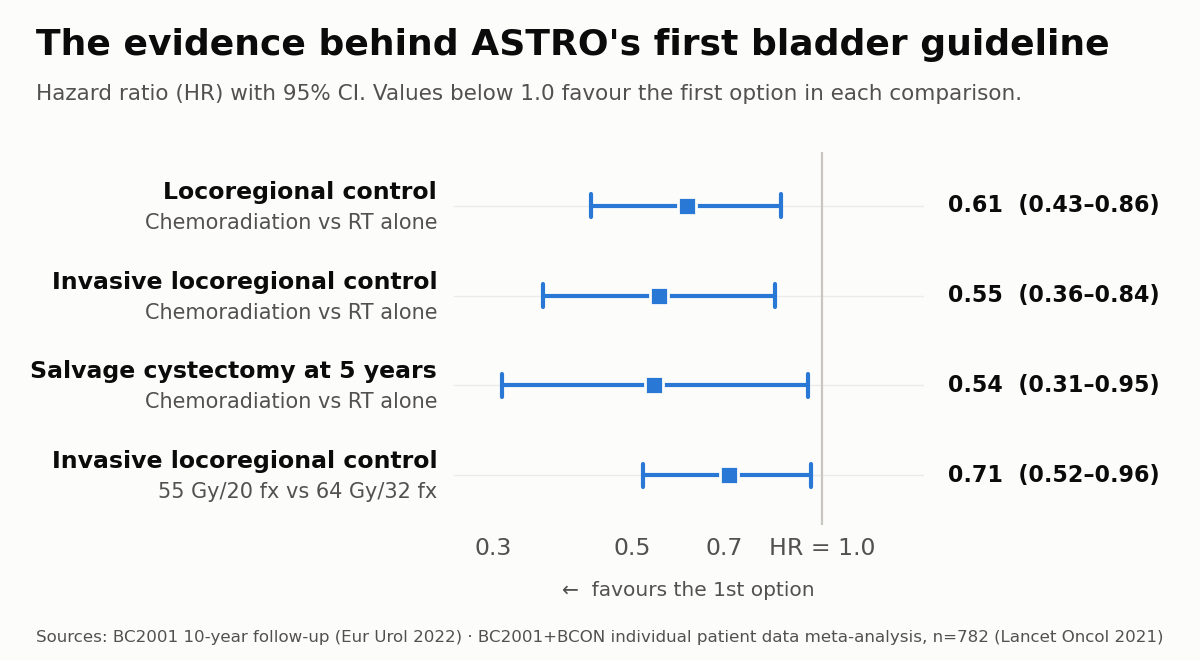
Most of the evidence is British. BC2001, the largest randomised bladder-sparing trial, enrolled 458 patients with T2-T4a N0M0 disease between 2001 and 2008. Its ten-year follow-up, published in European Urology in 2022, confirmed the value of adding 5-fluorouracil and mitomycin C to radiation: a hazard ratio of 0.61 for locoregional control (95% CI 0.43-0.86; p = 0.004) and 0.55 for invasive locoregional control (0.36-0.84; p = 0.006). The five-year cystectomy rate fell from 22% with radiation alone to 14% with chemoradiation (HR 0.54; 0.31-0.95; p = 0.034). Survival endpoints trended the same way without reaching significance.
Fractionation has also been settled. An individual patient data meta-analysis of 782 patients from BC2001 and BCON, published in The Lancet Oncology in 2021 and led by Ananya Choudhury — now a co-author of the guideline — compared 55 Gy in 20 fractions over four weeks against 64 Gy in 32 fractions over six and a half weeks. At a median follow-up of 120 months, the short course was not merely non-inferior: it cut the risk of invasive locoregional recurrence (adjusted HR 0.71; 0.52-0.96) with an equivalent toxicity profile (risk difference -3.37%; -11.85 to 5.10).
The phase 2 RAIDER trial tested the next step — daily plan selection. It randomised 345 patients with unifocal T2-T4a tumours between 2015 and 2020 to conventional whole-bladder treatment, standard-dose adaptive radiotherapy or dose-escalated adaptive radiotherapy at 60 Gy in 20 fractions or 70 Gy in 32. Among escalated patients, 86% in the 20-fraction cohort and 90% in the 32-fraction cohort met the mandatory medium-plan dose constraints, and radiotherapy-related late grade 3 or worse toxicity occurred in one of 58 and none of 56 patients respectively. Two-year overall survival reached 80% in the escalated arm, and only 3.8% of the whole cohort needed a salvage cystectomy.
What a department has to be able to do
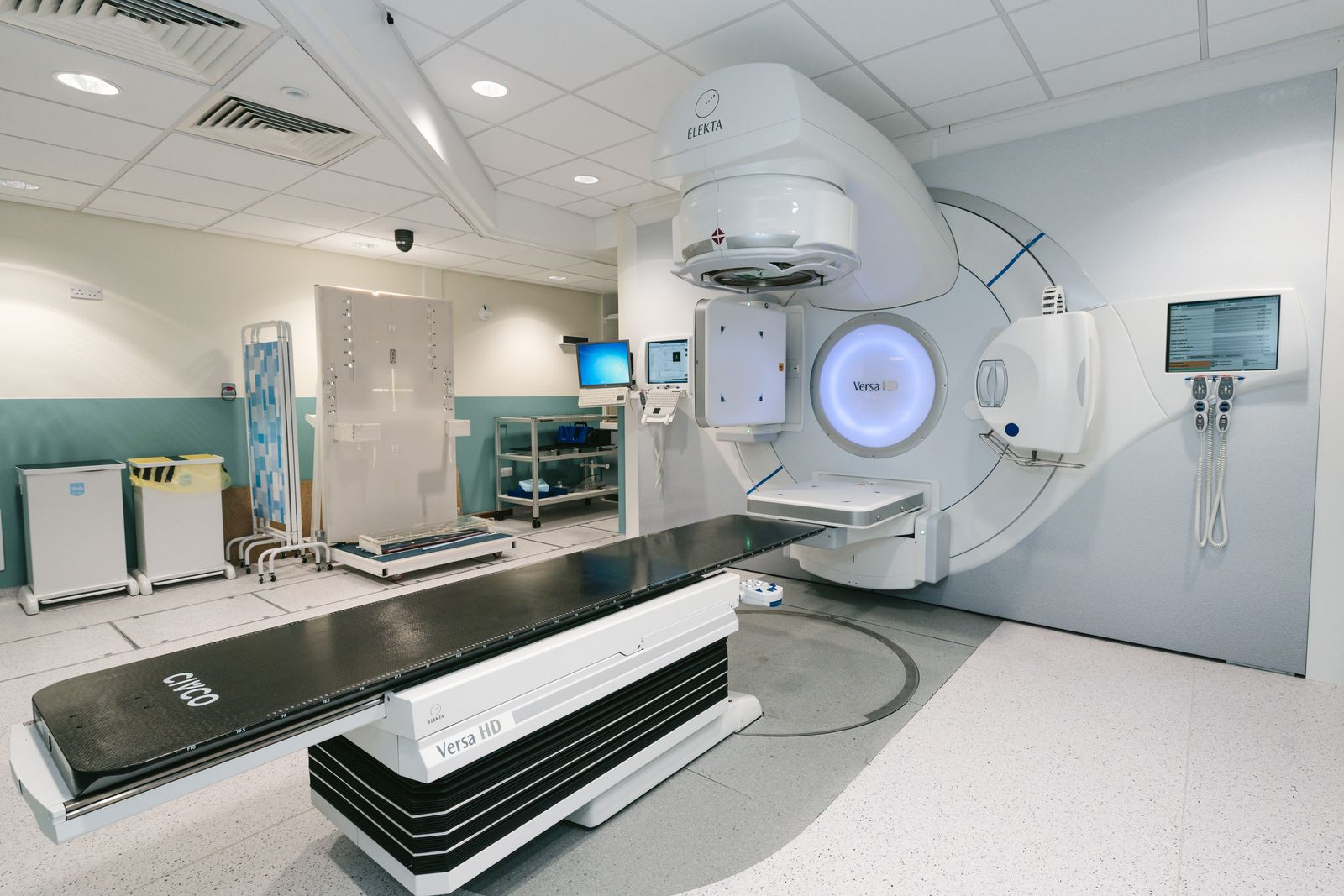
The technical recommendations are where the guideline bites. IMRT with daily image guidance, paired with published target coverage goals and normal tissue dose constraints, turns bladder filling control into a requirement rather than a refinement. The bladder moves and deforms; its volume differs between the planning scan and every single fraction, and without daily imaging the tumour drifts out of the high-dose region. Plan-of-the-day protocols with small, medium and large plan libraries demand cone-beam CT at every fraction, therapists trained to pick a plan in minutes, and physics support at the console — the same backbone that makes dose recalculation on CBCT and synthetic CT workable in adaptive workflows.
There is an organisational cost too. Trimodal therapy only works when urology, medical oncology and radiation oncology decide together: the resection has to be maximal, concurrent chemotherapy has to start on schedule, and surveillance cystoscopy has to be booked before treatment ends. The guideline recommends multidisciplinary evaluation for every patient, and in most health systems that coordination, not the linac, is the limiting factor.
What is still unsettled
Several questions stay open. Elective nodal irradiation remains conditional because randomised data are thin. The role of concurrent and adjuvant immunotherapy in bladder preservation depends on trials still reading out. And adaptive dose escalation, safe though it looked in RAIDER, was tested in a non-comparative phase 2 design — there is no randomised proof yet that pushing the tumour to 60 Gy in 20 fractions improves cancer outcomes over the standard 55 Gy.
The direction of travel is familiar from ASTRO’s work at other sites, including the recent update to the pancreatic radiation guideline: shorter schedules, mandatory daily imaging and decisions pushed into the multidisciplinary board. What this document delivers, for the first time under ASTRO’s name, is a curative non-surgical pathway written with the same technical precision cystectomy has always enjoyed.
Source: AuntMinnie