
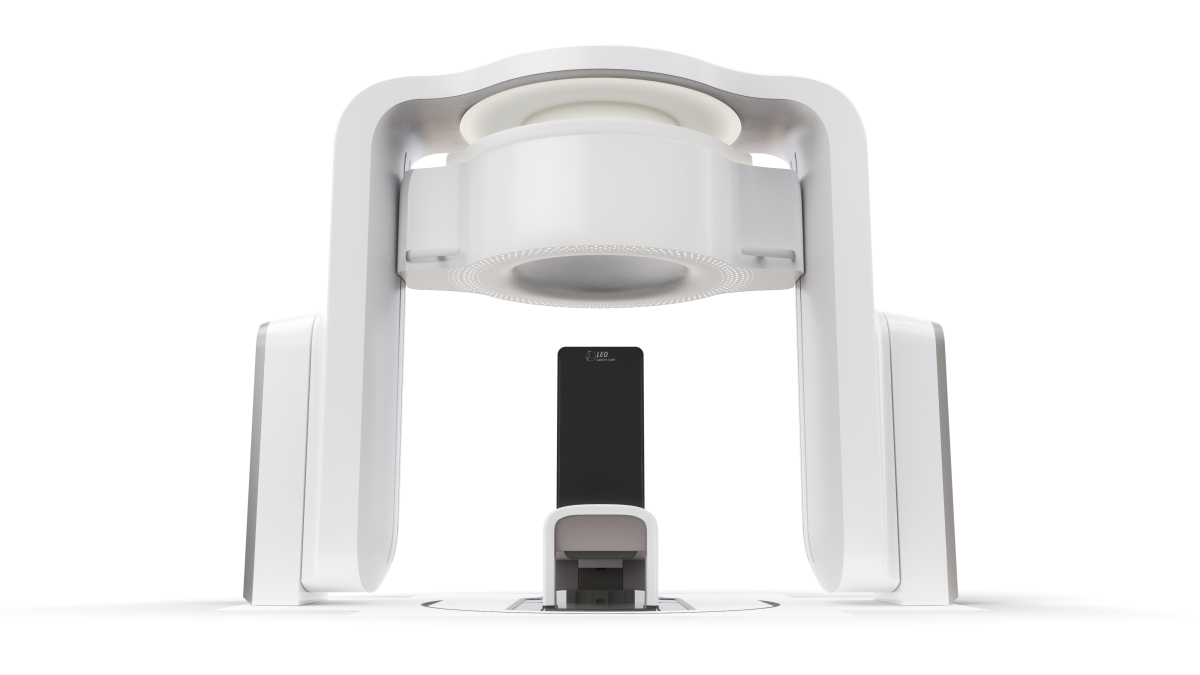
Particle therapy stands at a turning point. For decades, the expansion of proton and ion beam centers has been held back by the enormous size and prohibitive cost of the facilities required to house rotating gantries. Now, a US-based company called Leo Cancer Care has introduced a platform that could fundamentally reshape the infrastructure equation. The Marie® system uses upright patient positioning to eliminate the rotating gantry entirely — the single largest and most expensive component in any particle therapy installation — enabling advanced treatments to fit inside a room the size of a standard linear accelerator vault.
The Rotating Gantry Problem in Particle Therapy
Conventional proton therapy systems rely on massive rotating gantries to steer the particle beam around a supine patient from multiple angles. These structures can weigh hundreds of tons and require concrete bunkers that easily exceed three stories in height. The result is an installation cost that can surpass 200 million dollars, limiting access to a handful of major medical centers worldwide. Even mid-sized hospitals with a genuine clinical interest in particle therapy face financial and spatial barriers that make the investment impractical.
This structural limitation means that thousands of patients who would benefit from the ballistic precision of protons continue to receive conventional photon-based treatments. The medical physics community has recognized this bottleneck for years, and developments such as the integration of artificial intelligence with Monte Carlo simulations have helped optimize existing treatment planning workflows. However, the fundamental engineering problem remained unsolved until now.
How Marie® Addresses Size and Cost Barriers
Leo Cancer Care’s approach inverts the conventional logic. Instead of rotating a multi-hundred-ton structure around the patient, Marie® keeps the beam fixed and positions the patient vertically — either seated or in a semi-supported perched posture. The system provides six degrees of freedom for precise positioning adjustments, ensuring that the target volume receives the planned dose with accuracy comparable to gantry-based systems.
By removing the rotating gantry, the platform dramatically reduces the space required for the treatment room. An installation that previously demanded an industrial-scale bunker can now operate within dimensions similar to those of a standard LINAC vault. The associated cost reduction extends beyond civil construction; maintenance, energy consumption, and shielding requirements all decrease proportionally. This economy makes particle therapy financially feasible for a much larger number of institutions around the world.
The engineering simplification also carries implications for reliability. Fewer massive moving parts mean fewer potential mechanical failure points, which can translate into higher uptime and lower maintenance costs over the life of the equipment. For institutions operating in resource-constrained environments, this reliability advantage may prove as significant as the initial cost savings.
Compatibility with Multiple Beam Types and Modalities
One of Marie®’s most compelling features is its versatility. The platform is designed to integrate with any fixed particle beam available on the market, including protons, carbon ions, neutrons, and even FLASH therapy systems. This flexibility means that centers already equipped with particle accelerators can incorporate Marie® without replacing their entire beam generation infrastructure.
Compatibility with heavy ion beams, whose treatment planning benefits enormously from Monte Carlo simulations, extends the platform’s clinical potential to radioresistant tumors and pediatric cases. The integration with FLASH therapy — a modality that delivers ultra-high doses in fractions of a second — positions Marie® at the forefront of two of the most promising trends in modern radiation therapy simultaneously.
The system also includes an integrated fan beam CT at isocenter. This capability allows patient position verification immediately before and during treatment, without the need for transfer between devices. The integrated CT is a key enabler for online adaptive therapy, in which the treatment plan is adjusted in real time based on the anatomy of the day.
Patient Benefits and Clinical Outlook
Upright positioning during treatment offers advantages that go beyond engineering convenience. Patients with tumors in the head and neck, lung, or mediastinum can experience significant organ displacement when positioned supine — the weight of viscera and the action of gravity alter internal geometry. In a seated or semi-supported position, the anatomy more closely resembles the body’s habitual configuration during waking hours, which may result in smaller treatment margins and better preservation of healthy tissues.
From a psychological perspective, remaining seated with an open field of vision reduces the sense of confinement frequently reported by patients undergoing conventional radiotherapy. Leo Cancer Care describes the experience as more empowering — the patient maintains visual contact with the treatment team and the environment, which can help reduce anxiety and improve treatment adherence.
Reduced treatment time is another stated goal of the platform. With faster positioning and integrated image verification, the expectation is that each session can be completed in less time than with gantry-based systems. For high-volume centers, this translates into the capacity to treat more patients per day with the same infrastructure.
Online Adaptive Therapy as Standard of Care
Leo Cancer Care positions Marie® as a platform that paves the way for online adaptive therapy to become the standard of care. In this paradigm, each treatment fraction is preceded by a volumetric image of the patient, and the dosimetric plan is recalculated or adjusted to reflect anatomical changes — such as tumor shrinkage, weight loss, or variation in hollow organ filling.
The feasibility of this approach depends on extremely fast dose calculation algorithms. It is in this context that the fundamentals of Monte Carlo methods applied to radiation therapy gain practical relevance: the combination of dedicated hardware with GPU-accelerated simulations can enable dose recalculation in seconds, making online adaptation clinically viable even in high-throughput environments.
Timeline and Market Impact
Leo Cancer Care has announced that 2026 will be the year Marie® becomes a clinical reality for patients in the United States. If the timeline holds, it will be the first commercial upright particle therapy platform to enter routine clinical operation. The potential impact on the particle therapy market is substantial: by lowering the barrier to entry, Marie® could multiply the number of centers capable of offering proton therapy, especially in regions where existing hospital infrastructure cannot accommodate conventional installations.
For the medical physics and dosimetry ecosystem, the arrival of a new treatment geometry introduces both challenges and opportunities. Commissioning protocols, planning algorithms, and quality assurance procedures will need to be adapted for the upright configuration. At the same time, the mechanical simplification of the system may facilitate standardization and reduce inter-center variability.
Marie® represents more than a new piece of equipment — it is a paradigm shift in how particle therapy is conceived, installed, and delivered. If the promise of democratizing access to proton therapy is fulfilled, the benefits for cancer patients worldwide could be transformative.
Source: DOTmed News