Lessons from the Goiania radiological accident with cesium-137 reshaped global thinking on radioactive source security and emergency preparedness. The 1987 accident — one of the most serious involving sealed sources outside the nuclear industry — exposed systemic failures that went far beyond a single act of negligence. This article examines the observations and recommendations from the official IAEA report, covering regulatory systems, emergency response chains, medical preparedness, international cooperation, and the practical changes the disaster prompted in radiation protection worldwide.
For the full context of the accident — from the initial timeline to the environmental response — see our comprehensive guide to the Goiania radiological accident.
Radioactive Source Security: The Cardinal Rule
The IAEA report opens its final observations with a direct statement: security of the source is of paramount importance. Goiania demonstrated that actions which would be innocuous under ordinary circumstances became matters of life and death due to the presence of uncontrolled radioactive material. Sources removed from their designated location in the notification, registration, and licensing process present a serious hazard — and this principle has clear parallels with the safety of other hazardous materials such as cyanide or arsenic.
Primary responsibility lies with the source holder, not the regulator. Integrity audits, physical security arrangements, and periodic verification are the licensee’s obligations. The regulatory system, however robust, functions as a secondary check — an audit of the licensee’s compliance. In practice, resource limitations inevitably constrain the frequency of periodic inspections.
One proposal from the report deserves special attention. Rather than requiring licensees to simply maintain records for inspection, they could be required to notify the regulatory authority each time source integrity is verified. The suggested mechanism was a machine-readable postcard. If a licensee failed to report on schedule, the authority would be automatically alerted to check the source’s status. This concept — specific, simple, and enforceable — anticipated practices that only became standard decades later.
Hazard Markings and Physicochemical Properties of Sources
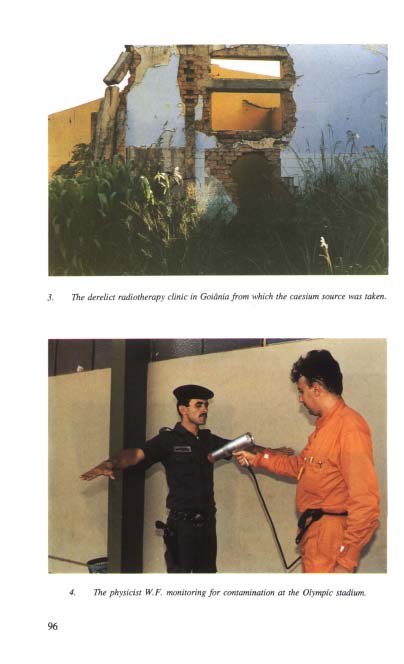
The blue glow of the cesium-137 chloride attracted curiosity and fascination among people in Goiania, directly influencing the course of the accident. The report recommends that radiation hazard markings be recognizable by the general public, not just trained professionals. The international radiation symbol works well in controlled environments but failed completely when the source reached the hands of civilians with no technical background.
The physical and chemical properties of sources must be considered in manufacturing licensing. The solubility and ease of dispersion of cesium chloride had a profound effect on the Goiania accident. The report notes that many less radioactive cesium-137 sources are already manufactured in vitrified form, which significantly inhibits dispersion. However, vitrified sources cannot achieve the high specific radioactivity required for radiotherapy equipment. This technical dilemma — clinical performance versus intrinsic safety of the chemical form — remains a relevant question for licensing authorities.
Chain of Command and Radiological Emergency Preparedness
To respond to a serious radiological accident, a country would probably need to engage many of its qualified personnel — possibly from widely separated establishments — and make use of much of its available equipment. The report stresses that an emergency plan must anticipate the need for integration of these capabilities, with a command structure already in place.
Goiania was remote from Brazil’s centers of radiological expertise. The logistics of mobilizing personnel and equipment was one of the greatest difficulties — air transport proved essential. The report insists that it is not enough to assign responsibilities: the authority to cut through bureaucracy must be conferred in advance. A clear chain of command facilitates the provision of all necessary resources during emergencies, including immediate mobilization.
Preparedness for radiological emergencies must not be limited to nuclear accidents. Goiania is a stark example of a serious radiological accident outside the nuclear industry. The report notes that most fatal radiological accidents had occurred outside the nuclear sector, citing similarities with the Ciudad Juarez accident in Mexico in 1983. International and national authorities had invested significant effort in nuclear accident preparedness, but other types of radiological emergencies had received far less attention.
Authorities must ensure that well-known, accessible means exist to summon assistance and notify relevant bodies when an accident affects the public. The report suggests using local organizations such as police and fire departments as designated contacts, leveraging each country’s existing infrastructure. For a detailed analysis of how the discovery and initial mobilization unfolded, see our article on the discovery of cesium-137 and initial response in Goiania.
Radiation Monitoring and Cytogenetic Dosimetry
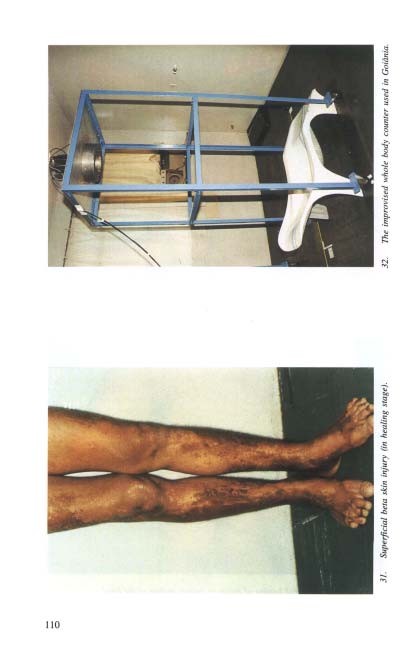
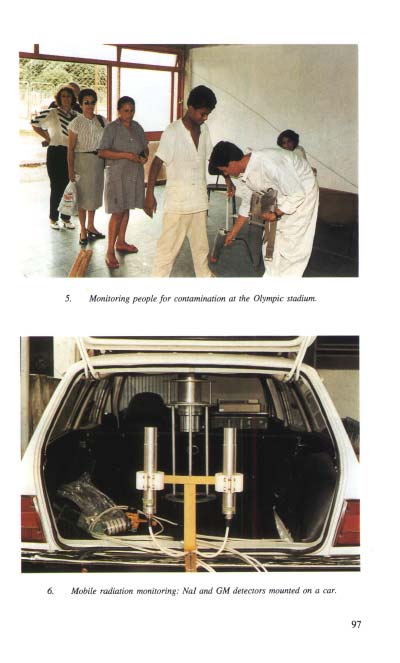
Readily transportable equipment for bioassay and whole body monitoring may be needed in addition to permanent dedicated facilities, according to the report. In Goiania, an improvised whole body counter was assembled using a leisure chair as the patient support and an NaI detector positioned at an unusually large distance. It worked, but the improvisation underscores the need for equipment that can be quickly deployed and adapted.
In total, 55 dose rate meters, 23 contamination monitors, and 450 quartz fiber electrometers (QFEs) were used. Instruments from various sources — CNEN and its institutes (IRD, IEN, IPEN), FURNAS, NUCLEBRÁS, universities, research facilities, and foreign aid — arrived in many cases without calibration certificates or instruction manuals. Continuous maintenance was inevitable, and an electronics and calibration laboratory had to be established directly in Goiania during the early phase.
Cytogenetic dosimetry — based on the analysis of chromosomal aberrations in lymphocytes — was confirmed as an extremely useful technique for estimating external whole body radiation dose and dose inhomogeneity. This information is valuable for physicians responsible for diagnosis and prognosis. The report recommends that national emergency plans ensure the availability of laboratories capable of this work, either domestically or through international cooperation agreements. Inter-comparison programs among laboratories should be conducted to establish coherence in results. For details on the dosimetric methods used, see the article on dosimetry and exposure assessment in the Goiania accident.
Medical Response and Internal Decontamination with Prussian Blue
Prussian Blue (ferric ferrocyanide) was confirmed as efficacious in promoting internal decontamination from cesium-137. The identified efficacy threshold was a daily dose of 3.0 g, administered as 1.0 g orally three times per day. The report recommends that national pharmaceutical authorities consider permitting emergency doses of up to 10–12 g per day for adult patients, given the exceptional circumstances of significant radioactive material incorporation.
Granulocyte macrophage colony stimulating factor (GM-CSF) produced questionable results when used in Goiania patients. The probable cause was unknown optimal dosages and timing of administration. The report recommends further experimental and clinical studies before any new application in actual radiological accidents.
A recurring pattern in radiological accidents is the difficulty of initial diagnosis. Affected people seek medical help for radiation exposure effects, but correct diagnosis is rarely made immediately. In previous accidents, misdiagnoses included insect bite, spider and snake bites, viral infection, and exposure to toxic chemicals. Recognizing radiation injury depends on educating health and safety professionals broadly — not just radiation protection specialists. The report proposes that Goiania serve as a case study in educational programs for health and safety professions.
Therapy for radiological accident casualties is varied and complicated. Patients need hospitals and staff engaged daily in hematological, chemotherapeutic, radiotherapeutic, and surgical treatment of cancer patients, the immunosuppressed, and those with blood dyscrasias. In most settings, medical personnel and facilities are not prepared for radiation injuries. Emergency plans must provide for immediate assistance from trained specialists. For the full medical response details, see our article on the medical response to the Goiania accident victims.
Remediation Criteria and Operations Under Adverse Conditions
After a radiological accident causing widespread contamination, there is typically a temptation to impose extremely restrictive criteria for remedial actions, usually prompted by political and social considerations. The report warns that such criteria impose substantial additional economic and social burdens on top of the accident’s direct damage.
The IAEA recommended a range of reference dose levels for remedial actions considered not unnecessarily restrictive. Normal planned exposure dose limits were not intended for application to accidental exposures — using them as post-accident remediation criteria is an unnecessary restriction. Nevertheless, the report realistically acknowledges that social and political pressures influencing the decision-making process should not be underestimated.
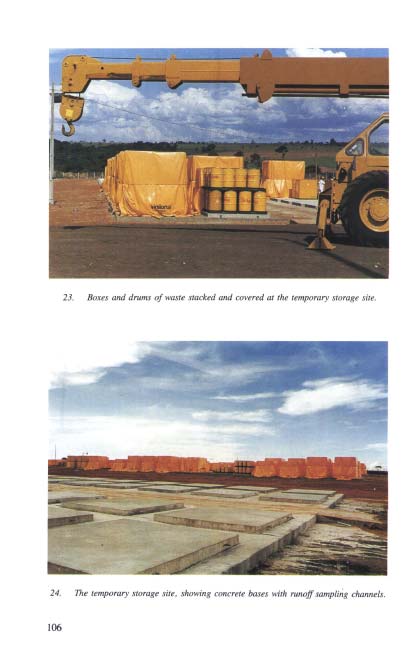
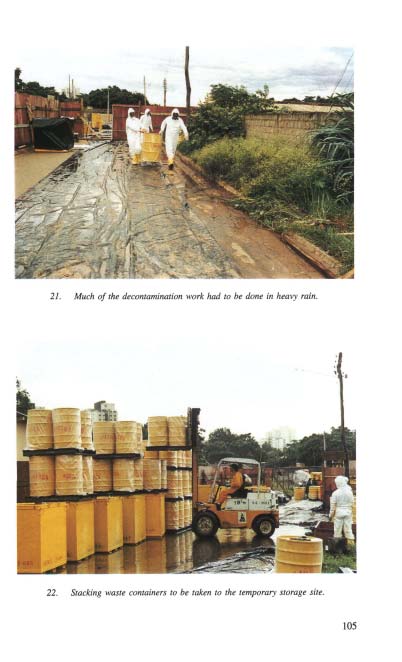
Two practical operational problems deserve particular mention. First, emergency equipment must be capable of operating in adverse ambient conditions. In Goiania, much of the decontamination work took place during intense tropical rainstorms. Removing contaminated mud from the most critical hotspots — with surface dose rates reaching 1.5 Sv/h — required careful planning to keep the daily dose of the 550 workers within the 1.5 mSv operational limit.
Second, there will almost certainly be a need to engage workers without previous radiological experience. Even professional staff may lack relevant operational experience for real emergency situations. Emergency plans must include provisions for rapid training. For details on the decontamination operations and waste management, see the article on environmental contamination and decontamination in Goiania.
International Cooperation and Accident Documentation
An IAEA-Brazil cooperation program on emergency preparedness was already underway before the Goiania accident. It included expert missions to Brazil, laboratory construction, and staff training through fellowships and technical missions. One particularly significant outcome was the training of a physician in radiological accident medicine — a capability that proved extremely valuable during the actual response.
Brazilian authorities informed the IAEA soon after the accident’s discovery and requested assistance under the Convention on Assistance in the Case of a Nuclear Accident or Radiological Emergency. The aid included experts and equipment from several countries. Since the accident, collaborative activities between Brazilian and international experts have produced evaluations that fed improvements into radiation protection systems worldwide. The report itself is a product of this international review.
The report insists on a frequently overlooked point: if lessons are to be learned and incorporated into emergency plans, the facts of an accident must be documented as soon as possible, since they tend to become blurred with time. An official recorder should be an integral part of the emergency response team from the very outset, facilitating subsequent reconstruction of the sequence of events.
Information dissemination to the media, the public, and the response force itself is equally critical. Meeting information needs during an accident drains resources from the very people trying to deal with the consequences. The report recommends that radiological emergency teams have administrative and public information support appropriate to the scale of the accident. Major emergencies require prompt on-site support. All individuals designated to respond to radiological emergencies should undergo formal training and drills appropriate to their functions.
The accident in Goiania was one of the most serious radiological accidents to date, causing radiation injuries to dozens of people — four of them fatally — and radioactive contamination across parts of the city. Radiological accidents are rare events, but rarity does not justify complacency. The public must feel confident that competent authorities are doing everything possible to prevent them. Learning the lessons of Goiania is a fundamental part of that commitment. For an integrated view of the entire event, visit our comprehensive guide to the Goiania radiological accident.