
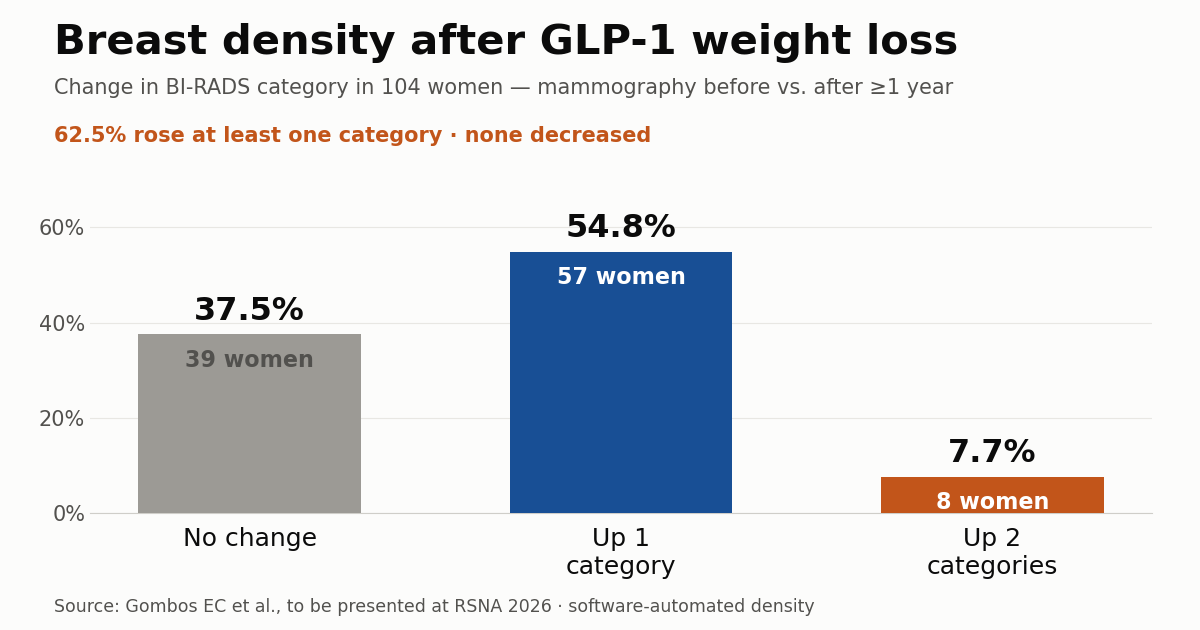
GLP-1 weight-loss drugs may raise the breast density measured on mammograms, according to a retrospective study to be presented next week at the RSNA 2026 annual meeting in Chicago. Among the 104 women with automated assessments available, 62.5% moved up at least one BI-RADS density category after losing weight, and none showed a decrease.
The finding matters because breast density is both an obstacle to reading mammograms and a marker of breast-cancer risk. As semaglutide and tirzepatide spread rapidly, the observation suggests that fast weight loss may shift the very parameter that drives supplemental-imaging recommendations.
What the study measured
The team led by Eva C. Gombos, an assistant professor of radiology at Harvard Medical School and associate physician of radiology at Brigham and Women’s Hospital, reviewed screening mammograms from 107 women, mean age 57.5 and ranging from 34 to 79. Each had one exam before treatment and another after at least one year on a GLP-1 drug, for 214 mammograms in all. Mean weight loss was 39.7 pounds, about 18 kg, with a range of 6 to 107 pounds.
Density was graded by three breast radiologists and by an automated software application (Quantra, Hologic), which produced BI-RADS categories for 104 of the participants. Density rose by one category in 57 women (54.8%) and by two categories, from fatty to heterogeneously dense, in 8 women (7.7%). The greater the weight loss, the larger the increase. “It was surprising that 62.5% of women had increased BI-RADS breast density despite substantial weight loss with no decreases observed. This may reflect disproportionate loss of breast fat, causing a relative increase in mammographic density even as absolute fibroglandular volume decreases,” Gombos said. The radiologists also noted breast-size reduction in 57.9% to 78.5% of patients.
Why density weighs on screening
BI-RADS sorts the breast into four density categories, from almost entirely fatty, through scattered and heterogeneously dense, to extremely dense. Fibroglandular tissue appears white on a mammogram, the same shade as many tumors, while fat appears dark. Dense breasts therefore hide lesions and lower the exam’s sensitivity, an effect known as masking, and that loss of sensitivity is steepest in the two densest categories. Density is also an independent risk factor: women with dense breasts are more likely to develop cancer than women with fatty breasts, which is why the shift documented here is drawing attention. That dual role makes density a trigger for offering supplemental MRI or ultrasound and for patient notification, now mandatory in the United States.
A category change is not a clerical detail. It can move a woman from the group for whom mammography alone suffices into the group advised to get additional imaging, with direct effects on cost, scheduling and anxiety. The work fits a wider push to refine density reporting, including the 2025 BI-RADS lexicon update.
The proposed mechanism and the GLP-1 context
GLP-1 receptor agonists such as semaglutide (Ozempic, Wegovy) and tirzepatide (Mounjaro, Zepbound) mimic incretin hormones, curb appetite and drive substantial weight loss. Mammographic density is a relative measure: it reflects the proportion of fibroglandular tissue, which is radiodense, to fatty tissue, which is radiolucent. The authors propose that weight loss strips fat from the breast faster than fibroglandular tissue, so the dense fraction grows in relative terms even as absolute glandular volume falls. The dose-response pattern supports that reading. This view of fat metabolism echoes imaging work on how GLP-1 drugs act on adipose tissue.
What changes in practice
In Brazil and across Latin America, GLP-1 uptake is climbing fast, and density notification is not standardized as it is under the US regulatory model. For mammography services the practical message is clear: ask directly about GLP-1 use and recent weight loss when reading serial exams. A density rise between one mammogram and the next can be biologically expected in someone who has lost weight, not necessarily a sign of new disease; recognizing that helps calibrate recalls, prior-year comparisons and the decision to add supplemental ultrasound. If the pattern holds in a growing population of GLP-1 users, services could see more women crossing into the dense categories and, with them, more supplemental studies and recall examinations. Recording the medication in the history should improve exam comparability over time and keep a single, expected density shift from being misread as a new finding.
Limitations and what to watch
The study is retrospective, with only 107 women, and density was also gauged by automated software that carries its own variability. Because it is a conference abstract, the data have not yet been peer-reviewed and may change in the final publication. The work describes an imaging association, not a clinical outcome: it does not show that the measured density increase corresponds to higher real cancer risk in these patients, nor does it track long-term follow-up. The next step is to confirm the finding in larger cohorts and to test whether density stabilizes or keeps rising with longer treatment.
Source: Diagnostic Imaging – Mammography Study Shows Increase of Breast Density with GLP-1 Medications | RSNA – official study release