
A new study in Radiology has shown that artificial intelligence applied to screening mammograms can track how a woman’s breast cancer risk evolves over the years — not just estimate it at a single point in time. By following that risk longitudinally, AI gives clinicians a practical tool for flagging women who may benefit from closer surveillance well before a tumor becomes visible.
What the study set out to do
Risk prediction has become one of the most promising applications of AI in breast imaging. Just weeks ago, another paper showed that three commercial AI models could predict breast cancer up to six years before diagnosis — a development we covered in our piece on AI that forecasts breast cancer risk a decade in advance. At least one model, Clairity Breast from Clairity, has earned FDA clearance for image-based risk prediction, with others under agency review.
Most of these studies, however, calculate risk at a single moment. That is useful, but it ignores an important nuance: a woman’s risk is not static. It can change as factors such as breast tissue density shift over a lifetime, directly altering her risk profile. To close that gap, the authors tracked risk longitudinally using Mirai, an open-source algorithm already validated as more accurate than traditional clinical models such as Tyrer-Cuzick and BCRAT.
Methods and the key numbers
The researchers retrospectively applied Mirai to roughly 54,000 women who underwent mammography between 2009 and 2019, then compared how risk scores changed in those who developed cancer versus those who stayed healthy. The contrast was striking and clinically coherent:
- Among women later diagnosed with cancer, the median risk score six years before diagnosis rose from 2.1 to 6.6.
- In women who remained cancer-free, scores were essentially stable (1.8 to 2.2).
- The annual rate of increase was far higher in the cancer group (1.13 per year) than in the cancer-free group (0.09 per year).
Women who developed disease tended to be older and to have dense breast tissue or a personal or family history of breast cancer — profiles that reinforce the clinical plausibility of the findings. More than any single score, it was the upward trajectory that separated the two groups.
What the AI is actually seeing
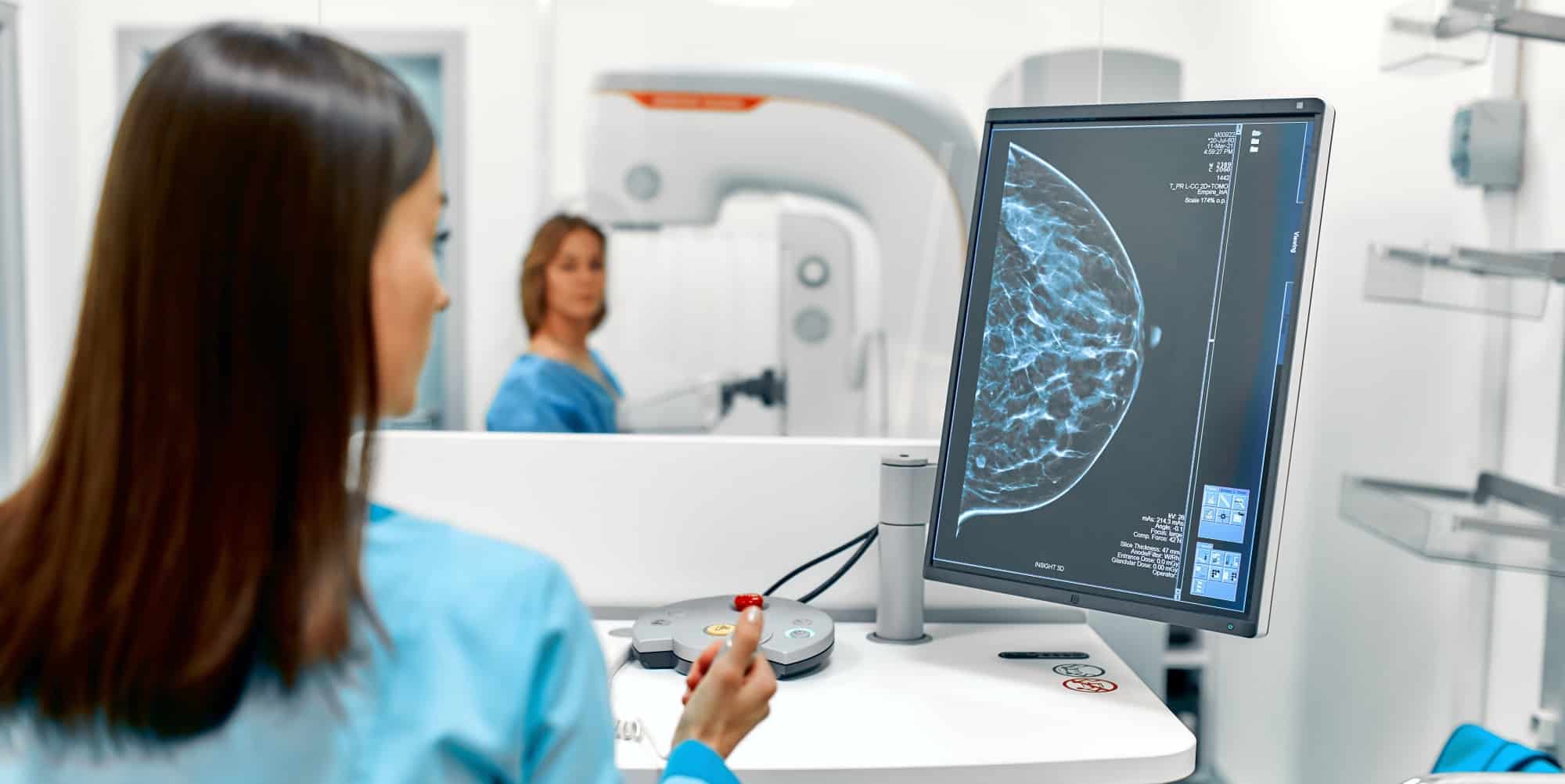
That raises an unavoidable question: what is the algorithm detecting if the cancer is not yet visible to the radiologist reading the mammogram? The most likely answer is that AI is picking up subtle shifts in breast parenchymal tissue patterns — changes that, in the authors’ words, “may precede radiographic detection.” In effect, those patterns act as imaging biomarkers. This is where the real value lies: it turns the mammogram, today used mainly to find lesions that already exist, into a sensor that can signal trends before anything becomes palpable or visible to the human eye.
It is worth underscoring why a longitudinal signal matters more than a one-off score. A single elevated reading can reflect noise, positioning, or transient density changes. A score that climbs steadily across several rounds of screening, by contrast, is far harder to dismiss as an artifact — it behaves like a biological trend. That distinction is exactly what makes the Mirai trajectory clinically interesting: it converts a static snapshot into something closer to a moving baseline, the way a cardiologist watches a trend in blood pressure rather than a single measurement.
Implications for clinical practice
For radiologists and screening programs, longitudinal reading opens the door to personalized screening intervals, supplemental modalities such as MRI or ultrasound, and tailored preventive strategies. Rather than scanning every woman on the same biennial cadence, programs could intensify follow-up precisely for those whose scores are climbing steadily, while avoiding overburdening women whose risk stays flat. This dynamic stratification fits squarely within the personalized-medicine trend that also surfaces when we review the leading AI vendors already cleared by the FDA.
In settings where screening capacity is uneven across regions — much of Latin America included — tools that help prioritize who truly needs additional imaging can stretch scarce resources without indiscriminately inflating exam volumes. The benefit is operational as much as it is clinical.
Outlook and limitations
The usual caution applies: this is a retrospective study, and prospective validation across diverse populations is the natural next step before any large-scale adoption. It will also be essential to confirm that these models hold up across different equipment, ethnicities and age groups, and to define how clinicians should act on a rising score in day-to-day practice. Even so, the work meaningfully advances our understanding of how risk can be calculated long before a diagnosis — and it is easy to picture that knowledge translating into earlier intervention, exactly the kind of promise that defines the rise of personalized medicine in radiology.
Source: The Imaging Wire