
Prostate cancer screening gets a clearer path in a new American Cancer Society (ACS) guideline that supports PSA testing every two years for average-risk men aged 50 to 69 and leans on MRI to avoid unnecessary biopsies. Published on November 12, 2026, in CA: A Cancer Journal for Clinicians, it is the group’s first major revision since 2010 and signals a shift toward broader but more judicious screening.
What the new ACS guideline recommends
For average-risk men, the core advice is straightforward: a PSA test every two years from ages 50 through 69, after a conversation about the benefits, limitations, and harms. Higher-risk men — Black men and those with a strong family history, such as a first-degree relative diagnosed before 65 or multiple relatives diagnosed at any age — should start earlier, at 45, and screen annually; non-Black men with a single first-degree relative diagnosed at 65 or older screen every two years from 45. From 70 to 74 the decision becomes individual, and the ACS no longer recommends routine screening at 75 and older, noting that very healthy men aged 75 to 79 may still discuss continuing.
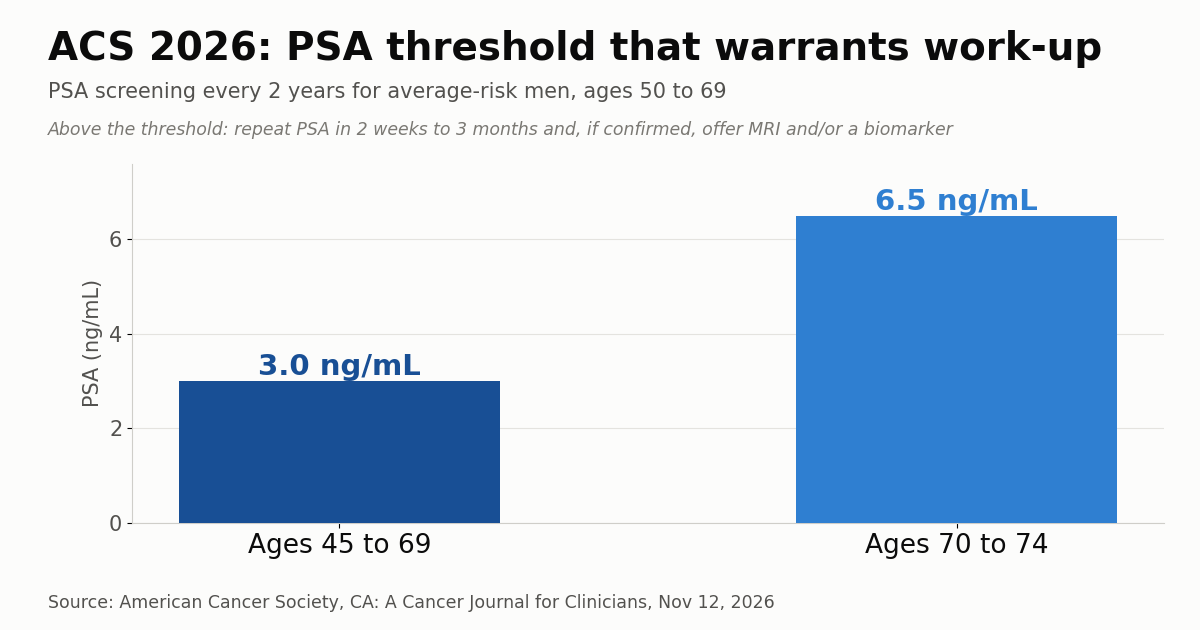
The PSA thresholds that trigger work-up are set by age band: 3.0 ng/mL or higher for men aged 45 to 69, and 6.5 ng/mL or higher for those aged 70 to 74. An elevated result should be repeated between two weeks and three months later, so a single spike does not by itself send a man to biopsy; if the elevation is confirmed, the guideline advises offering prostate MRI and/or a validated biomarker before any biopsy. That is where MRI takes center stage, sorting the men who truly need a needle from those who can be followed. A reading that falls back below the age-specific threshold, by contrast, can return a man to the routine two-year interval.
Even after a cancer diagnosis, the guideline says active surveillance should be offered as the initial option when the tumor has a low risk of growing or spreading — precisely the setting in which imaging supports monitoring rather than immediate treatment.
From the 1990s boom to the overdiagnosis backlash
Of all the major cancer screening tests, few have swung as sharply as the prostate’s. PSA screening took off in the 1990s after the FDA approved the first blood tests for the protein. Enthusiasm faded in the 2000s, as clinicians learned that many prostate cancers are slow-growing and that men were being biopsied and treated for disease that posed no threat. Screening became the poster child for overdiagnosis, and in 2012 the U.S. Preventive Services Task Force (USPSTF) discouraged widespread PSA use.
The pendulum then began to swing back. As screening rates fell, prostate cancer incidence and mortality started to rise, and the field concluded that PSA does have a role — provided it is used more selectively. The difference from the 1990s is what now happens after an abnormal PSA: instead of sending everyone to biopsy, imaging filters the cases.
Why MRI became the central piece
Recent studies have shown that MRI helps determine which men with elevated PSA should be biopsied and which can stay under active surveillance. In CISNET modeling cited by the ACS, keeping the 3.0 ng/mL threshold and using MRI to guide biopsy decisions cut biopsies by 30% to 34% and overdiagnoses by 8% to 14%, with a 1% to 9% gain in lives saved. Validated biomarkers, the group notes, have negative predictive values above 90% and can avoid 35% to 40% of biopsies. That evidence underpins deciding when to biopsy from imaging rather than from the blood number alone.
The data were strong enough to convince even the Cochrane group — historically wary of new screening tests — to reverse course in May and recommend PSA screening. The ACS guideline does not mention prostate AI, but recent research suggests algorithms can make MRI even more precise, reducing unnecessary biopsies and catching cancers a radiologist might miss, as shown by an open-source model that matched radiologists on prostate MRI.
What changes in practice and what to watch
The open question is whether the USPSTF will follow suit. The task force is reviewing its lukewarm 2018 guidance, which currently frames screening for men 55 to 69 as an individual decision, but amid recent turmoil at U.S. federal agencies there is no telling how long that will take.
Beyond the United States, the MRI-before-biopsy logic runs into access: multiparametric prostate MRI and specialized reading remain concentrated in referral centers and the private sector in much of Latin America, which limits a direct transfer of the ACS pathway to public systems. The practical point is that the guideline does not just widen PSA screening; it moves the bottleneck to imaging, making access to quality MRI a key determinant of how many men actually benefit from fewer biopsies.
There are limits to keep in mind. The recommendations target average-risk men in the U.S.; thresholds rise with age and routine screening stops at 75. The projected gains come from modeling, with their own assumptions, and depend on good-quality MRI and consistent interpretation — factors that vary across services and will decide whether the promise of fewer biopsies holds up in practice.
Source: The Imaging Wire — Broader Prostate Screening Supported in ACS Guidelines · American Cancer Society — guideline update (CA: A Cancer Journal for Clinicians, 2026)