
Prostatic artery embolization (PAE) is now an established treatment for benign prostatic hyperplasia (BPH) and can be offered as a first-line option to well-selected patients. That is the core message from interventional radiologist Mina S. Makary, MD, associate professor of radiology at The Ohio State University Wexner Medical Center, in an episode of the video series “Interventional Radiology in Focus” published by Diagnostic Imaging on October 6, 2026. This is an expert perspective rather than a new study: Makary walks through patient selection, the role of CT angiography (CTA) and cone-beam CT in planning, embolic agent choices including glue, and follow-up with the IPSS score.
What the expert argues
Makary starts with epidemiology: BPH affects about 20% of men aged 40 to 50 and more than 80% of men over 70, causing irritative and obstructive lower urinary tract symptoms. The best-known surgical options, including transurethral resection of the prostate (TURP), prostatic urethral lift (UroLift) and aquablation, are performed through the urethra. PAE, by contrast, is delivered through radial or femoral arterial access. According to Makary, bleeding and sexual dysfunction, two of the biggest patient concerns with urologic procedures, are essentially non-existent after embolization; that is his clinical view, not a result from a trial presented in the video.
Patient selection is framed as decisive. Makary lists profiles that may not be good candidates: bladder dysfunction, neurological conditions, trauma, peripheral arterial disease, major vessel occlusions and contraindications to iodinated contrast. In practice, PAE assumes that symptoms stem from prostatic obstruction and that there is a workable arterial route to the gland.
CTA and cone-beam CT in procedure planning
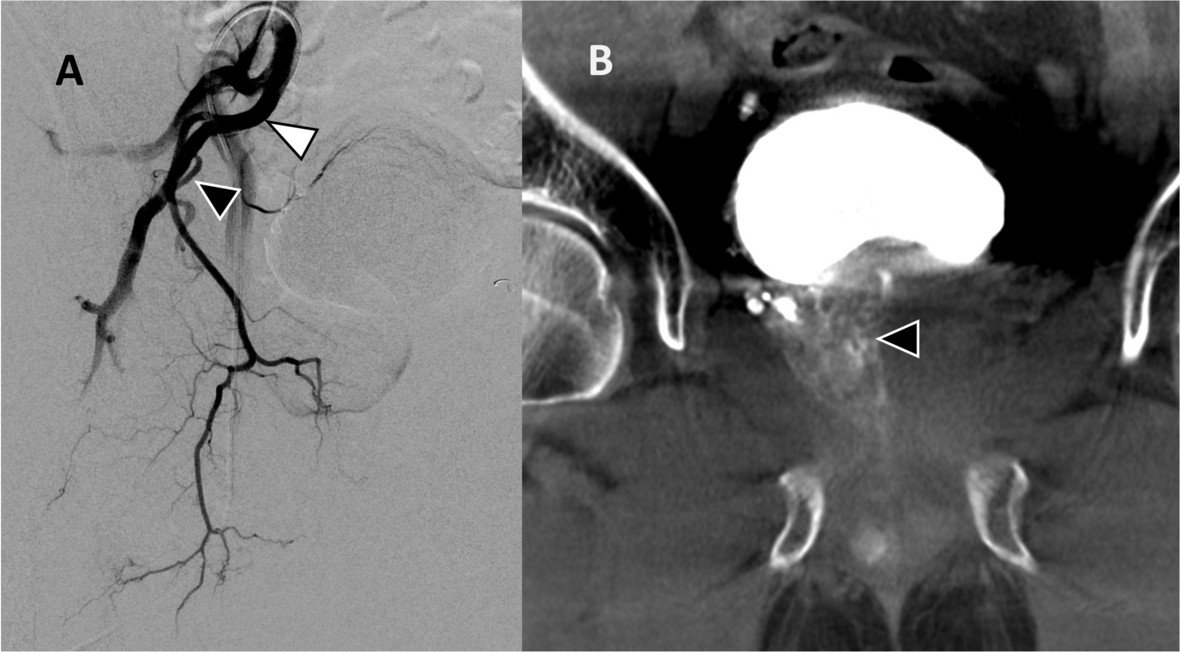
In Makary’s view, preprocedural CTA is not required but helps map anatomic variants before the patient reaches the angiography suite. During the case, cone-beam CT (CBCT) confirms that the catheterized vessel actually supplies the prostate and helps exclude non-target branches; he considers it particularly valuable during an operator’s first 50 to 100 cases. Knowledge of variant prostatic and internal iliac anatomy is, in his words, paramount. When non-target embolization is a risk, the options include more distal catheter positioning, coiling to protect the unwanted branch or adjusting particle size.
The literature supports that approach. A Marseille series in Diagnostic and Interventional Imaging (2020) of 23 patients treated with 3D CBCT reported 91% technical success and no non-target embolization, with a mean dose-area product of 146.7 Gy·cm². A 2024 pictorial review in CVIR Endovascular, the source of the image above, shows how CBCT separates a true prostatic blush from a thickened bladder wall, reveals accessory arteries to the median lobe and flags rectal branches that should be coiled before embolization. Readers following the evolution of interventional suites will see parallels with AI-assisted angiography for embolization and with the latest interventional system upgrades.
Particles, glue and unilateral treatment
Makary singles out embolic agents as the most interesting frontier of the technique. PAE has traditionally relied on particles, and debate continues over size, volume, angiographic endpoint and safety. Glue, usually n-butyl cyanoacrylate (NBCA), adds another tool with its own performance profile, safety profile and technical limitations. Device innovation in the embolization space is also visible in recent clearances such as TriNav Advance for liver embolization.
Glue data are still early. A systematic review in CVIR Endovascular (2025) pooled six studies and 667 patients: IPSS improvement in 83% to 94% of cases, prostate volume reduction of 11% to 40.5% and minor complications in 4% to 22%, with no major adverse events, but with small samples and short follow-up. A single-arm meta-analysis by Brazilian authors, published in September 2026 in Interventional Radiology, included eight studies and 723 patients and estimated a mean IPSS drop of 10.44 points and a volume reduction of 25.56 mL, with adverse events in 13%; the authors acknowledge that long-term evidence remains limited.
Makary also says PAE works even when only one side of the prostate can be treated, whether because of variant anatomy, occlusion or failure to catheterize both vessels. A 2024 Greek study in the World Journal of Radiology on intentionally unilateral PAE in 13 selected patients found outcomes not significantly different from bilateral embolization, with a 45.4% lower dose-area product and 35.9% shorter fluoroscopy time, a meaningful point for patient and staff radiation protection.
What the trials and guidelines say
Efficacy against placebo was shown in the randomized trial by Pisco and colleagues in Lisbon, published in European Urology in 2020: in 80 men with severe symptoms, PAE beat a sham procedure by 13.2 points in IPSS change at six months. The comparison with TURP is less favorable over the long term. In the Swiss non-inferiority trial from St. Gallen, with five-year results in European Urology Focus (2024), mean IPSS reduction was 7.78 points after PAE and 11.57 after TURP; resection was superior on most patient-reported outcomes except erectile function, and on maximum urinary flow. The authors concluded that improvement after PAE was inferior and that its limitations belong in patient counseling, with the caveat of substantial loss to follow-up, especially in the embolization arm.
On guidelines, the shift has been substantial. In earlier versions, starting in 2019, the American Urological Association (AUA) did not recommend PAE outside clinical trials. The 2026 guideline, whose surgical management section appeared in the Journal of Urology, strengthened PAE as an option for prostates of 50 mL or larger with Grade B evidence, according to a summary from the Society of Interventional Radiology, which also highlights the call for a multispecialty approach and for interventional radiologists to perform the procedure.
Practical implications and limits
For interventional radiology services, including those in Brazil and Latin America, Makary’s view points to three priorities: joint clinical triage with urology, an imaging protocol that adds CTA when anatomy is uncertain, and CBCT access in the angiography suite, especially during the learning curve. Dosimetry (dose-area product, cumulative air kerma and fluoroscopy time) deserves close attention, because PAE can be lengthy and involve considerable exposure, as the dose-area product figures above show. Clinical response takes a few months, and Makary recommends measuring it with IPSS and quality-of-life scales before and after treatment. As a limitation, the video reflects one specialist’s experience; comparisons with TURP, durability and the role of glue still depend on larger trials and longer follow-up.
Source: Diagnostic Imaging