
Annual FDA authorizations of radiology AI rose 42% between 2023 and 2025, yet the kind of tool reaching the market barely changed. That is the central finding of the most comprehensive analysis of the field to date, published online on September 24, 2026, in Academic Radiology by Siddhant Dogra and Jason Wei of NYU Grossman School of Medicine and Stella K. Kang of Columbia University Irving Medical Center. The authors characterized 1,094 radiology AI devices authorized from 1998 through December 2025 and found a market that is scaling in volume, concentrating interpretive AI in a few subspecialties and increasingly adopting predetermined change control plans (PCCPs).
What the Academic Radiology study measured
Unlike the agency’s quarterly list updates, which we covered when the FDA reached 1,614 AI devices, 76% of them in radiology, this work is a peer-reviewed characterization of the entire cohort. The team started from the public FDA AI-Enabled Medical Devices list, extracting submission number, manufacturer, decision date, advisory panel and product code, and cross-checked every record against the three openFDA interfaces: 510(k), De Novo and PMA. Each device was classified by functional category, computer-aided detection subtype where applicable, clinical use case and manufacturer segment, separating original equipment manufacturers (OEMs, such as the large CT and MRI vendors) from independent software companies.
Because the cutoff and inclusion criteria differ, the paper’s 1,094 devices do not match the counts in the 2026 list update; the two sources complement each other. The study received no funding, and one author discloses equity in a2z Radiology AI.
The headline numbers
The 510(k) pathway, based on substantial equivalence to a predicate device, dominates by a wide margin: 1,078 devices (98.5%), against only 8 De Novo grants and 8 premarket approvals (PMA), roughly 0.7% each. The year 2025 alone accounted for 253 authorizations, 23.1% of the entire historical series.
By function, medical image management and processing systems (the regulatory category known as MIMPS, covering reconstruction, denoising, segmentation and post-processing) make up 38.2% (418 devices). Imaging systems, meaning acquisition hardware with embedded AI, account for 33.4% (365). Interpretive tools, which detect, classify or prioritize findings, represent 21.5%, with the remainder in a smaller fourth category. That mix held steady even as authorizations accelerated.
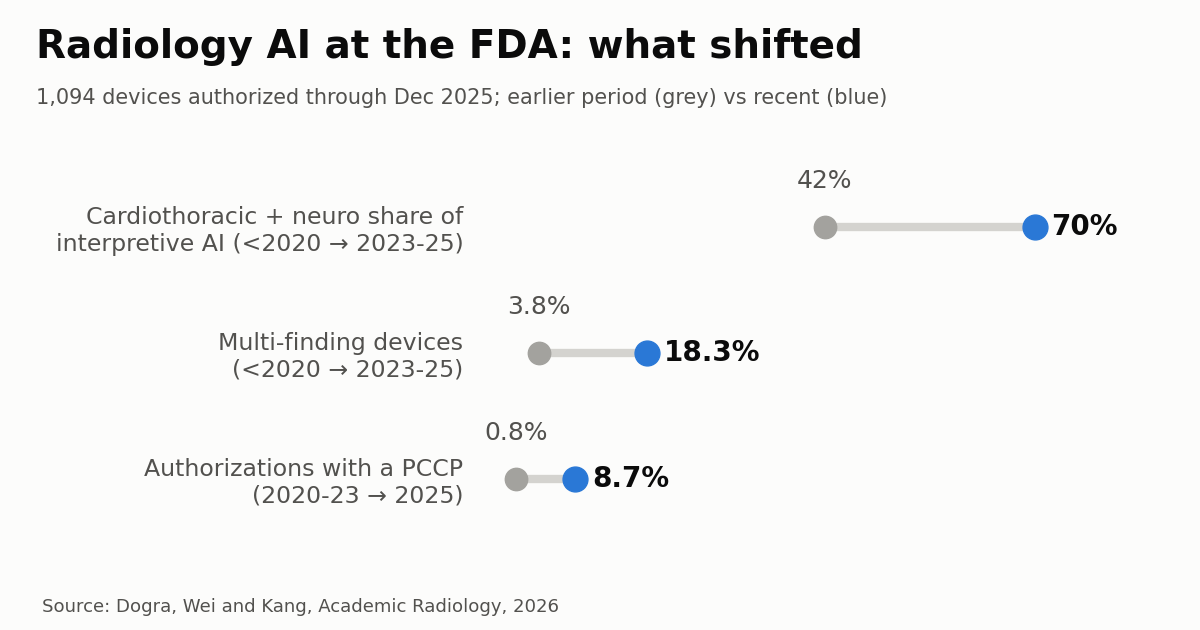
The change shows up inside interpretive AI. Excluding dental products, cardiothoracic imaging and neuroradiology went from 42% of authorizations before 2020 to 70% in 2023-2025. Multi-finding devices, which flag several conditions on a single exam, grew from 3.8% to 18.3% (P=.03). In their discussion, the authors sum it up: interpretive AI intensified within already-leading use cases rather than diversifying across subspecialties.
OEMs and independents follow different regulatory tracks
The most original part of the paper compares equipment makers with independent developers. Median FDA review time was 118 days for OEMs and 138 days for non-OEMs (P<.001). Independents cited an AI device as their primary predicate in 74.1% of submissions, versus 44.8% for OEMs (P<.001), and what the authors call the predicate gap was larger among OEMs (32.9% vs 10.6%). In practice, software companies build equivalence chains on top of other cleared AI products, while hardware makers often anchor AI features to conventional acquisition platforms.
Predetermined change control plans also differ: 4.2% of non-OEM devices were authorized with a PCCP, versus 1.5% of OEM devices (P=.02). Overall, the share of authorizations with a PCCP jumped from 0.8% in 2020-2023 to 8.7% in 2025. The mechanism, formalized in FDA final guidance issued in December 2024, lets manufacturers describe in advance how an algorithm will be retrained or tuned and under which tests, without a new submission for each version. That is precisely the kind of predictability Radiology Partners asked the FDA for in its letter on imaging AI rules.
Why it matters for buying and governing AI
Kang and colleagues argue that an accurate picture of this market informs procurement and governance decisions, identifies underserved clinical areas where research and development are most needed, and sets a baseline for evaluating the foundation models and generative tools now entering the regulatory pipeline. For a radiology department, three practical readings stand out.
First, a 510(k) clearance says little about clinical performance: it attests equivalence to a predicate, which may itself have been cleared against another predicate. Long chains of AI built on AI justify local validation before deployment. Second, an authorized PCCP changes the maintenance contract: the hospital needs to know when the model will be updated, how it will be notified and which monitoring metrics still apply. Third, the concentration in chest and neuro means musculoskeletal, abdominal, pediatric and non-screening breast imaging still have fewer authorized options, which matters for portfolio planning. If you are comparing vendors, our ranking of manufacturers with the most authorizations and our review of the 2025 year-end figures help put each product in context.
In Brazil and across Latin America, FDA authorization is often the first milestone vendors cite, but it does not replace local registration. At ANVISA, software as a medical device falls under RDC 657/2022, with risk classification under RDC 751/2022, and there is not yet a consolidated equivalent of the PCCP; significant algorithm updates may require a registration amendment. Buyers importing solutions should confirm that the version approved locally matches the one authorized in the US.
Limitations and what comes next
The primary source is the FDA’s own list, which depends on how the agency flags AI in each submission; devices with undeclared AI may be missed. The analysis is descriptive and does not measure performance, adoption or clinical outcomes, and functional classification requires judgment calls by the authors. Detailed breakdowns by detection, triage and quantification subtype are in the full text, behind a paywall.
The authors note that the structural features they describe are likely to remain relevant as the cohort grows and the field moves into an era of foundation models, generalist tools and generative AI. With multi-finding devices already gaining ground, the next regulatory test will be how the FDA handles systems that read the whole exam and draft preliminary reports.
Source: Radiology Business; original study: Dogra S, Wei J, Kang SK. Academic Radiology, 2026