
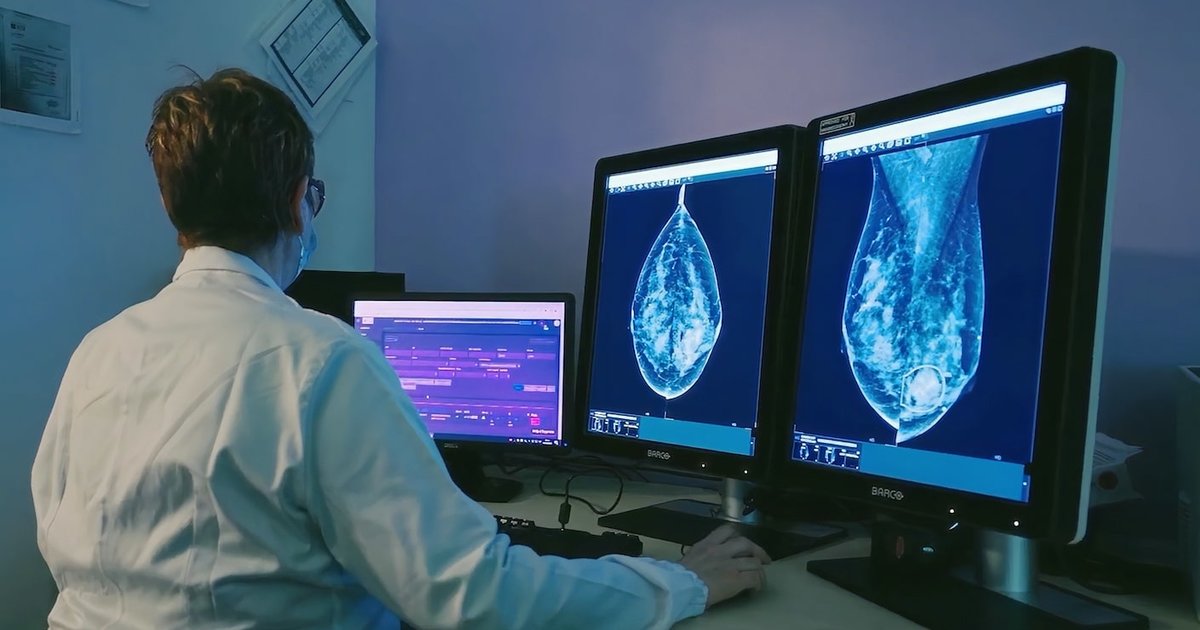
Sweden’s Stockholm Region will use artificial intelligence as the independent second reader in screening mammography, replacing the second radiologist of traditional European double reading at three hospitals in the capital. The software is Lunit INSIGHT MMG, from South Korea’s Lunit, deployed together with Sectra, and once fully implemented it is expected to support 200,000 to 250,000 examinations a year. Lunit announced the rollout on Sept. 28, and the news was covered by Health Imaging and Radiology Business.
What changes in Stockholm’s screening program
The deployment covers Capio S:t Göran Hospital, Karolinska University Hospital and Södersjukhuset (Sös). According to Lunit, it is the company’s second region-level rollout in Sweden, after Dalarna County in central Sweden. In practice, every screening mammogram is still read by a radiologist, but the independent second read, which in Sweden and most of Europe is performed by another specialist, becomes the algorithm’s job. Flagged cases still go to a radiologist consensus discussion before any patient is recalled.
The starting point was S:t Göran, a roughly 300-bed hospital on the island of Kungsholmen, where the tool moved from prospective evaluation to routine use in 2023. The company says the system has since supported about 200,000 exams over three years, including through a change of mammography units at the site. That detail matters, because vendor or detector changes commonly shift the performance of models trained on images from a specific manufacturer.
Karin Dembrower, MD, senior breast radiologist and head of breast radiology at S:t Göran, described the expansion as the next step in a progression from clinical research to routine implementation and real-world validation, bringing an approach first tested at one hospital to a regional screening environment. Lunit CEO Brandon Suh said Stockholm shows how rigorous clinical evidence can translate into broad adoption.
The evidence behind the decision: ScreenTrustCAD
The scientific basis is the ScreenTrustCAD study, led by Dembrower and published in Lancet Digital Health in October 2023. It was a prospective, population-based, paired-reader non-inferiority study run at S:t Göran from April 2021 to June 2022 in 55,581 women aged 40 to 74. Each exam was read independently by two radiologists and by the AI, allowing different reader combinations to be compared on the same images.
The headline result: double reading by one radiologist plus AI was non-inferior to standard double reading by two radiologists, with 261 versus 250 cancers detected, a relative proportion of 1.04 (95% CI 1.00–1.09). AI reading alone was also non-inferior (246 vs 250), and triple reading by two radiologists plus AI detected 269 cancers. The study was funded by Swedish agencies, Region Stockholm itself and Lunit, a conflict worth keeping in mind.
A follow-up analysis in Radiology in 2025 looked at human-AI interaction in the same cohort. Exams flagged only by one radiologist were recalled 14.2% of the time, with a positive predictive value (PPV) of 3.4%; exams flagged only by the AI were recalled 4.6% of the time, but with a PPV of 22%. The authors raised concern that radiologists may agree with AI too much when it is wrong, or too little when it is right. Lunit says one-year real-world results presented at RSNA 2024 showed a 15% increase in cancer detection and a reduction of more than 36% in radiologist reading time, partly driven by the tool’s normal-flagging function.
European context: double reading and the MASAI trial
Independent double reading is recommended by European breast screening guidelines and practiced in Sweden, Norway, Denmark, the U.K. and elsewhere, unlike the U.S., where single reading dominates. The model is expensive in specialist hours, and the shortage of breast radiologists across Europe is the main driver behind AI initiatives.
The other landmark Swedish study is MASAI, a randomized trial in the Malmö area using different software (ScreenPoint’s Transpara) and a different strategy: instead of replacing the second reader, AI triages low-risk exams to single reading and high-risk exams to double reading. In the 105,934-woman analysis published in Lancet Digital Health in 2025, cancer detection rose 29% (6.4 vs 5.0 per 1,000) and screen-reading workload fell 44.2% with no rise in false positives. In January 2026, The Lancet published the primary endpoint: a non-inferior interval cancer rate (1.55 vs 1.76 per 1,000), sensitivity of 80.5% vs 73.8% and identical 98.5% specificity. We have covered the triage approach in AI could cut 77% of mammograms from double reading and in mammography AI cuts radiologist workload by 64%, and the extreme case of fully autonomous triage of normal exams in Vara wins CE mark for autonomous mammography triage.
What it means for Brazil and Latin America
The Brazilian reality is different. In the public SUS system, screening is largely opportunistic, with a long-standing recommendation of biennial mammography for women aged 50 to 69, and independent double reading is not standard practice. Brazil’s National Cancer Institute (INCA) estimates roughly 73,000 new breast cancer cases a year for 2023–2025. With breast radiologists concentrated in state capitals and in the South and Southeast, AI in Brazil is less likely to replace a second reader and more likely to add a second read where there is only one today, or to prioritize reporting worklists at overloaded services.
That changes the validation question. An algorithm shown to be non-inferior to a Swedish second radiologist still has to prove itself on Brazilian equipment, protocols and populations, with their own breast density, age mix and prevalence. On the regulatory side, diagnostic support software is a medical device and must be registered with ANVISA under RDC 657/2022 for software as a medical device and RDC 751/2022 for risk classification. Sites should also run local performance monitoring, audit discordant cases and track model versions, the same safeguards the Swedes mapped in a qualitative risk study before switching AI on at S:t Göran. For more on the same vendor, see Lunit mammography AI boosts radiologist specificity.
Limitations and caveats
There are important caveats. ScreenTrustCAD was a single-hospital study, partly funded by the vendor, and its endpoint was screen-detected cancer, not interval cancer, a metric MASAI could only measure after two years of follow-up. The real-world figures released by Lunit come from a congress presentation and a corporate press release, not a peer-reviewed paper. Finally, removing the second radiologist puts more pressure on the single human reader: in S:t Göran’s pre-implementation risk inventory, staff worried that patient-reported symptoms could be missed by the lone radiologist and that the algorithm’s performance might drift over time. Stockholm’s scale will make it one of the most closely watched real-world tests of this model in Europe.
Source: Health Imaging / Radiology Business; Lunit press release (PR Newswire)