
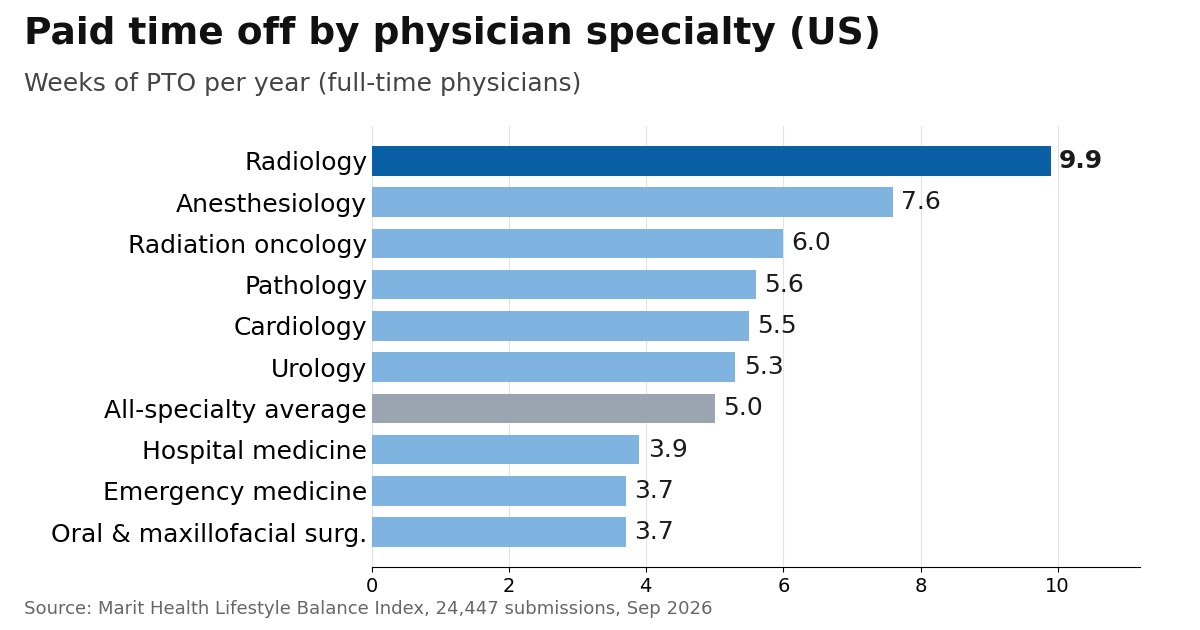
Full-time radiologists in the United States take an average of 9.9 weeks of paid time off (PTO) per year, the most of any of 36 physician specialties and nearly double the 5.0-week all-specialty average. The figure comes from the Lifestyle Balance Index, released on September 22 by pay-transparency platform Marit Health from 24,447 anonymous physician submissions and covered by Radiology Business and Health Imaging. The same index, however, places radiology squarely in the middle of the lifestyle table, at 16th: the long time off coexists with heavier-than-average working weeks.
What the Marit index measures
Marit pooled salary and schedule submissions from full-time physicians, with data frozen on September 16, 2026. Specialties with fewer than 30 reported salaries were excluded. The index combines five factors: average weekly hours, schedule quality (the share of weekday, day-shift and shorter-shift work), call burden, percent clinical time, and average annual PTO in weeks. Each factor is normalized so that 1.0 equals the all-specialty average, and the five normalized values are multiplied to produce a single score.
Preventive medicine topped the ranking (1.50), followed by dermatology (1.44), allergy and immunology (1.39), rheumatology (1.34) and psychiatry (1.33). At the bottom sit the fields defined by emergencies and heavy call: neurosurgery (0.50, at 56.6 hours per week), general surgery (0.61), and critical care, OB-GYN and anesthesiology (all 0.64).
Radiology: time off offsets the schedule
Radiology’s numbers explain its midpoint position. The specialty reports 46.2 hours per week, above the 45.6-hour average. Its schedule quality score is 0.96, below average, and its call burden is 1.05, above average. Clinical time reaches 91%, versus 88% overall. On nearly every day-to-day axis, the radiologist works slightly more, or at worse hours, than the typical physician.
What pulls the score back to exactly 1.00 is the annual calendar. Marit itself calls radiology “a different kind of outlier”: it lands at the midpoint despite above-average call and below-average schedule quality, and the counterweight is PTO, nearly double the specialty-wide average.
Anesthesiology is an instructive comparison. It ranks second for time off at 7.6 weeks, yet falls to 32nd on the index because it carries the highest call burden in the entire dataset. Long vacations alone do not guarantee balance.
Radiation oncology and pathology also stand out
For readers in radiation therapy, a different number matters. Radiation oncology ranks 11th with an index of 1.20, 45.9 weekly hours, above-average schedule quality (1.15), below-average call (0.97) and 6.0 weeks of PTO, the third-highest on the list. Marit groups it with the specialties that deliver a better lifestyle than their pay would predict, alongside dermatology, allergy, physical medicine and rehabilitation, and ophthalmology. Pathology, another diagnostic field without a fixed patient panel, ranks 15th with 5.6 weeks off.
Why radiology accumulates so much PTO
Marit does not dig into causes, but the US market offers well-known clues. A large share of American radiology runs through private, partner-owned groups that have historically negotiated long blocks of time off as part of the package. There is also no fixed patient panel to cover during an absence: the study lands in the worklist and any credentialed colleague can read it. Week-on/week-off schedules, common in overnight reading and teleradiology, compress hours and free up entire weeks.
Then there is the shortage. With positions sitting open for months, as our analysis of zombie jobs and the regional radiologist shortage showed, time off has become a recruiting currency alongside pay, which rose 6.6% in the latest Doximity survey. The side effect is familiar to anyone who builds a schedule: every week off must be absorbed by those who stay, against rising imaging volumes.
The hidden cost in the working weeks
The index shows that radiologists’ rest comes in concentrated blocks rather than spread out. Longer weeks, above-average call and a high clinical share mean the annual time off coexists with intense working stretches. That fits the literature on attrition: the JACR study on why radiologists quit points to workload as a central driver, and most radiologists live with musculoskeletal strain from long reading sessions. Generous vacations help, but they do not replace a sustainable day-to-day schedule.
What it means outside the US
The survey is US-only, and direct comparisons are risky. In Brazil, salaried physicians are entitled to 30 days of vacation by law, but many radiologists work as independent contractors or on a per-study basis with no paid leave at all: every week off is revenue lost. Teleradiology, which has grown fast across Latin America, makes calendars more flexible but rarely pays for the absence.
For imaging and radiation oncology managers anywhere, the takeaway is that retention goes beyond the per-study rate. Predictable schedules, paid call and planned time off weigh on the decision to stay or leave, and the US market, which competes for the same readers through teleradiology, already uses them as selling points.
Limitations of the data
The figures are self-reported and anonymous, drawn from users of a salary platform, which leaves room for selection bias. The analysis covers only full-time physicians, and the definition of PTO can vary between contracts, mixing vacation, CME and other leave. Averages hide dispersion: partners in private groups and hospital-employed radiologists live very different realities. Finally, the index multiplies equally weighted factors, a methodological choice that can reward or penalize specialties with an extreme profile on a single axis.
Source: Radiology Business and Marit Health