
Radiology was one of the big winners in Doximity’s 2026 physician compensation survey: an average annual salary of $610,000, up 6.6% from $572,000 in the previous edition, against average growth of just 2% across all specialties. That lifted the specialty three places in the ranking of the highest-paid U.S. physicians, from 11th to 8th. The figure matters less as market gossip than as a thermometer: the price of labor rises when supply fails to track demand, and that is exactly what American radiology is living through.
The Doximity 2026 numbers
Doximity runs a digital platform counting roughly 85% of practicing U.S. physicians as members, and its annual survey has become a reference for compensation by specialty and by metro area. In the 2026 edition the top of the table remains surgical — neurosurgery at $829,161, thoracic surgery at $749,707 and orthopaedic surgery at $696,852 — but imaging shows up twice in the top ten.
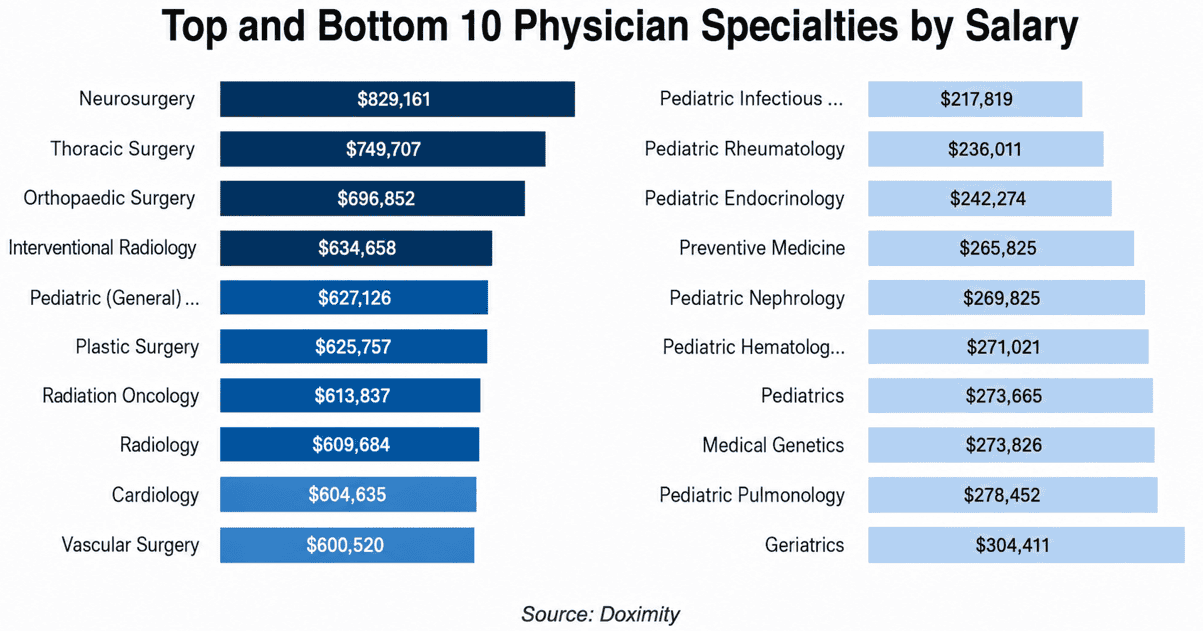
Interventional radiology sits 4th at $634,658, and diagnostic radiology 8th at $609,684. Radiation oncology lands just above, 7th, at $613,837. At the other end of the table, pediatric subspecialties dominate the ten lowest-paid slots, starting at $217,819 for pediatric infectious disease — a nearly fourfold spread between top and bottom that says a great deal about how the U.S. system prices procedures versus consultation time.
Worth noting: the 6.6% growth in 2026, while far above average, is smaller than the year before. In the 2025 survey, radiology pay had risen 7.5%, placing the specialty among the four fastest-growing. The deceleration is modest, but it suggests the peak of the heat may have passed.
Interventional radiology led growth across all specialties
The standout in the survey is not diagnostic radiology: it is interventional. With a 10.8% increase, IR posted the largest rise in annual compensation among all specialties surveyed, reaching $635,000. The move makes structural sense. Image-guided procedures have migrated into the interventional radiology scope in oncology, peripheral vascular work and embolization, and these are well-reimbursed procedures competing directly with open surgery. Where the interventional radiologist operates as a proceduralist rather than a support service, compensation follows.
What sits behind the raise: shortage
The survey also measured perceptions of working conditions, and those numbers explain the pay rise better than any market analysis. Among respondents, 85% reported that the physician shortage had affected their clinical practice and 76% said the shortage and other pressures had compromised the quality of care they deliver. Pay rising 6.6% while three in four physicians say quality has slipped is not a sign of prosperity — it is a sign of overload being compensated with money.
In radiology that picture has already surfaced on several fronts we have tracked. Report turnaround time grew 177% in a decade in the United States, a direct indicator of volume per radiologist above capacity. And the radiologist exodus the OIG confirmed in the VA system, worsened after the telework ban, shows what happens when an employer tries to retain staff without offering flexibility in a market that pays more and demands less physical presence.
AI stopped being a threat in physician perception
The mood swing on artificial intelligence is perhaps the most surprising finding. Among surveyed physicians, 66% reported using AI daily or weekly; 23% expect AI to boost their compensation within the next year; and 67% believe doctors who stay current with AI tools will hold an earnings advantage over those who do not.
For radiology, cast for a decade as the first specialty due for automation, those numbers mark a narrative inversion. The likelier reading is not that AI will directly lift salaries, but that it stopped being seen as a substitute and started being seen as a productivity multiplier — and under volume-based compensation, productivity and pay blur together. The embedded risk is equally clear: if AI raises the number of studies one radiologist can report, the market may capture that gain by needing fewer radiologists rather than by paying each one more.
Gender gap: radiology among the smallest, but still there
The pay gap between male and female physicians held at 26% for the second consecutive year, with men earning an average of $122,000 more. The stability is the bad news: two years without narrowing suggests the problem is not resolving through market inertia. Radiology had one of the smallest gaps among specialties, at 10% — better than average, far from zero, and still worth tens of thousands of dollars a year on a six-figure salary.
Reading this for other markets
Transposing these figures directly to Brazil does not work, but the forces at play are the same. Brazilian radiologist compensation is dominated by production — value per report, per shift or per rota — and faces price pressure from teleradiology, which globalized the supply of interpretation and lets a service in any state buy remote reporting at the lowest available price. That compresses margin precisely in the part of the work that is easiest to outsource.
The strategic read the U.S. data suggests is interesting: the strongest growth is in what cannot be outsourced. Interventional radiology requires physical presence, a suite, a team and procedural skill, which is why it leads the increase. The same reasoning applies elsewhere: intervention, studies that depend on protocols customized alongside the clinician, and imaging governance work — protocol audit, quality, AI validation — that nobody buys by the report.
Limitations of the survey
Some methodological caution is mandatory before using these numbers in a negotiation. The Doximity survey rests on voluntary self-reporting, which opens the door to selection bias: those who answer tend to be those interested in comparing pay. There is no probabilistic sampling, and the platform’s membership base, however large, is not random.
The figures are also unadjusted for hours worked, productivity or employment model. A 6.6% rise in average salary may reflect a higher hourly price, more hours worked, or a shift in sample composition — and those three explanations carry opposite implications for quality of life. National averages likewise hide enormous geographic variation within the United States, and nominal growth has to be read against inflation to become a real gain. The 2% average growth across all specialties, for instance, may be a real-terms loss depending on the year.
The overall picture, though, is consistent with everything else the indicators show: radiology remains among the best-compensated specialties in the United States, and it is being paid above average precisely because there are fewer radiologists than there are studies to report.
Source: The Imaging Wire — Radiology Salary Growth Beats Other Specialties