

How cesium-137 spread through Goiânia’s urban environment
Environmental contamination from cesium-137 in Goiânia affected an area of roughly 1 km² across the Aeroporto, Central, and Ferroviários districts, with secondary foci detected in other parts of the city. Cesium chloride — the highly soluble compound inside the ruptured source capsule — was dispersed by a combination of natural and human factors that caught even the response specialists off guard. For a comprehensive overview of the entire incident, see our complete guide to the Goiânia radiological accident.
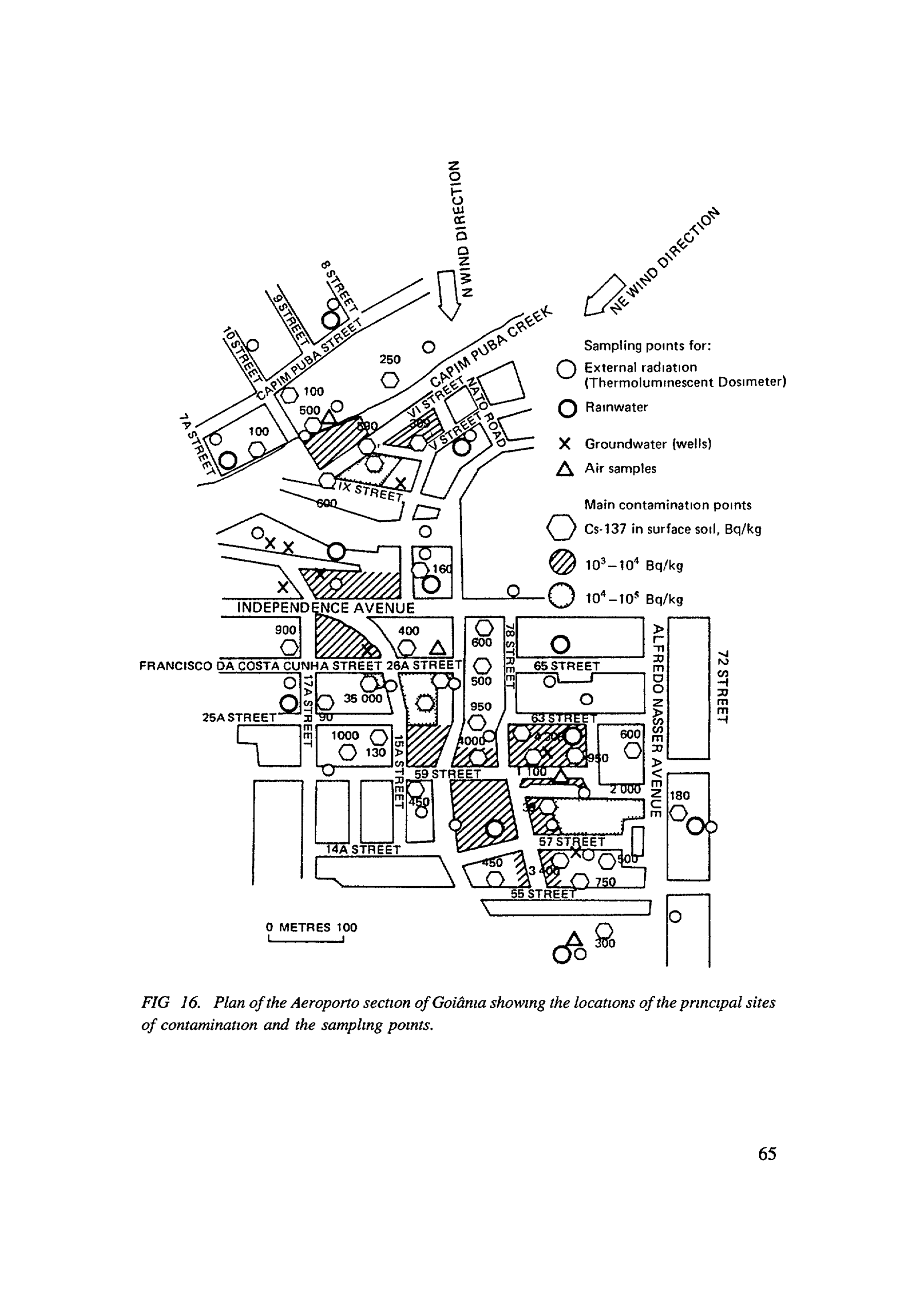
Meteorological data from Brazil’s Ministry of Agriculture recorded 25.2 mm of rainfall on September 21 and 18.4 mm on September 23, 1987, followed by a dry spell until September 27–28, when another 8.7 mm fell. These rains were preceded by strong winds and very high temperatures — the mean over the 15 days before the accident’s discovery was 26.4 °C. The intense heat dried out the ground rapidly, and winds caused resuspension and dispersion of cesium particles. The scale of this effect came as a genuine surprise to the response team.
In some houses, contamination deposited on rooftops became the dominant contributor to indoor dose rates, forcing complete removal of roof tiles. Beyond natural processes, radioactive material was also transported by people walking through contaminated sites and through disposal of contaminated household waste in empty lots.
Response phases and field operations organization
The physical response to the Goiânia accident can be divided into two main phases. The initial phase demanded urgent action to identify sources of acute exposure and bring the situation under control. The recovery phase aimed at restoring normal conditions. In practice, the boundaries between these phases overlapped considerably.
By Saturday, October 3 — five days after discovery — seven main contamination foci had been identified. This essentially marked the end of the urgent initial phase: the major hazard sources were under control. Even so, new, less contaminated locations continued to emerge in the following weeks. As we describe in our article on the discovery and initial response, this phase required massive resource mobilization over 1,000 km from the nearest centers of radiological expertise.
The week from October 3 to 10 served as a period of consolidation and recovery planning. The team assessed required resources — personnel, hardware, and disposable supplies. The Administrative and Logistical Support Group (GALA), originally from the Angra Emergency Plan, proved essential, particularly for its contacts with the Brazilian Air Force for transport. Experience showed, however, that improvisation and managerial authority to bypass bureaucracy were equally necessary.
A critical early decision shaped the entire timeline: no major decontamination work would begin until comprehensive surveys were completed and a waste storage site was being prepared. Written procedures, action criteria, and quality control protocols were prepared before heavy work commenced.
Evacuation criteria and intervention levels
The radiological criteria adopted in Goiânia were shaped by both technical principles and intense political and social pressures. The original evacuation limit, set by physicist W.F. in the first moments of the response, was a dose rate of 2.5 μSv/h at 1 m height inside residences — derived directly from the then-current public dose limit of 5 mSv per year.
After about one week, this criterion was relaxed to 10 μSv/h, maintaining the 5 mSv/year basis but incorporating modifying factors:
| Modifying factor | Description | Range adopted |
|---|---|---|
| Occupancy factor | Fraction of time spent at the location | 0.30 to 0.75 |
| Geographical distribution | Ratio of mean to maximum dose rate | 0.1 to 0.2 |
| Time distribution | Reduction from cleaning or weathering | 0.1 to 0.4 |
Source: The Radiological Accident in Goiania (IAEA, 1988)
In all cases the most conservative (highest) value was used. Notably, the Goiânia accident was never officially declared an emergency — there was strong political resistance to any comparison with nuclear power accidents, which heavily influenced the approach taken.
Remedial action criteria
The general criterion stipulated that the dose to the critical group in the first year should not exceed 5 mSv, with a long-term target below 1 mSv per year. Upper bounds for exposure were allocated by pathway:
| Exposure pathway | 1st year limit | Details |
|---|---|---|
| Inside houses (external) | 1 mSv | Primarily roof contamination |
| Outside houses — external | 3 mSv | Contaminated soil |
| Outside houses — internal | 1 mSv | Ingestion of fruit, vegetables, eggs, meat |
| Total outside | 4 mSv | — |
Source: The Radiological Accident in Goiania (IAEA, 1988)
The action level for surface contamination inside houses was set at 37 kBq/m², per CNEN basic regulations for non-active areas. For external exposure via soil, an action level of 1.0 μSv/h was adopted (after subtracting the natural background of 0.2 μSv/h), corresponding to a surface activity of 430 kBq/m² or 22.5 kBq/kg in the top 15 mm of soil. The investigation level was set at 10⁴ Bq/kg. For fruit already contaminated by initial deposition, the derived level for picking followed Brazilian food regulations at 650 Bq/kg.
Radiological surveys: from helicopter to handheld monitor
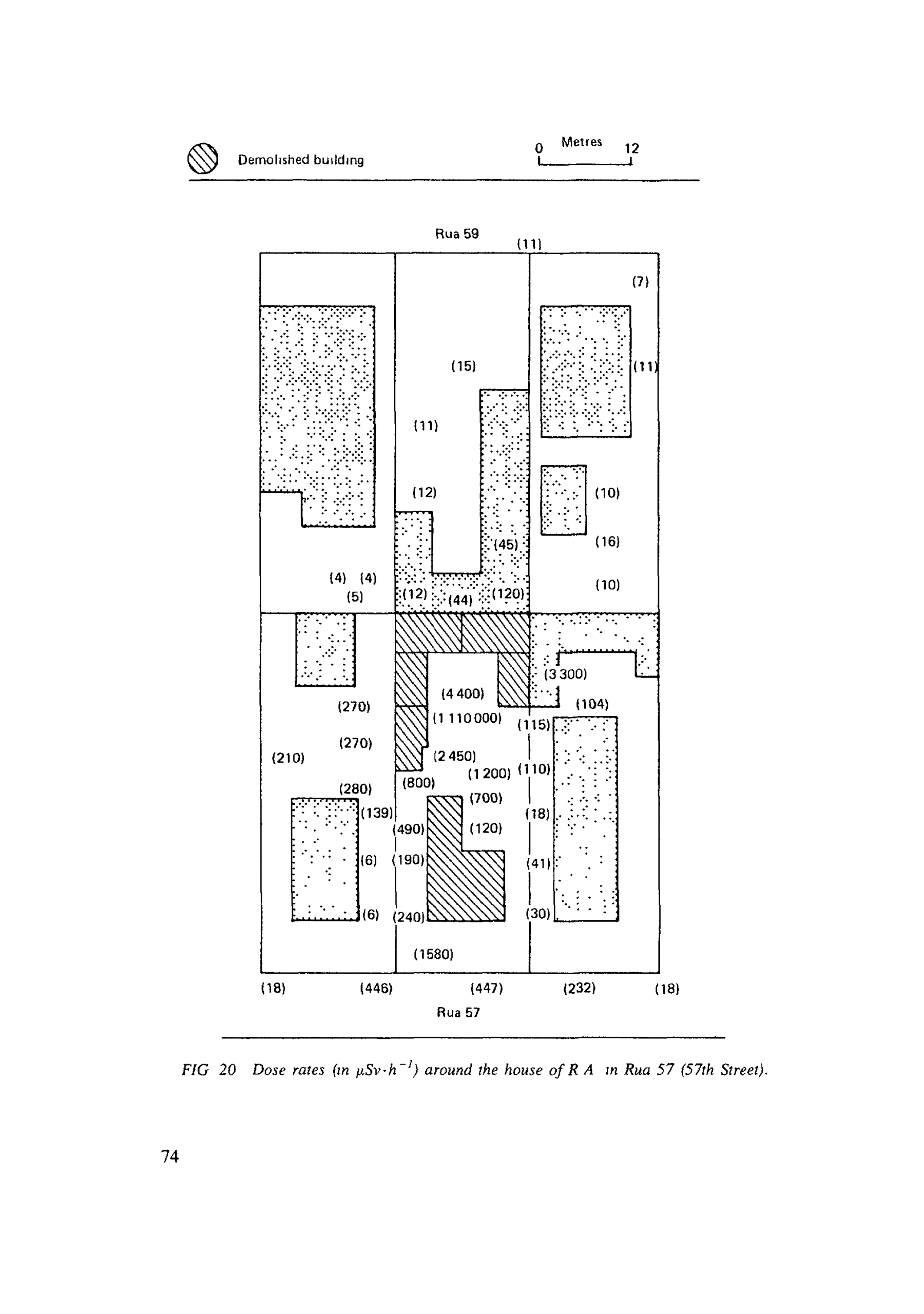
To confirm that all significant contamination foci had been located, a multi-level radiological survey strategy was deployed. On October 7 and 8, an aerial survey covered Goiânia by helicopter using a portable battery-powered gamma spectrometer with NaI(Tl) detectors totaling 840 cm³. Most of the survey was flown at 40 m altitude, effectively monitoring a circle of 80 m radius at ground speeds between 50 and 70 km/h. In two days, approximately 67 km² of urban area was covered.
The aerial survey confirmed that no major focus had been missed and detected a discrete spot producing a dose rate of 21 mSv/h at 1 m. Vehicle-based surveys then complemented the coverage: the helicopter detectors were mounted in a car, while a second vehicle equipped with a 2″ × 2″ NaI(Tl) crystal surveyed different areas. Later, detectors were installed in the back of a station wagon for more precise readings. One practical problem: the electronics were sensitive to temperature variations, requiring an air-conditioned vehicle.
On-foot monitoring with handheld instruments covered houses, public spaces, vehicles, and even banknotes (the latter mainly to reassure the public). Systematic interviews with hospital patients and residents about visitors and movements during the critical period revealed contamination transport routes — and uncovered 42 additional less-contaminated sites both inside and outside the city.
Environmental monitoring: soil, vegetation, water, and air
Over 1,300 measurements quantified the environmental dispersion of cesium-137 in soil, vegetation, water, and air, focusing on areas within roughly 50 m of the main foci. The IAEA report notes that the exclusive presence of cesium-137 simplified instrumentation — a single-channel analyzer with a 3″ × 3″ NaI crystal was sensitive enough for short 10-minute counts. In emergencies involving multiple radionuclides, significantly more complex instruments would be needed.
Soil
Approximately 400 soil samples were analyzed, with activity levels ranging from 10² to 10⁵ Bq/kg. Spatial distribution reflected wind patterns, confirming resuspension and airborne dispersion. Depth profiles showed that, for any given surface activity, the top 15 mm of soil retained an average of 60% of the cesium — critical information for planning soil removal. As discussed in our dosimetry article, these data fed directly into dose estimation models.
Vegetation
At the same locations as soil samples, 263 vegetation samples — including leaves, branches, and fruit — were collected. Leaf radioactivity closely paralleled soil levels in both magnitude and distribution. A practical finding confirmed the dust deposition mechanism: washing reduced radioactivity by 50%.
Water resources
Hydrographic basin monitoring covered surface water, suspended matter, bottom sediments, fish, and riverbed screening. The main focus was Capim Puba creek, a Meia Ponte river tributary that receives both stormwater and sewage from the three most contaminated sites. Monitoring revealed no significant radioactivity. Goiânia’s public water supply draws from a treatment plant upstream of Capim Puba creek — a natural protective factor.
Aerosols
During waste removal operations, aerosol activity was monitored at 50 m from the main foci. Measured values were in the mBq/m³ range:
| Point | Nov. wk 2 | Nov. wk 3 | Nov. wk 4 | Dec. wk 1 | Dec. wk 2 |
|---|---|---|---|---|---|
| 1 | 0.9 ± 0.3 | 3.8 ± 0.4 | < 0.4 | 0.33 ± 0.11 | 0.3 ± 0.07 |
| 2 | 1.0 ± 0.4 | 7.5 ± 4 | 2.9 ± 2 | 4.4 ± 0.3 | N/A |
| 3 | 0.7 ± 0.3 | < 0.5 | 2.2 ± 0.3 | 2.6 ± 0.2 | N/A |
Aerosol activity due to cesium-137 (mBq/m³) at 50 m from main foci during waste removal. Source: The Radiological Accident in Goiania (IAEA, 1988), Table IV
Decontamination operations and waste management
Large-scale decontamination hit an unexpected bottleneck: selecting and constructing the waste storage site. It became clear early on that large volumes of radioactive waste would be generated — clothing, soil, roof tiles, building materials. Site selection triggered intense public opposition to anything radiation-related. Any location within Goiânia was ruled out. On October 16, a site 20 km from the city was chosen, but only as a temporary solution.
The planning, preparation, and construction of the storage facility took longer than expected. Only by mid-November could major decontamination work begin. In the interim, activities were limited to preparations and preventing further deterioration. These included: design and construction of waste containers, assembly of heavy machinery (excavators, front- and back-loaders), updating of operational procedures, testing of decontamination techniques, and scheduling.
The program gained renewed momentum when the CNEN president decided to take personal charge in Goiânia — cutting bureaucratic steps in decision-making between local and federal authorities — and when Brazil’s President visited the city. A target date of December 21 was set for decontaminating the main areas, allowing evacuated residents to return home for Christmas.
By this point the mobilized workforce comprised approximately 250 professional and technical staff plus 300 support personnel (transport, demolition, logistics), with significant analytical and dosimetry contributions from CNEN institutes in Rio de Janeiro and São Paulo. The December 21 deadline was met by working 12-hour daily shifts, often in adverse weather. This closed what the report calls the “containment element” — remaining contamination no longer posed a significant short-term hazard.
After Christmas, additional work addressed areas around the main foci where radioactivity levels were lower. This phase required no heavy machinery — only manual operations and chemical processes with optimization procedures. It continued until March 1988. To understand how the accident began, read our article on how the Goiânia radiological accident happened.
Practical lessons from the environmental response
The IAEA report identifies three central elements in the environmental response: gaining control, containing the problem, and taking remedial action. These overlapped in time and with the two main phases of the accident. One explicit lesson — particularly relevant for radiation protection professionals — is that accident facts must be documented as early as possible, since they tend to become blurred with time.
Goiânia demonstrated in practice that overly restrictive intervention criteria (such as the 5 mSv/year evacuation limit) can carry disproportionate economic and social burdens, especially when pessimistic correction factors accumulate in deriving action levels. At the same time, systematic interviewing of affected individuals about their movements and contacts proved one of the most efficient tools for directing monitoring resources — and the importance of this approach cannot be overstated, as the report itself emphasizes. See also our article on the medical response to the Goiânia accident victims for how clinical care integrated with the environmental response.