
Kaiser Permanente, one of the largest health systems in the United States, has cut its MRI wait times by more than 50% after deploying an FDA-cleared artificial intelligence algorithm. The tool does not replace a single scanner: it reduces image noise, which shortens each exam’s acquisition time and lets the system book more patients on the equipment it already owns.
What Kaiser Permanente achieved
As reported by Radiology Business, the network folded a noise-reduction AI algorithm into its MRI workflow and saw patient wait times fall by as much as 60%. In concrete terms, exams that once ran 40 to 45 minutes now finish in roughly 30 minutes.
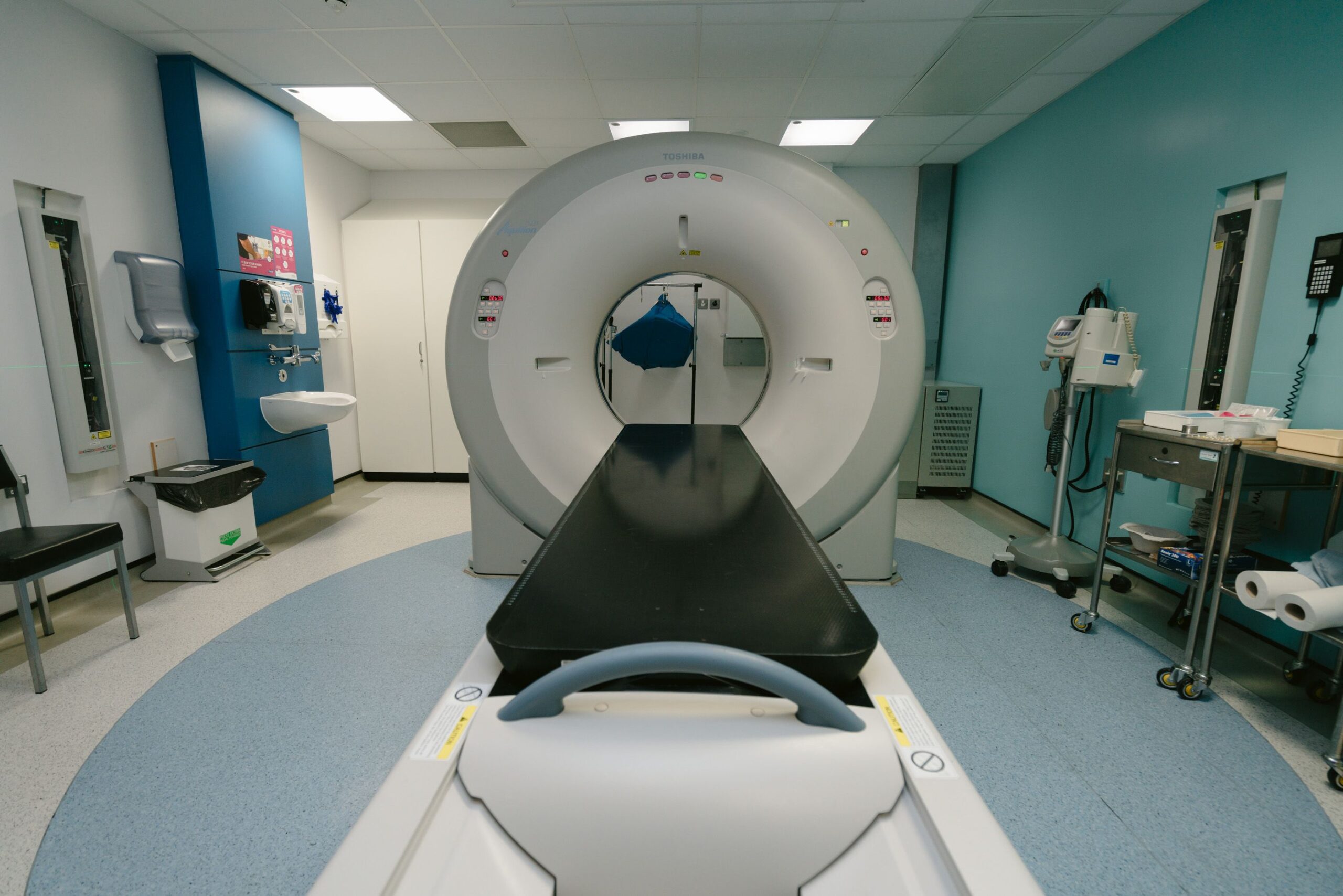
Shorter exams translate directly into more available slots. Facilities absorbed a higher volume of requests without buying additional machines — a meaningful outcome given that a single MRI scanner costs millions of dollars and demands dedicated, magnetically shielded infrastructure.
Daniel Yang, MD, the organization’s vice president of Artificial Intelligence and Emerging Technologies, stressed that the health system tracks a dashboard of metrics to make sure speed does not erode diagnosis: scan time, image quality, appointment availability, repeat-scan requests, and the effect on radiologist workflow.
How AI speeds up an MRI
The engine behind the change is deep-learning reconstruction (DLR). Rather than altering the physics of the exam, the algorithm is applied after signal acquisition to strip out noise and blur, raising the signal-to-noise ratio (SNR). With an intrinsically cleaner image, the protocol can use fewer signal averages and undersample k-space more aggressively — collecting less raw data — without losing diagnostic quality. The payoff is a shorter sequence that keeps its sharpness.
Commercial versions already exist. GE’s AIR Recon DL was FDA-cleared in 2020 and Subtle Medical’s SubtleMR in 2019, while AIRS Medical’s SwiftMR is a vendor-neutral option promising up to 50% scan-time reduction. In April 2026 SwiftMR won an expanded FDA clearance to run alongside the OEMs’ own DLR pipelines — in one published example, a routine brain exam dropped from 15 to 9 minutes when both AI layers were stacked on a 3-tesla scanner.
Abbreviated protocols add another lever, keeping only the sequences needed to answer a specific clinical question. Abbreviated breast MRI, for instance, delivers near-full-protocol performance in about half the time. A complementary frontier is AI applied to MRI interpretation, which adds diagnostic value on top of the faster scans.
The capacity math and scheduling AI
Trimming minutes per exam has a multiplier effect. A scanner running ten hours a day at 40-minute exams handles about 15 patients; at 30 minutes it handles 20 — roughly 33% more capacity per machine with zero new hardware. Add the drop in repeat scans (each repeat burns an entire slot) and the net effect on the queue is larger still.
Yet wait time is not only about exam length. A second AI front works on scheduling: machine-learning models predict no-shows, enable smart overbooking, trigger targeted reminders, and match the right protocol to each patient, shrinking idle scanner time. It is the pairing of faster acquisition with smarter logistics that truly collapses the backlog.
The effect compounds over a fleet of scanners. A health system running dozens of magnets can free the equivalent of several full-time machines purely from software, deferring or avoiding capital purchases that each run into the millions. Because the gains show up as extra daily slots rather than as a one-off, the queue keeps shrinking week after week — which is precisely how a headline figure of “more than 50%” becomes achievable without a single new scanner arriving on the loading dock.
Clinical implications and the Brazilian context
For radiologists and technologists the message is twofold: there is genuine room to widen access without burning out staff, but acceleration needs governance. In Brazil, where the public-system (SUS) MRI queue can reach eight months in some municipalities — even as cities such as Porto Alegre have cleared historic backlogs — tools that expand installed capacity carry direct social weight.
The Brazilian bottleneck, though, is not only about machines. The shortage of radiologists, concentrated in the North and Northeast and in the interior, pushes report turnaround past 72 hours in remote units. Speeding up acquisition without expanding interpretation capacity merely shifts the bottleneck — which is why acceleration AI must advance hand in hand with teleradiology and assisted triage.
Quality caveats and the road ahead
AI reconstruction is not risk-free. Aggressive algorithms can over-smooth an image and mask small lesions, or introduce synthetic textures that do not match real anatomy. That is why Kaiser’s governance model — monitoring image quality and repeat-scan rates — matters as much as the speed gain. Every deployment should undergo local validation, with radiologists comparing accelerated and conventional exams before routine adoption.
The road ahead blends accelerated acquisition, abbreviated protocols, and scheduling AI, always under human oversight. To see which companies are leading the charge, it is worth following the roundup of top AI vendors cleared by the FDA. The promise is clear: more patients scanned, with less waiting, and no compromise on diagnostic safety.
Source: Radiology Business