
The US cancer mortality rate fell 35% between 1991 and 2024, the equivalent of more than 4.8 million deaths averted — and for metastatic disease, five-year survival more than doubled, from 17% in the mid-1990s to 36% in 2016-2022. The figures come from the American Association for Cancer Research’s Cancer Progress Report 2026, released on September 16. The same document carries the projection that blocks any easy celebration: annual new cases are expected to reach 2.5 million by 2050, 19% above the roughly 2.1 million estimated for 2026.
Progress is not evenly distributed
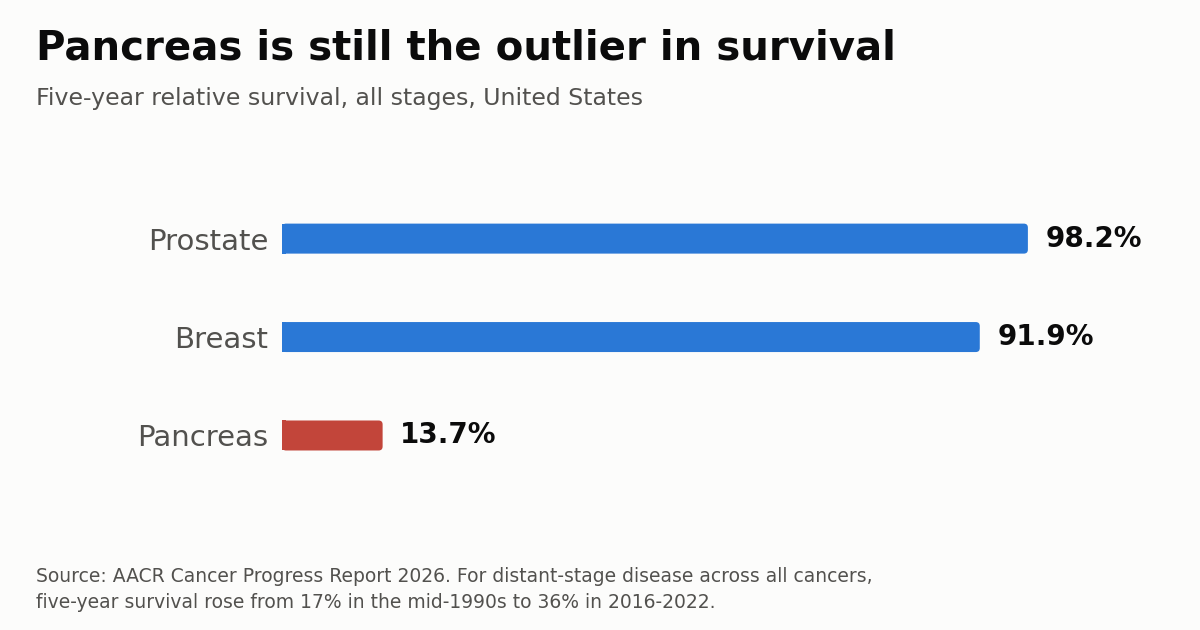
Five-year relative survival across all stages reaches 98.2% for prostate and 91.9% for breast cancer. For pancreatic cancer it sits at 13.7%. Same disease category, same health system, almost 85 percentage points apart — and the explanation is not treatment, it is timing of diagnosis. Prostate and breast have established population screening programmes; the pancreas has none, and the tumour usually announces itself clinically once it is already unresectable.
Between July 2025 and the report’s publication, the FDA approved 11 new anticancer therapies and expanded the indication of five more. Disparities remain stubborn: Black men and American Indian/Alaska Native women had the highest incidence rates between 2019 and 2023, and rural populations showed 6% higher incidence and 18% higher mortality than metropolitan ones. Unequal access to diagnostic imaging is a meaningful part of that arithmetic.
Why breast cancer lands in the credit column
Female breast cancer mortality fell 44% between 1989 and 2024, roughly 546,000 deaths averted, at a recent pace of about 1.2% per year. The report credits the combination of early detection and personalised treatment — and notes that the USPSTF has returned to recommending mammography from age 40, reversing its 2009 change.
In lung cancer, declining mortality accounted for the largest share of deaths averted between 1975 and 2020, mostly through tobacco control. But the ceiling of what anti-smoking policy can deliver on its own is close, and that is where low-dose CT screening takes the lead role — the theme that dominated the WCLC 2026 sessions on scaling lung screening.
MASAI: the trial radiology will cite for a decade
The report cites the Swedish MASAI trial in stating that AI-supported screening was associated with a 12% lower interval cancer rate. The number deserves unpacking, because it is more interesting than the headline.
An interval cancer is one diagnosed between two screening rounds, after a mammogram read as negative. It is the most honest metric a screening programme has: it measures what got through, not what was found. MASAI randomised more than 105,000 women in southwest Sweden 1:1 — one arm with AI-supported reading that triaged exams to single or double reading, the other with standard double reading and no AI. The AI arm detected 29% more cancers at screening, with higher sensitivity, identical specificity and a lighter reading workload.
And here is the caveat The Lancet‘s commentary insisted on recording: 29% more cancers detected produced only 12% fewer interval cancers. If every extra detection corresponded to a tumour destined to become clinical disease, the two numbers would move together. The gap between them suggests part of the gain is overdiagnosis — lesions that would never have caused symptoms. That does not invalidate a solid, favourable result, but it reframes the conversation: the real benefit is fewer interval cancers with unfavourable characteristics, not simply “finding more.”
Lung: two products cited, one bottleneck untouched
The AACR document mentions two recently cleared tools for early lung detection: RevealAI-Lung from RevealDx, with a reported 18% reduction in false positives, and eyonis LCS from Median Technologies, with 93% sensitivity in testing. These are vendor figures obtained on validation sets — a different category from a randomised trial endpoint like MASAI’s, and they should be read that way.
The bottleneck in lung screening is rarely the algorithm. It is uptake, it is the follow-up queue for the indeterminate nodule, it is who tells the patient. None of that improves because sensitivity rose two points. We have covered the same gap between promise and delivery in real-world evidence on AI in lung cancer screening — the pattern repeats.
Workload: the most concrete short-term effect
According to the AACR, AI assistance could cut reading workload by up to 44%. That is probably the most immediate and least glamorous impact of the technology on radiology, and it comes from the same MASAI design: AI does not replace the reader, it triages. Very-low-probability exams go to single reading; everything else keeps double reading. The radiologist stays in the loop but stops spending time where the diagnostic yield is close to zero.
For departments running a chronic backlog, that is worth more than any marginal sensitivity gain. It is the same mechanism described in the study where AI cut mammography reading workload by 64%. The question still open — and no report answers it — is what happens to human reader accuracy when only the hard cases arrive, shift after shift.
Reading this from outside the US
The data are American and do not transfer directly. Brazil’s INCA estimates around 704,000 new cancer cases per year for the 2023-2025 period, with a stage distribution at diagnosis systematically worse than the US one — which means a large share of the survival gain observed in the US is available there through a cheaper route than novel therapy: diagnosing earlier.
In practice, three things matter more than buying an algorithm: installed mammography and CT capacity outside major cities, time from abnormal exam to biopsy, and an auditable follow-up loop for suspicious findings. AI tooling comes after that, as a multiplier. Ahead of it, it is just cost.
Source: The Imaging Wire — data from the AACR Cancer Progress Report 2026