
FDA reveals the top 10 radiology AI vendors
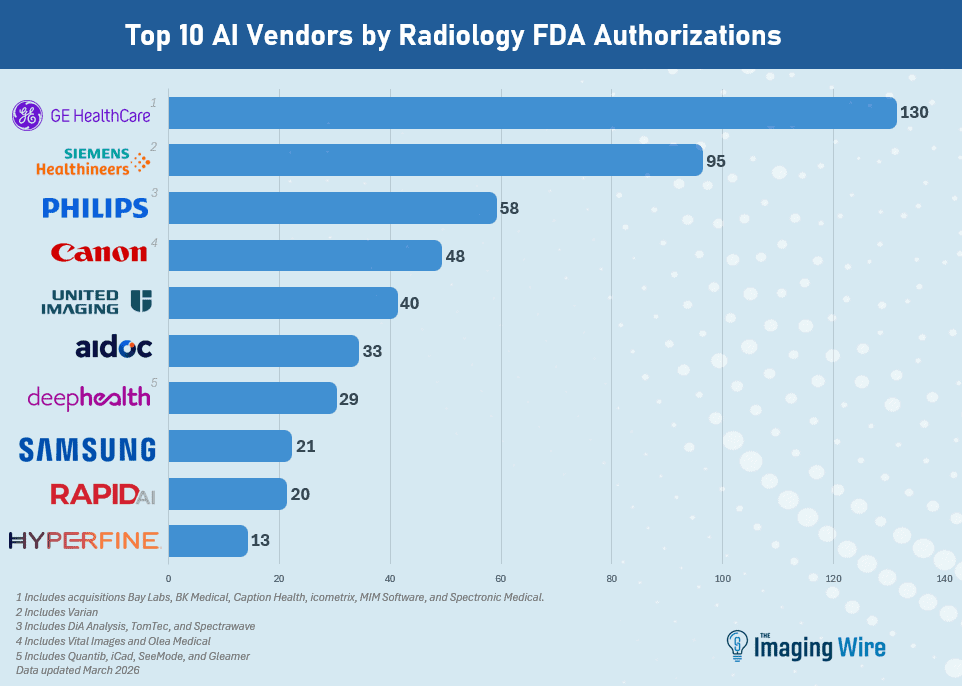
FDA authorizations confirm radiology as the engine of artificial intelligence in medicine: GE HealthCare leads the ranking of the largest AI vendors with 130 clearances, followed by Siemens Healthineers (95) and Philips (58). The agency’s updated list of AI-enabled medical devices, covering data through the end of the first quarter of 2026, has become a barometer for the sector — and it shows that the pace of approvals is accelerating.
Since 1995, when the FDA began tracking these authorizations, a total of 1,524 AI-enabled medical devices have been cleared, a 5.1% increase over the fourth quarter of 2025. Of that total, 1,164 are radiology devices — that is, 76% of all AI authorizations in medicine. No other specialty comes close.
What the first-quarter 2026 numbers say
In the first quarter of 2026, the FDA authorized 92 AI-enabled medical devices — a 28% jump over the previous quarter. Of those, 69 authorizations (75%) were for radiology equipment, a proportion almost identical to that seen in the fourth quarter of 2025 (76%). The pattern is clear and persistent: medical imaging concentrates the overwhelming majority of algorithms reaching the market.
It is worth recalling what the agency counts here. The list blends standalone software algorithms — such as tools that flag a possible stroke on a CT scan — with hardware that has embedded AI, like a mobile X-ray unit capable of detecting fractures during acquisition itself. That breadth explains why traditional equipment manufacturers rank so well, since every scanner or workstation shipped with an embedded AI feature can add to a vendor’s tally.
The list has been maintained since 1995 and is refreshed on a roughly quarterly basis, which is why it has become a closely watched gauge not only of the health of the AI industry but also of which companies are pulling ahead. Reading it over time reveals less about any single approval and more about the direction of travel: a steadily widening pipeline, with imaging firmly at its center.
Rounding out the top 10 are Canon (48 authorizations), United Imaging (40), Aidoc (33), DeepHealth (29), Samsung (21), Rapid.ai (20) and Hyperfine (13). The figures include recent acquisitions, which helps explain how giants consolidated their positions by buying startups that already carried clearances of their own. Aidoc’s trajectory, for instance, illustrates how AI-focused companies carved out relevant space even while competing against century-old manufacturers, a theme we explored when covering Aidoc’s US$ 150 million raise with Goldman Sachs and Nvidia.
Why radiology dominates AI authorizations
There are structural reasons for this concentration. Radiology produces standardized digital data in enormous volume — images in DICOM format, organized in PACS and ready to feed deep learning models. Unlike other clinical areas, where data tends to be textual, ambiguous or hard to label, medical imaging offers ideal terrain to train and validate algorithms.
Add to that the real pressure of daily practice: a shortage of radiologists, growing backlogs and the need for rapid triage in urgent cases. AI steps in as a tool for prioritization, finding detection and productivity gains. It is no coincidence that so many approved algorithms solve concrete tasks — identifying hemorrhages, lung nodules, fractures or signs of embolism — rather than making generic promises. We have already discussed how radiology led FDA-approved AI devices in 2025, and the 2026 data only reinforces that trend.
The dominance of large manufacturers also reflects a maturing market. GE HealthCare, Siemens Healthineers, Philips, Canon and United Imaging together account for roughly 371 of the radiology authorizations among the top vendors — a clear majority of the leaderboard. Their advantage is not only technical but commercial: established sales channels, existing installed bases and the financial muscle to absorb specialized startups. That is how a company can climb the ranking through acquisition almost as quickly as through internal development.
Implications for clinical practice
For anyone working in an imaging department, these numbers carry practical weight. The more authorized vendors and algorithms there are, the greater the chance of finding a mature, regulated solution for a specific need — whether reducing reporting time, standardizing measurements or supporting pathology detection. FDA validation, while not an absolute guarantee of local performance, acts as a quality filter that guides purchasing decisions.
Internationally, tracking this ranking helps managers and radiologists anticipate which technologies are likely to reach their markets, since many regulatory bodies watch what happens in the United States. A standing caveat applies, however: no algorithm should be adopted without validation in the institution’s real workflow, accounting for patient profile, available equipment and integration with the information system. A U.S. regulatory clearance does not replace local clinical commissioning.
Outlook: a sector that is accelerating
The most revealing data point may not be the ranking itself, but the speed. The FDA is not merely keeping pace with healthcare AI innovation — it is accelerating its rate of approvals compared with the previous update. If that curve holds, the number of authorized devices should keep climbing each quarter, with radiology preserving its dominant share.
Open questions remain. Consolidation through acquisitions could concentrate the market in a few large players, with consequences for pricing and interoperability. And the governance challenge persists: how to monitor these algorithms’ performance over time, ensuring they stay safe and effective outside the controlled environment of approval studies. Today’s ranking is a snapshot of a market in full ferment — and the next quarterly update promises fresh reshuffling.
Source: The Imaging Wire