
A team of researchers at the Cleveland Clinic, in the United States, has unveiled a quantum computing paradigm that could reshape how machines process complex biological data. Named quantum hyperdimensional computing (QHDC), the approach blends the physics of quantum computers with an information-processing model inspired directly by the workings of the human brain. According to the report by Inovacao Tecnologica, early tests suggested performance up to 500 times faster than known methods running on conventional quantum computers.
The work was published in the journal npj Unconventional Computing and describes a strategy that breaks with the field’s dominant approach. Instead of forcing classical algorithms to run awkwardly on quantum processors, the authors designed operations that are native to quantum logic from the start. The result, they argue, is a theoretical and practical foundation for a new class of quantum algorithms aimed at biomedical research.
What hyperdimensional computing is
Hyperdimensional computing (HDC) starts from an observation borrowed from neuroscience: the brain does not store an idea in a single neuron. When you think of a cat, there is no isolated cell responsible for that concept. The information is spread across thousands or millions of neurons at once. This distribution brings two key advantages. The first is redundancy: if one neuron fails, the memory remains intact. The second is robustness to noise, since small errors do not destroy the stored meaning.
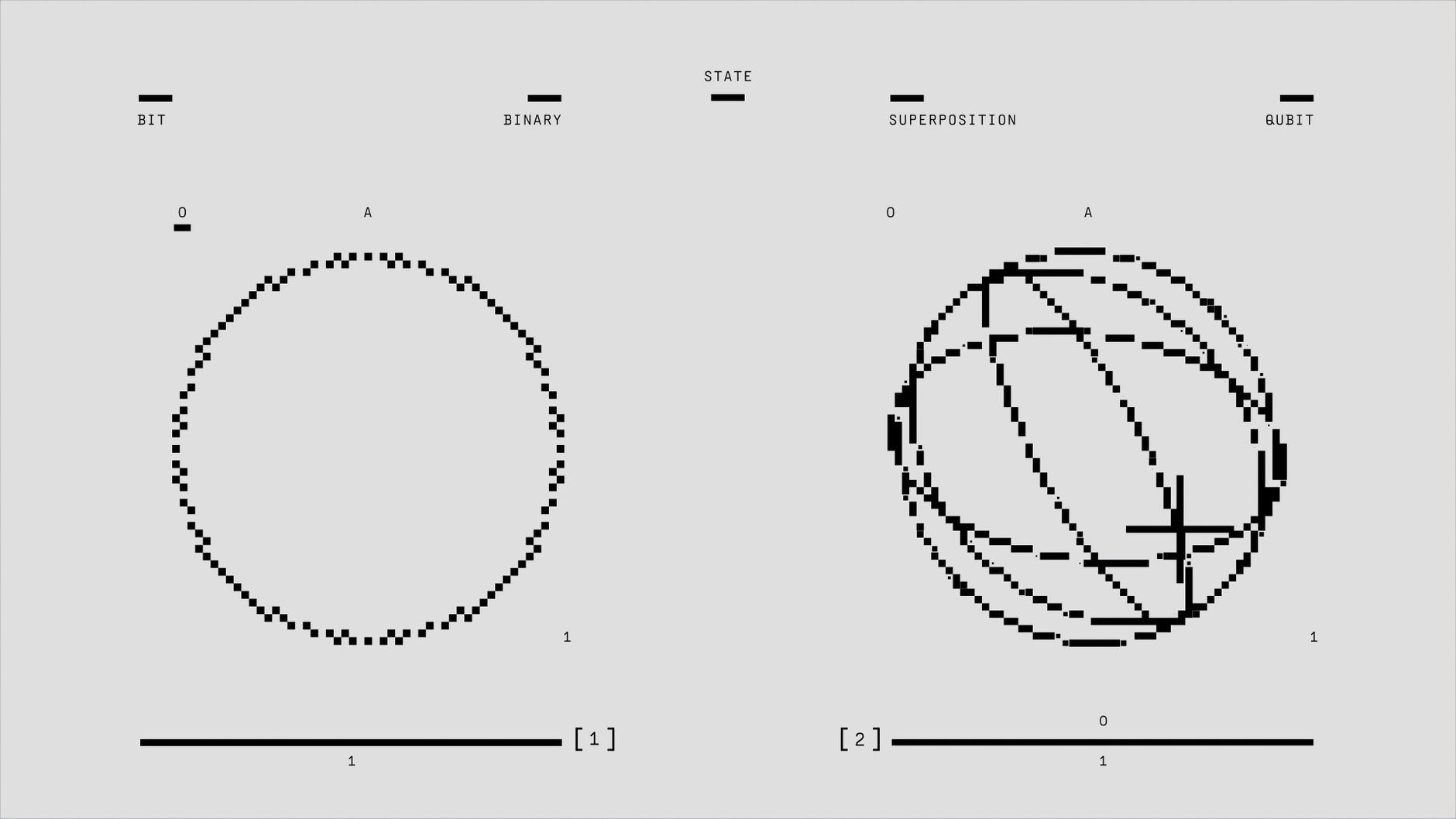
To reproduce this behavior in a machine, HDC represents each concept as a huge vector with thousands of dimensions, called a hypervector. Simple operations on these vectors make it possible to combine ideas, associate concepts and measure similarity. Because it relies on distributed representations, the system tolerates errors naturally, without heavy correction. That property is precisely what makes the technique appealing for the quantum environment, which is notoriously sensitive to interference.
How quantum physics enters the picture
The core of the Cleveland Clinic proposal is an elegant mapping between the elements of hyperdimensional computing and the principles of quantum mechanics. Hypervectors are represented as quantum states. The operation of grouping concepts, known as bundling, is carried out through quantum superposition. The operation of associating concepts, called binding, is performed natively through entanglement between qubits.
That fit is the central point of the paper. Rather than treating quantum hardware as a faster classical computer, the researchers exploit exactly what makes quantum physics peculiar. Superposition and entanglement stop being obstacles to be tamed and become working tools. According to the authors, this opens the door to architectures they call quantum neuromorphic, that is, brain-inspired systems built on quantum principles.
Validation on real hardware
An important highlight of the study is that it did not stay in theory or simulation alone. The team implemented and validated the method on a real IBM quantum processor with 156 qubits. Fundamental operations such as bundling, binding, permutation and similarity measurement were executed using techniques like the linear combination of unitaries and the Hadamard test.
The tests covered two distinct tasks: symbolic analogical reasoning and supervised classification. In both, the system worked, confirming that the proposal is not only viable on paper but physically realizable on today’s quantum hardware. A caveat is in order: while the original report stresses a 500-fold speedup, the scientific paper and the technical analyses we reviewed emphasize resource efficiency and physical realizability above all, without detailing that specific figure. The number should therefore be read as reported by the source rather than as a settled benchmark.
Why this matters for biomedicine and medical imaging
The reason the Cleveland Clinic is investing in this path is clear: biomedical research deals with enormous, multidimensional data sets full of uncertainty. Genomics, drug discovery and medical image analysis produce volumes of information that are hard to handle with classical computers. For Dr. Fabio Cumbo, who led the work, QHDC lays the foundation for a new class of algorithms able to increase the speed and efficiency of biomedical research, especially when the possible outcomes are still unknown.
In clinical imaging practice, this kind of advance is still far off, but the direction is intriguing. The ability to represent complex data in a distributed, noise-tolerant way speaks directly to the challenges of processing volumetric exams, fusing modalities and cross-referencing clinical information. It is a frontier that adds to the more immediate progress of classical artificial intelligence, already present in tools cleared by regulators, as we showed in our overview of the top AI vendors by FDA approvals.
There are also natural bridges to problems radiotherapy already faces. Dose calculation, for instance, involves heavy physical modeling and has been accelerated by surrogate models, a topic we detailed when discussing the use of AI in dose calculation and its clinical limits. More efficient computing paradigms for complex data could, in the future, extend those approaches.
Between enthusiasm and realism
It is important to stay grounded. This is early-stage research, validated on controlled tasks and on a single type of processor. There is, today, no ready clinical application based on quantum hyperdimensional computing. The field of quantum computing itself still faces challenges of scale, stability and error correction before delivering a practical advantage on real-world problems.
Even so, the study matters because it offers a solid, demonstrable theoretical framework. By showing that neuroscience concepts can be translated naturally onto quantum hardware, the researchers open a research route that may mature in the coming years. For healthcare, already undergoing a rapid transformation driven by AI, it is worth watching closely. The same movement that today brings technology closer to the patient, as we discussed when analyzing how AI helps patients understand their radiology reports, stands to benefit from any real leap in processing capacity.
For now, quantum hyperdimensional computing is a well-founded promise, not a product. But it is exactly the kind of foundation that tends to precede major technological leaps in medicine.
Source: Inovacao Tecnologica — Cumbo, F. et al. “Quantum hyperdimensional computing: a foundational paradigm for quantum neuromorphic architectures”, npj Unconventional Computing (2026), DOI 10.1038/s44335-026-00064-6.