
What if you could control the heart’s rhythm with a sticker the size of a postage stamp, with no surgery at all? MIT researchers have built exactly that: an ultrasound-based pacemaker that stimulates the heart from outside the body, doing away with the traditional implant. The work was published in Nature Biomedical Engineering.
How the device works
The system has two parts. The first is a wearable ultrasound sticker, roughly the size of a postage stamp. The second is a separate, pocket-sized control unit that houses batteries and the electronics.
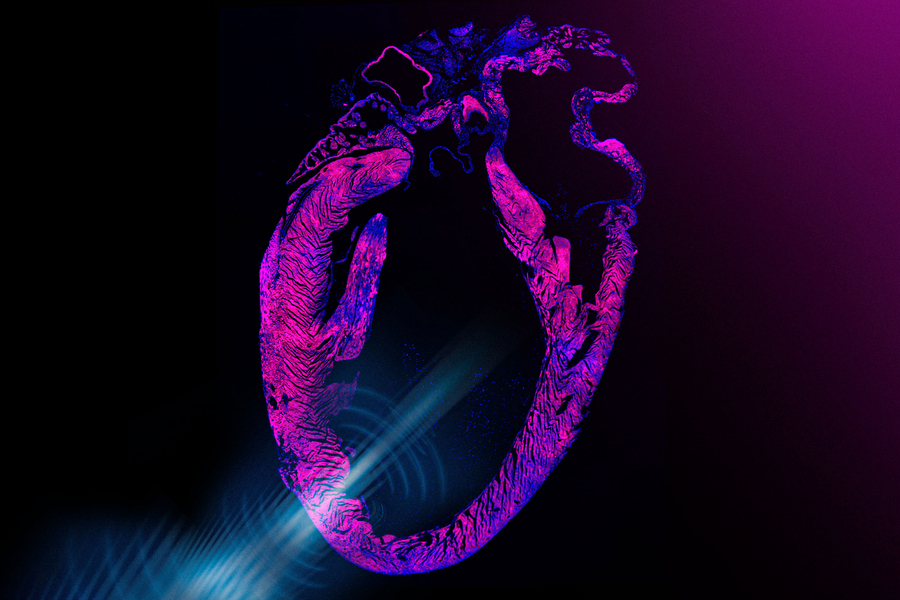
The sticker uses miniature ultrasound transducers to send acoustic pulses through the chest. Those pulses stimulate heart cells and help maintain a regular heartbeat. It is a radically different approach from the conventional pacemaker, which relies on electrodes in direct contact with the heart muscle.
Ultrasound has a key physical advantage for this application: acoustic waves pass through soft tissue with relative ease and can be focused at depth, making it possible to reach the heart without incisions. It is the same property that makes echocardiography possible — except here, instead of capturing the echo to form images, the system uses the energy of the waves to stimulate cells.
The role of sonogenetics
The technology combines ultrasound stimulation with a technique called sonogenetics, which genetically modifies cells so they respond more strongly to sound waves. The researchers engineered cardiac cells to produce ion channels that open more readily when exposed to ultrasound.
The mechanism is elegant: when activated by the acoustic pulses, those channels allow calcium to enter the cells, and it is precisely this calcium influx that triggers contraction of the heart muscle. Instead of an electrical shock, sound takes over command of the beat.
What the experiments showed
In laboratory tests, the scientists applied ultrasound to genetically engineered human cardiac cells and observed them contracting in sync with the pulses. The team also tested the approach in rats, where the device corrected arrhythmias and restored normal heart rhythms — all without invasive procedures.
The researchers envision that a future clinical version would require a one-time gene therapy to increase cardiac cells’ sensitivity to ultrasound. Gene therapies are already approved for certain inherited disorders, but the acoustic-pacemaker approach remains at a preclinical stage. That point is worth stressing: the road from success in rats to use in humans is usually a long one.
Correcting arrhythmias in a living animal model is an important proof of concept, but the leap to a beating human heart — larger, thicker-walled and in constant motion — will demand far more evidence on safety, on the precision of acoustic targeting and on the durability of the genetic modification over time.
Why it matters
Traditional pacemakers, used by millions of patients worldwide, require surgical implantation and direct contact with heart tissue. That carries known risks: infection, lead displacement, battery failure and the need for repeat surgeries over a lifetime. A noninvasive alternative could reduce some of these risks, especially in fragile patients or those at high surgical risk.
It is worth recalling that the industry has already been working to make pacemakers less invasive, with leadless models implanted directly into the ventricle. The MIT concept goes further: it removes not only the leads but the implant itself. Even so, relying on a gene-therapy step introduces a new kind of complexity — regulatory, ethical and financial — that will need careful evaluation before any clinical use.
Ultrasound is already one of medicine’s most versatile and safest modalities, with no ionizing radiation, and its role keeps growing — a theme we explored when discussing the growing role of AI in ultrasound. Seeing the same physics applied not to generate images but to stimulate living tissue shows how the line between diagnosis and therapy is blurring.
Imaging integration and outlook
One of the most intriguing developments is the possibility of integrating the pacing sticker with an ultrasound imaging patch previously developed by the same research line. A combined system could, in theory, monitor cardiac activity and deliver pacing therapy through the same wearable device — uniting diagnosis and treatment in a single patch on the skin.
The study was led by researchers at MIT in collaboration with the University of Southern California, Harvard University and the University of California, Los Angeles. Funding came from the National Institutes of Health (NIH), the National Science Foundation (NSF), Research to Prevent Blindness and the U.S. Department of Defense. There is still a long validation road ahead, but the convergence of ultrasound, gene therapy and wearables points to a cardiology increasingly less dependent on the scalpel. For those following imaging technology, it is also worth watching how cutting invasive procedures is reshaping neighboring fields, such as image-guided cardiac catheterization.
Source: DOTmed News